Contents
Round and luminous, sometimes enormous on the horizon: the full moon is hard to miss. It has fascinated and inspired rituals in many cultures for as long as people can remember. In the world of personal growth, it has become an ideal time to reflect, give thanks, and let go.
If the new moon is a time for setting intentions, the full moon is a time for reflection. Here’s how to prepare a simple, calming full moon ritual in six steps and adapt it to your life.
What is the full moon?
The full moon occurs when Earth is between the Sun and the Moon. The side of the Moon facing us is then fully illuminated. It comes about fourteen to fifteen days after the new moon and returns roughly every 29.5 days.
On that evening, the Moon rises around the time the Sun sets and stays visible all night. This nighttime light has long shaped agricultural work, celebrations, and calendars: many cultures have even given each full moon of the year a name.
The symbolism of the full moon
Symbolically, the full moon represents culmination: what was planted at the new moon comes to maturity, and the light reveals what was hidden. That’s why it’s associated with three practices: taking stock, expressing gratitude, and letting go of what no longer serves you.
You don’t need to believe that the Moon has an influence to enjoy this ritual. It simply gives you a regular time to slow down, notice how far you’ve come, and clear your mind before the second half of the cycle.
Preparing your ritual
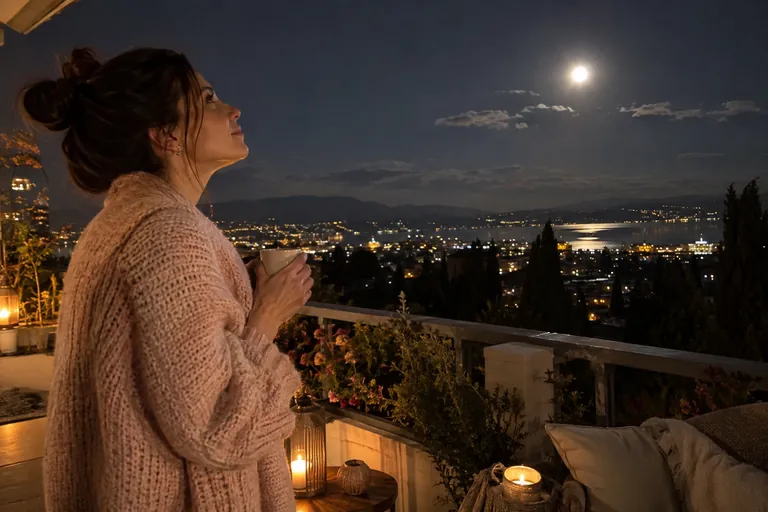
Find the full moon date in a lunar calendar. You can do your ritual that evening, the night before, or the following night. If the weather allows, settle near a window or outside on a balcony or in a garden to enjoy the Moon’s light.
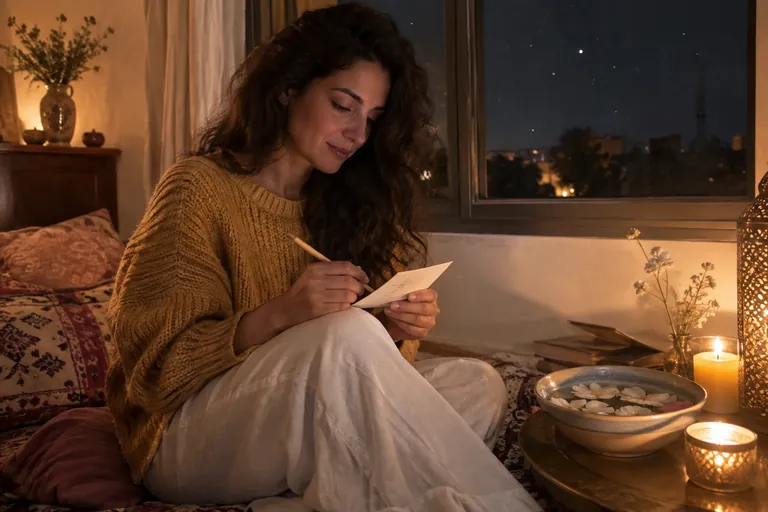
Prepare your journal, a pen, a loose sheet of paper for your release writing, and anything that makes the moment pleasant for you: a candle, herbal tea, a blanket, soft music. On other evenings, a evening ritual shorter version keeps this date with yourself.
Review your intentions
Review your intentions without judging yourself. For each one, ask yourself: What has moved forward? What has been difficult? What have I learned? Does this intention still feel right for me? An intention that hasn’t moved forward isn’t a failure: it may point to an obstacle worth looking at, or to a wish that has become less important to you.
Also take time to celebrate. We tend to move quickly past what has worked and focus on what’s missing. Writing down your progress, even the tiniest steps, helps sustain your motivation for what comes next. It’s the same principle as the gratitude journal.
 Read alsoMorning routine: build a morning that feels like you
Release writing
This is often the most powerful part of the ritual. On a separate sheet of paper, write what you’re ready to let go of: a habit that wears you down, a fear, a grudge, a demand you place on yourself, a thought that keeps going around in your head. You can write a list or a letter.
Then tear up the page and throw it away: the symbolic gesture helps mark the end. Letting go doesn’t mean erasing an emotion or memory, but giving it less space in your life. If this theme resonates with you, our article on letting go offers more ideas.
A full moon ritual in video
For a complementary perspective, watch this video from Karissa Love.
Variations on your ritual
- A walk under the full moon, in silence, to take stock.
- A warm bath, to symbolize letting go and relaxation.
- A meditation in the moonlight, sitting near a window.
- A symbolic decluttering : a drawer, a closet, or your files, to make your space feel lighter too.
- A moment to rest, simply put: the full moon can be an invitation to slow down.
Frequently asked questions
What’s the difference between a new moon ritual and a full moon ritual?
The new moon is associated with intentions and beginnings; the full moon, with reflection, gratitude, and letting go. The two complement each other and mark the month in two phases.
Can you do a full moon ritual without having done the new moon ritual?
Of course. You can simply reflect on the past month, give thanks, and release what weighs on you, without setting intentions beforehand.
Why do some people sleep poorly during the full moon?
Some studies have observed slightly shorter or lighter sleep around the full moon, but the findings remain debated. Brighter light at night may play a role: blackout curtains can help if you’re sensitive to it.
What if the sky is cloudy?
The ritual is still meaningful: the full moon is there, even when hidden behind clouds. Sit near a window or light a candle to symbolize its light, and follow the same steps.