
The Law of Attraction: What It Really Says and How to Use It
Is positive thinking enough to attract what you want? What the law of attraction really says, and how to make it a practical tool for setting intentions.
The Miraya Journal
Law of attraction, 369 method, 55x5, law of assumption: understand these practices and use them as tools for setting intentions, without pressure or magical thinking.
31 articles in this topic
Where to start
Manifestation encompasses many different practices: writing an intention, repeating it, visualizing it, noticing signs. In this journal, we approach them as tools to clarify what you want and direct your attention, not as promises.
Start by understanding the law of attraction and what psychology says about it. Then choose a writing method, 369 or 55x5, and try it for a few days before judging it.
Applied to a specific area: manifesting love and manifesting money, without magical thinking. Do you often see 11:11 ? Make it an intention-setting ritual. The affirmations and visualization extend these methods. To anchor a new intention in your daily life: reprogram your subconscious, with a 21-day plan. Two intention-setting practices to distinguish: the two-cup method and letter to the universeTo track a marker you can actually observe, distinguish outcome goals and process goalsIf the project no longer feels right for you, you can also prepare to stop thoughtfully without reducing it to failureWhen a desire really does feel like your own, a short trial can help you discover what it’s really like to pursue it. If no one has set a deadline for you, find out how to move a project forward without creating artificial urgencyOnce you’ve chosen a priority, a not-to-do list can help protect its boundaries. To see what changes beyond the number of sessions, learn to observe qualitative progress with comparable records. If you share the creation, take time to clarify roles and expectations in a project for twoFor a recent interruption, start by pick things up after an unexpected event without trying to catch up on everythingTaking a small step is still an option: you can also adjust the format to the time you have or choose to take a breakTo leave a record of this change, choose a simple way to mark this step in the projectThis review can help you choose a project that suits your current stage of lifeOnce the judgment has eased, An error log focused on correction can guide your next attempt. To check what you can recall without your notes, try turning your notes into active recall questions. You can then space out your check-ins with a flexible practice, depending on how you use it and what you observe. Before adding a new course, take the time to choose a resource suited to your next use. As delivery approaches, sort through the final details to finish a defined version. If you interrupt your work, prepare a pause note so you can pick up where you left off laterYou can also separate your interests from the commitments you choose to take on.
Is positive thinking enough to attract what you want? What the law of attraction really says, and how to make it a practical tool for setting intentions.
Three, six, nine: the 369 method involves writing the same intention eighteen times a day. How to practice it and make it genuinely useful.
A letter to the universe is a practice for writing down an intention, not proof that a force is responding to you. In it, you set out the context, a specific wish, an inner obstacle, and one small step.
What if you were already living what you want? The law of assumption, rooted in Neville Goddard’s teachings, invites you to inhabit the feeling of your wish fulfilled.
Two cups, a journal, plain water. The ritual is for naming what you’re letting go of and what you’re choosing, not for making an event happen.
Your subconscious isn’t a hard drive to reformat, but your automatic patterns can change. Seven methods, what the research says, and a guided 21-day plan.
An hour of free time doesn’t always mean an hour of available attention. Using an illustrated journal as an example, explore three possible formats: go deeper, keep in light touch, or take a break. These options are about organizing your project; unusual or persistent fatigue calls for medical advice.
The folder is open again, but the old dates no longer match your situation. Find the reliable version, the people to inform, and the next useful step with an example of a family collection, without turning every missed session into work you owe.
A move, a new job, or a more stable period: your circumstances change without deciding forever what matters to you. Compare your interests with the time and space you actually have, choose a trial format and a time to revisit your choice, without turning a “season of life” into an age-based standard.
Are background research and new ideas taking time away from your project? Start with a real session to choose a temporary exclusion, its alternative, and its exceptions. The travel journal example shows how to protect a priority without turning the list into permanent prohibitions.
A first version exists, a challenge has been understood, or a shared contribution deserves recognition. Choose a low-key way to mark the milestone, with or without an audience, without waiting for the project to end or turning celebration into a required emotion or rest into a reward.
A clearer text, more even stitching, or an easier restart can’t always be summed up in a single total. Explore a comparison method based on a criterion, records, and their context, then decide how that observation will shape your next session.
Fifty-five repetitions a day for five days in a row: the 55x5 method is short and intense. Here’s how to practice it without turning it into a chore.
A botched seam or a muddled concept can lead to a specific question. Discover a short page to describe the difficulty, find reliable feedback, and try a correction without turning your rereading into a trial against yourself.
Shared enthusiasm can hide two different ideas of the outcome. Before your album or workshop, compare your expectations, availability, and boundaries, then make the tasks, coordination, and decisions that require mutual agreement visible.
11:11 on your phone screen, again. Coincidence, a sign, a wink? What mirror hours are all about, and how to turn one into a moment with yourself.
Choosing a learning resource for your needs: compare formats, try an exercise, and avoid piling up courses without using them.
Interest or commitment: distinguish curiosity, trying something, and making a decision; leave room to explore and choose your commitments with a simple workshop.
Finish a project without endless revisions: sort through the sticking points, define the version you’ll deliver, and prepare to wrap up with a practical workshop.
Active recall for learning from your notes: useful questions, a guided session, feedback, and simple tips for reviewing without judging yourself.
Manifesting love doesn’t mean waiting for it to fall from the sky. It means knowing what you want to experience, nurturing your relationship with yourself, and creating opportunities to meet people.
Put a project on hold without losing track: write a restart note, protect useful materials, and choose a realistic time to review it.
Spaced practice without a rigid schedule: plan your review sessions, adjust the intervals, and pick up again after a break with a simple workshop.
Visualizing bills won’t fill a bank account. But working on your relationship with money, your beliefs, and your concrete choices can truly change your situation.
A project can have mattered to you without needing to occupy your life indefinitely. This guide helps you compare stopping, pausing, and changing course; consider the consequences ahead; and plan a clear wrap-up for the people involved, without glossing over or erasing the path you’ve taken.
When no one is waiting for your album or story, how can you make room for it without inventing a sense of urgency? Find ways to choose a time slot, prepare to pick it up again, and recognize a completed step, while giving yourself permission to adjust the pace or let the project wait.
A finished portfolio and a creation discussed during a session aren’t the same benchmark. Using personal examples, learn to connect a desired outcome, an observable action, and a useful record, then revisit the process when it no longer serves the project.
You like the idea of an activity, but you don’t yet know much about its day-to-day tasks? Plan a limited trial to discover what draws you in, what feels difficult, and what depends on the circumstances, while keeping several options open and avoiding an outsize purchase.
Tell the difference between an intention, a goal, and a first step with concrete examples and a guided tool to choose a direction that fits your life.
Build a specific if-then plan: identify a situation, prepare a feasible response, and adjust after a real attempt with our guided tool.
A good step doesn’t just say what to do: it shows what will be ready to start the next one.
The Miraya app
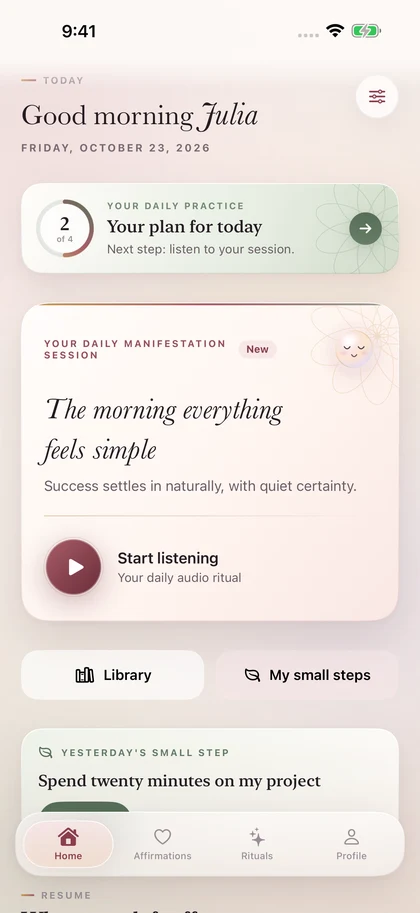
Every day, Miraya creates a session based on your goals and manifestations, then narrates it. You press play and close your eyes.