Contents
Measuring qualitative progress means describing what changes based on comparable records, without turning every experience into a score. You can track the precision of a movement, the clarity of a text, or your independence by observing a situation before and after, using the same questions.
The number of sessions tells part of the story of your work, but not always what you’re learning. You can write a lot without getting better at structuring a story, or practice only a little and finally understand a challenge. This guide offers a light-touch way to track your progress: choose a criterion, keep a record, then compare without ranking yourself or drawing conclusions about your worth.
What is qualitative progress?
Qualitative progress describes how you do something or a quality of the result. A text becomes easier to follow. You can explain why you chose a color. You spot a mistake before finishing the whole piece. You can describe these changes without claiming they represent exactly a twenty percent improvement.
That doesn’t mean they’re impossible to observe. “I feel like I’m getting better” expresses a general impression. “I can explain the connection between the two parts of my story” offers a more precise indicator. The description is still open to interpretation, but it gives you something to compare and a starting point for a useful conversation.
| Aspect | Quantitative record | Qualitative record |
|---|---|---|
| Writing | Number of pages | How clearly the scenes connect |
| Learning | Number of sessions | Explaining a concept without help |
| Creation | Number of drafts | Making a deliberate choice among several options |
| Organization | Number of tasks completed | Ease of picking up again after an interruption |
Both approaches can coexist. The guide to defining what success looks like for a goal helps you choose what’s truly worth tracking. A simple number can be useful as long as it doesn’t replace the experience you want to understand.
How can you measure qualitative progress without making up a score?
Start by choosing just one dimension. If you want to improve a story, you could look at clarity of point of view, consistency over time, or precise descriptions. Focusing on one at a time keeps every reread from becoming an overall assessment of your writing. You can switch dimensions after a few tries.
Next, describe what you would see if that dimension changed. For consistency over time: the reader knows when a scene takes place, flashbacks are signaled, and details about timing don’t contradict one another. These are suggested criteria for working on your text, not universal standards of literary quality.
The meta-analysis by Harkin and colleagues focuses on goal monitoring and suggests that making progress visible may be broadly useful. It does not specifically validate this article’s qualitative framework. Applying it to a personal journal is a practical suggestion: keep records to help you choose what to do next, without promising an automatic effect.
Quiz
Two points to check
The number of sessions is enough to describe the quality of what you learn.
See the answer
False. The amount of practice and the quality of the result are two different pieces of information.
A text can become clearer while losing a quality you liked.
See the answer
True. Several dimensions can change in different ways within the same draft.
Flip cards
Four points to keep in your journal
CriterionFlip
A specific quality you want to observe.
RecordFlip
A dated example that lets you review the work.
ContextFlip
The instructions, support, and conditions that make a comparison open to interpretation.
DecisionFlip
The next attempt you choose based on what you observe.
 Read alsoThe Law of Attraction: What It Really Says and How to Use It
A four-part method
1. A modest starting record
Keep a sample, sketch, private recording, or dated description. You don’t need to choose your worst attempt to make your progress look dramatic. An ordinary piece of work will be more honest and often more useful. Note the conditions: approximate duration, help received, instructions, and materials.
This detail helps you avoid misleading comparisons. A text you spent an hour preparing can’t be compared directly with a five-minute improvisation. A drawing made from a reference and one drawn from memory involve different things. Your skill learning journal can preserve these contexts in a few lines.
2. A consistent question
Frame a question that the record can answer. “Does the character want something identifiable in this scene?” is more useful than “Am I talented?” The first opens the door to a possible revision; the second calls for a sweeping judgment that one excerpt can’t answer.
For a less visible activity, describe a situation. If you’re learning to explain a topic, ask yourself whether you can give an example and answer a simple question. If you’re working on organization, notice whether you can find the next step without rereading the whole file. The criterion should stay close to how you’ll actually use the skill.
3. A comparison with context
After several attempts, take a new record under sufficiently similar conditions. Read both without immediately looking for which one is “better.” First describe the differences: the second has fewer characters, the explanation starts with an example, the materials you need are already gathered. Then ask yourself whether those differences serve your intention.
You can notice a gain and a loss at the same time. A clearer text may have lost an image you loved. A faster method may leave less room for exploration. Progress doesn’t have to be a line that rises on every measure. You can keep an improvement while bringing back a quality that had disappeared.
4. A decision for the next session
End the comparison with one small choice. Keep the structure, rework the transitions, or ask for feedback on a specific passage. Without this decision, tracking can become a collection of archives. The guide for breaking a project into milestones connects your observation to a practical next step.
Don’t correct everything at once. If the comparison reveals five difficulties, choose the one that gets in the way most or the one you can understand right now. You can leave the others in a note. A useful measure helps direct your effort; it doesn’t require you to produce a perfect version right away.
Personal workshop
Choose the situation that applies to you
Open a prompt, then write your answer in your journal. There are no fields or saved entries on this page.
No visible difference
Check how specific the criterion is and whether the conditions for both records match.
Two opposing opinions
Ask what use or preference explains each observation.
A tempting score
Try writing what the score might mean in terms of actions or outcomes.
Example: improving at describing a place
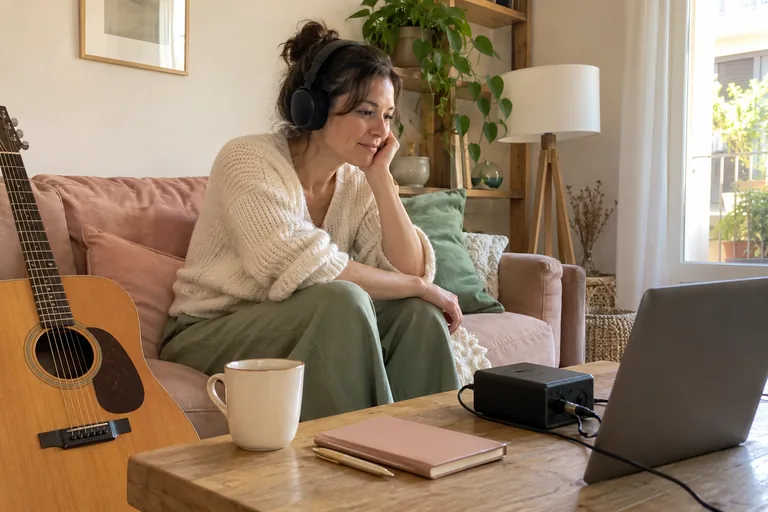
At first, you write: “The room was beautiful and pleasant.” A week later, you describe the light on the hardwood floor, the sound of the street, and the empty space by the window. The second text contains more observable details, but that alone isn’t enough to declare it better in every context.
If your intention is to create a mood, these details can be useful. If you’re writing a very short note to find an address, they may be unnecessary. The right choice depends on the project. Our exercise for describing a place with the five senses offers an exploration; you can then choose what serves the text.
You could write: “I find it easier to replace a general adjective with a detail. I still include too many elements in one sentence.” This observation recognizes a change and names work that remains. It doesn’t need a score out of ten or a comparison with an experienced writer.
What role should other people’s perspectives play?
Outside feedback can reveal what you no longer notice, but it reflects a particular perspective. Does the person know the prompt? Are they part of the intended audience? Are they talking about a difficulty understanding the text or a personal preference? Ask for feedback on a specific criterion using the guide for asking for feedback on a creation.
Avoid collecting opinions until you get one that reassures you. Two contradictory responses may simply point to different uses. You can make the final decision, explain your choice in a decision journal and then test the version with the audience it’s actually intended for.
Consent matters, too. Don’t share a recording or document containing information about other people just to measure your progress. An anonymized excerpt or an invented example is often enough. The quality of your tracking doesn’t justify neglecting privacy.
When progress is still hard to see
A lack of visible difference doesn’t automatically mean you haven’t learned. You may understand the task better without yet being able to perform it consistently. Conversely, one isolated success doesn’t prove you’ve mastered the skill in every situation. Note what you actually know and what needs another try.
Check your criterion, too. “Sounding natural” may be too vague to guide a comparison. Rephrase it as an observable behavior: finish an explanation without losing your train of thought, choose a suitable example, or find information without help. You can adapt the goal when conditions change instead of forcing a measure that’s no longer relevant.
Finally, allow for periods without evaluation. A solo creative session can exist simply for the pleasure of exploring. Not every hobby needs to become an improvement program. Tracking is an option that should serve your project, not a condition for being allowed to practice.
Checklist
Your next practice
0 / 4
You can keep one useful action and set the rest aside.
Generator
A wording to adapt
I can show precisely what changed in this version.
See all the phrases
Observe
- I can show precisely what changed in this version.
- This feeling is information, distinct from the observable record.
Continue
- I’ll keep this improvement and try a small variation.
- I’ll ask for feedback on this criterion without asking for an overall judgment.
For a complementary perspective, watch this video from Julia Ravey.
Frequently asked questions
Can you measure progress without numbers?
Yes, by using descriptions and comparable records. You need to specify the criterion being observed and the context. A sentence like “I explain this step without looking at my notes” may be more informative than a general score.
How often should you compare your entries?
Choose an interval that gives you time to practice. Comparing after every action can become intrusive. You can revisit your records at the end of a stage or during a review you choose, with no required schedule.
Should you keep all your drafts?
No, a few dated examples are often enough. Keep what helps clarify a specific question, then delete or archive the rest according to your needs. The goal is to find useful information, not to build a complete file.
How can you avoid judging yourself as you reread?
Start by describing what’s there before evaluating it. Separate the text or action from your identity. The judgment-free goal review offers questions to help you keep that distance.
What if I go backward on one measure?
Look at the conditions and other dimensions before drawing a conclusion. A new difficulty, a different format, or the removal of support may explain the gap. You can return to an easier exercise or ask for a targeted explanation.
Can how you feel be an indicator?
Yes, if you describe it as a feeling and place it in context. It can complement an observable record without always replacing it. Feeling more at ease and producing a clearer result are two different pieces of information.
Sources
- Harkin B. et al. (2016). Does monitoring goal progress promote goal attainment? A meta-analysis of the experimental evidence.
- American Psychological Association (2015). Overview of the meta-analysis on goal monitoring.
The suggested exercises are editorial adaptations, not individually validated protocols. The example situations are fictional.