Contents
A mistake journal helps you understand a specific difficulty, check a correction, and choose a new attempt. To learn without punishing yourself, note what happened in the task, not a judgment about who you are.
You confuse a concept, sew a seam incorrectly, or forget a step in a software program. A mistake can become information, but only if you have reliable feedback and a chance to try again. This guide offers a short page for everyday learning. It doesn’t invite you to cause mistakes in a dangerous situation or replace professional procedures.
What is a learning mistake journal for?
The journal makes visible the reasoning that led to an answer or an action. Without that record, you may correct the result while keeping the idea that will produce the same mistake later. A sentence like “I confused the final length with the extra allowance” explains more than a simple red mark on an exercise.
It shouldn’t become an inventory of flaws. You can choose recurring, surprising, or important mistakes that matter for what comes next, and let minor, harmless slipups fade away. Writing everything down takes time and can distract you from practicing. This page is a working tool, not a case against you.
| Element | Useful note | Judgmental note |
|---|---|---|
| Situation | I used the wrong unit | I’m incapable of thinking |
| Hypothesis | I thought the two measurements were equivalent | I always make a mess of everything |
| Correction | Check the unit before calculating | Pay more attention |
| New attempt | Solve a different example | Never make a mistake again |
You can connect this page to your skill learning journal, but give it a distinct purpose. The journal tells the story of your journey; the mistake journal examines a few points where a correction can change your next attempt.
What does research say about learning from mistakes?
In her 2017 research review, Janet Metcalfe describes the value of errors followed by corrective feedback in learning situations. The important point isn’t making mistakes for their own sake: it’s receiving reliable information and examining your reasoning. Laboratory findings don’t mean that every mistake, in every context, is beneficial.
The circumstances matter. Low-stakes practice gives you room to try and make corrections; a situation involving safety, health, or professional responsibility isn’t suited to improvisational experimentation. If you’re learning a technical activity, follow the instructions and seek qualified guidance. Use your journal after you’ve made things safe and taken any necessary action.
A mistake also doesn’t mean you have to adopt a positive attitude right away. You can feel disappointed or annoyed, then return to the analysis later. The guide to softening your inner dialogue after a mistake helps separate acknowledging a difficulty from putting yourself down.
Quiz
Two points to check
Making a mistake is enough to learn, even without reliable feedback.
See the answer
False. Correction and examining your reasoning are essential to the approach described.
An aesthetic preference is always a technical mistake.
See the answer
False. The judgment depends on the criteria, intention, and creative context.
Flip cards
Four points to keep in your journal
SituationFlip
The instruction and the response or action you produced.
ReasoningFlip
The rule or assumption you were using.
CorrectionFlip
Verified information, rephrased in your own words.
New attemptFlip
A small variation to see what you understand now.
 Read alsoThe Law of Attraction: What It Really Says and How to Use It
How do you keep a mistake journal in five useful lines?
1. The task and the response you produced
Describe the instruction, the context, and what you did. Keep only the details needed to understand the gap. If you’re learning a language, write down the sentence and the meaning you wanted to convey. If you’re drawing, describe the problem you noticed with proportion or perspective instead of judging the whole piece.
A dated record can help you retrace a step in your learning, but it doesn’t need to be detailed. You can attach a small example, a private photo of the object, or an excerpt. Avoid keeping other people’s confidential data just to illustrate your mistake.
2. What you thought when you responded
Write down the assumption or rule you used, even if it now seems obvious that it needs correcting. “I chose this word because it looks like the French word” reveals a strategy. “I knew it was wrong all along” may be a reconstruction after the fact. If you don’t remember, simply note that you’re unsure.
This step can sometimes help you notice that you didn’t understand the instruction, rather than the subject matter. In that case, your next step will be to ask for clarification. The guide to dare to say you don’t know can help you ask a question without turning not knowing into shame.
3. The verified correction
Give the correct answer or expected action, along with its source: an exercise answer key, a teacher’s explanation, official documentation, or a reliable demonstration. A random opinion you find may not be enough. If sources conflict, leave the question open and try to understand the context in which each applies.
Don’t just copy it down. Rephrase what changes in your reasoning. If you had missed a condition, write it down. If you had applied a rule too broadly, note where it applies. To ask for help, prepare a specific request using the guide for asking for feedback on a creation.
4. A different example
Test the correction in a small, new situation. Repeating the exact same exercise with the answer in front of you mostly shows that you can follow it. A modest variation can show whether you recognize the principle. The goal isn’t to trick you, but to check what the correction actually taught you.
If the attempt is still difficult, simplify it or ask for an additional explanation. Don’t repeat an action you don’t understand over and over. A five-minute small step can help isolate a single difficulty, as long as that length of time suits the activity.
5. A cue for next time
Finish with a short question you can revisit: “What unit is required?”, “What does this pronoun refer to?”, “Did I check the margin before cutting?” This cue should direct your attention to the right place. “Stop getting distracted” doesn’t say what you can do.
You can also create a if-then plan when a situation recurs: if I finish the calculation, then I check the unit before confirming. Keep the number of cues small. Too many rules at once can make the practice hard to follow.
Personal workshop
Choose the situation that applies to you
Open a prompt, then write your answer in your journal. There are no fields or saved entries on this page.
The same mistake keeps happening
Check the principle you understood and where you place your cue.
The correction is uncertain
Leave the question open and look for a source or a knowledgeable person.
The notebook becomes accusatory
Put it aside. A learning tool shouldn’t become constant monitoring.
Example: a mistake in a sewing project
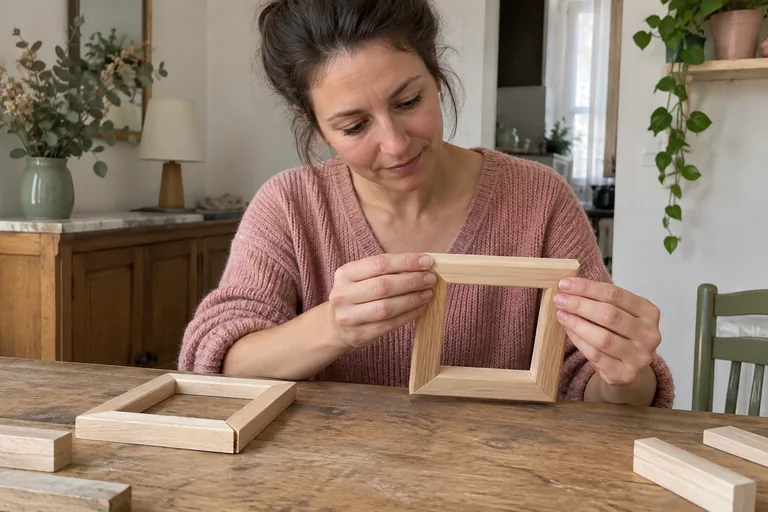
Imagine you cut a piece too small. After putting the tools away safely, you note that you followed the finished measurements without adding the allowance specified by the pattern. The correction isn’t to write “I need to be more careful,” but to understand where the finished measurements and cutting measurements are indicated.
You consult the pattern instructions or ask a knowledgeable person to demonstrate. Then you practice on a scrap piece with a simple shape. The new attempt lets you check that you’ve read the instructions correctly before using the fabric intended for the project. You don’t need to remake the whole piece to learn this point.
In the creative project journal, you keep the decision about the failed piece: possible recovery, modification, or replacement. In the mistake notebook, you keep the principle you learned. This separation prevents every mishap from turning into an endless account.
How can you review without feeding shame?
Review the pages by learning question, not as a chronological collection of mistakes. You can group instruction errors, misunderstood rules, and forgotten steps. Look for corrections you can now apply and points where you still need help. Reviewing should lead to a decision, not a general accusation.
Delete or archive pages that are no longer useful, as you see fit. You don’t have to keep proof of an outgrown mistake forever. A end-of-course review can summarize what you can now do and which questions remain open, without copying down every failure.
If the journal leads you to replay every scene, look for fault everywhere, or feel constantly watched, pause using it. A learning practice may not be right for you at a given time. You can ask for support, and consult a health care professional if this distress persists or disrupts your daily life.
When a mistake affects someone else
Self-analysis doesn’t replace making amends or getting necessary information. If your mistake affects someone else, address that consequence first, in context. Don’t use the lesson learned to avoid responsibility, and don’t share the other person’s story in a shared journal without their consent.
You can recognize exactly what’s yours to own without making yourself responsible for everything. The nonjudgmental review helps distinguish your decisions, the information available, and external factors. Understanding doesn’t erase the impact of the mistake; it can guide a fairer response and a better-prepared next attempt.
Checklist
Your next practice
0 / 4
You can keep one useful action and set the rest aside.
Generator
A wording to adapt
I applied this rule; now I’m checking which contexts it applies to.
See all the phrases
Understand
- I applied this rule; now I’m checking which contexts it applies to.
- I don’t remember my reasoning, and I can note that uncertainty.
Try again
- I’m testing the correction on a different example with no safety implications.
- If I’m still stuck, I’ll ask for an explanation instead of punishing myself.

For a complementary perspective, watch this video from TED.
Frequently asked questions
Should you write down every mistake?
No, choose the ones that shed light on something you learned or could happen again. Small, harmless slipups don’t need to be recorded. A journal that’s too exhaustive can become more burdensome than the practice itself.
How can you tell whether a correction is reliable?
Look for a source suited to the task: an official correction, documentation, or someone qualified. If the context is technical or involves safety, ask for appropriate guidance. A convincing answer isn’t necessarily a verified one.
Why try a different example?
A small variation helps you see whether you understand the principle beyond the memorized answer. It should be proportionate to your level. If you get stuck, return to the explanation instead of making more random attempts.
Can you use this journal for a creative activity?
Yes, as long as you distinguish a technical error from an aesthetic choice. A personal preference is not a universal mistake. Define the problem in relation to your intention and the result you want.
What should you do when the same mistake keeps happening?
Check your understanding, the context, and how you’re practicing. The cue you chose may be too vague or may come too late. You can ask for a demonstration and note what changes in your learning journal.
How can I avoid defining myself by my mistakes?
Describe a specific action rather than an identity. You can acknowledge responsibility without concluding that you’re incapable. The guide to talking about yourself without putting yourself down offers more precise, less sweeping ways to phrase things.
Sources
- Metcalfe J. (2017). Learning from Errors. Annual Review of Psychology, 68, 465–489.
The suggested exercises are editorial adaptations, not individually validated protocols. The example situations are fictional.