Contents
- Identify what makes the project feel intimidating
- Choose an action with a clear endpoint
- Set up a short, clearly defined session
- Adjust the size of the step to the kind of work
- Connect the first step to an intention that matters to you
- Leave a note or marker that makes it easier to pick up again
- Frequently asked questions
You know what you’d like to do, but the project feels too big as soon as you get close to it. Writing a report, taking up a hands-on activity again, or planning a gathering seems to require more free time than you ever have. So you wait for the right opening, the right energy, and a clear enough idea of what comes next.
The five-minute first step offers another way in: choose an action that’s short enough to start now, but meaningful enough to actually change the situation. Five minutes have no special power. They’re a practical limit. What matters is moving from an abstract project to a completed action whose result you can see.
Identify what makes the project feel intimidating
Before shortening the time, get specific about what’s holding you back. You may be missing information, afraid of making something awkward, unsure where the files are, or anticipating a lengthy setup. These problems don’t all call for the same response. A timer alone won’t solve an external dependency or a lack of materials.
Ask yourself: “If I had to get started for five minutes, what would concretely stop me?” The answer may be very ordinary: finding the document, choosing a topic, clearing a small surface. You’ve just identified a real preparatory step. It’s worth naming instead of folding it into the idea that you lack motivation.
If the project involves an important consequence, choose a reversible preparation step. Gathering your questions or comparing information doesn’t commit you in the same way as sending a final decision. A short time frame doesn’t automatically make an action harmless. You can start slowly while still respecting what’s at stake.
Choose an action with a clear endpoint
A useful action has a verb and a recognizable outcome. “Think about my workshop” stays open-ended. “Find the times for two workshops” gives you a clear point to stop. “Make progress on my writing” is vague; “write three possible titles” defines a try that can fit into a short time slot. A small step is one option: you can also adjust the format to the time you have or choose to take a break.
The outcome doesn’t need to be ready for publication. A draft, a clearly worded question, or a space ready to use may be enough. It only needs to reduce uncertainty or prepare for a relevant action. If, after five minutes, you have exactly the same decisions to make as you did at the start, the step may have been too abstract.
Also check that you’re not consistently choosing the most comfortable tasks around the project. Putting your pencils away may be necessary once. Reorganizing them at every session doesn’t replace the first stroke. Ask yourself what small outcome would bring you closer to the part you’re avoiding, without asking you to succeed at it right away.
Set up a short, clearly defined session
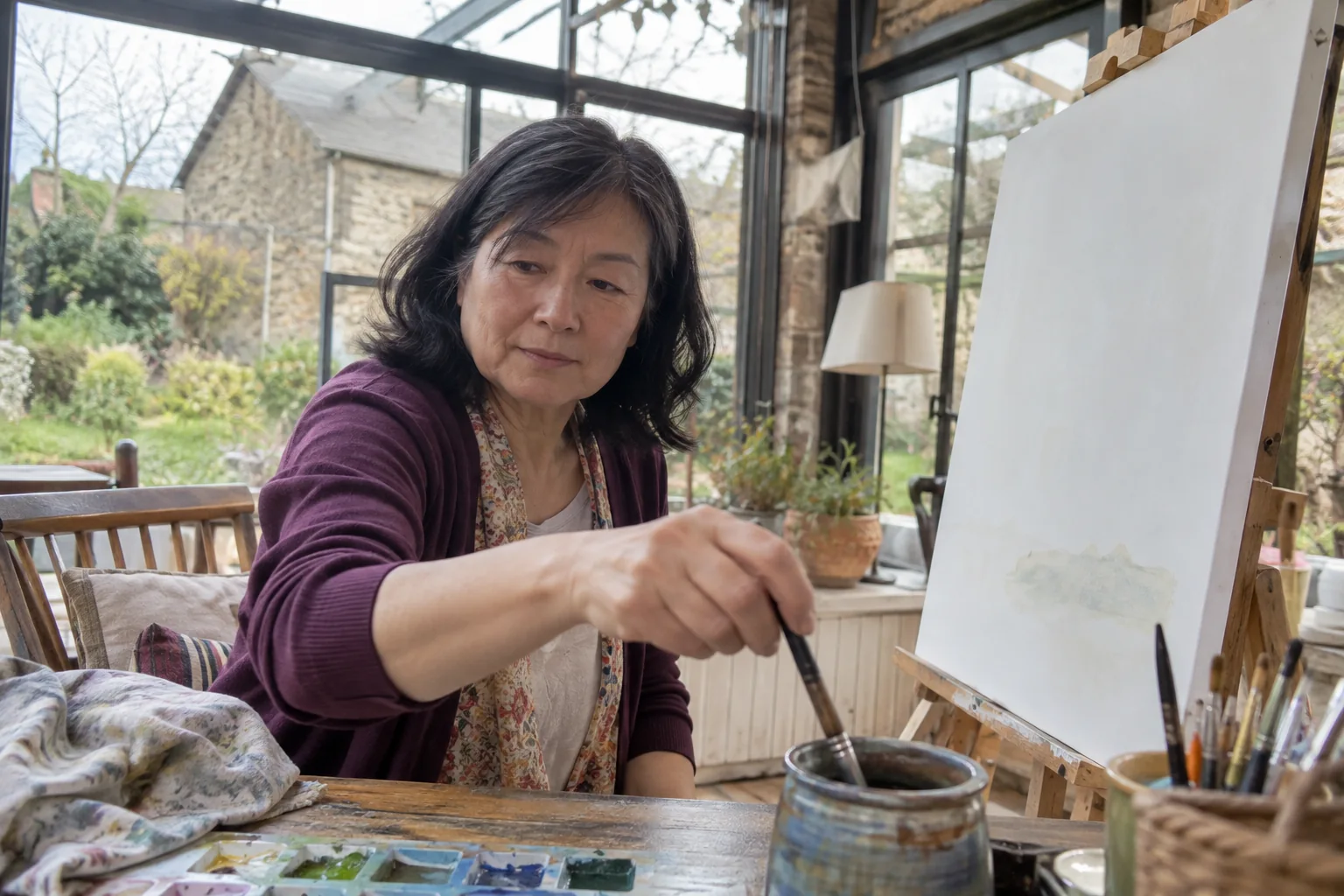
Gather the minimum you need, choose a usable spot, and decide whether you want a timer. You can also set a content limit: one sentence, a reference photo, a list of three questions. The limit should help you get started without making you monitor the time constantly. For a creative activity, the first step might be to choose three materials you already have instead of making a shopping list.
Tell yourself clearly that you’re allowed to stop when time is up. If every small step automatically turns into a long session, you may stop believing the promise of an easy start. You can keep going when the circumstances are right, but continuing is a separate choice.
During your time slot, note new ideas without following every one of them. You were looking up class times and discovered several fascinating techniques: save their names for later, then finish the comparison you planned. A small step works best when its boundaries stay clear. It doesn’t require you to solve every question the project brings up.
Find your five-minute entry point
Fill in these prompts to prepare for your next attempt. Nothing is sent or saved.
Your prompt will appear here after you make your choices.
Adjust the size of the step to the kind of work
Some activities require more than five minutes to set up. In that case, use the small step to prepare for a proper session: check your materials, reserve a place, charge a device, or choose an instruction. Don’t pretend that a complex practice can be broken down indefinitely without losing its meaning.
For a writing project, the step might be the beginning of a paragraph. For a group activity, it might be reading the participation requirements. For a hands-on creative project, it might be a very simple sample. Choose the size based on the circumstances, not to follow a method word for word.
You can also use a shorter version on busy days and a longer session when you have time. The goal isn’t to reduce all your ambitions to five minutes. It’s to make getting started feel less exceptional. A small first step can sometimes make room for something bigger, and sometimes it’s enough for the day.
 Read alsoSelf-sabotage: understanding why you hold yourself back and how to move past it
Connect the first step to an intention that matters to you
A series of micro-actions can turn into busyness if they aren’t connected to a direction. Before you begin, remind yourself in one sentence what you want to nurture: understanding a subject, returning to a practice, preparing for a conversation, or making a project ready to share. This sentence helps you check whether the step you chose still serves what you want.
If you use a guided visualization, finish it by naming this specific step. Imagine the real beginning: where you sit, the document you open, the first question you write down. Then do what you just chose as soon as a suitable time slot comes up.
In Miraya, “My Small Steps” lets you keep track of an intention, a concrete action, and a review. You can write “get the materials ready for a first try,” then note what you did. The journal is useful when it describes your practice as it actually happened. It doesn’t need to turn every day into a spectacular success to show continuity.
Leave a note or marker that makes it easier to pick up again
Before you close the project, write down where you are and what step could come next. One sentence is enough: “found three ideas, choose the second for a draft,” or “checked the times, ask whether the equipment is provided.” You’ll avoid spending your next session rebuilding the context.
Then look at the result precisely. You may not have finished the project, but you’ve gained information or created a first piece. That difference deserves to be acknowledged without exaggeration. It can also show that the next step needs more time or someone’s help.
If several short attempts don’t change anything, take another look at the project. The problem may be a vague instruction, an unresolved dependency, or a desire that has changed. The guide on limiting beliefs can complement your reflection when you notice a rigid idea about what you should know how to do. But start with the practical conditions: they often offer the most directly accessible point of adjustment.
Frequently asked questions
Do I need to practice every day?
No. Choose a frequency that fits the project and your availability. For some activities, two focused sessions during the week will be more useful than showing up every day without making meaningful progress.
What if I keep going after five minutes?
You can keep going if you want to and if it fits with your other commitments. Still, keep the right to stop the next time: the small step should remain a reliable way in, not a misleading promise.