Contents
- What does active recall change about your study sessions?
- Is active recall supported by research?
- How can you turn your notes into good questions?
- A ten-minute active recall session
- Which format should you choose for what you’re learning?
- How can you revisit your questions without building up a backlog?
- How can you tell whether the method is really helping you?
- What limitations should you keep in mind?
- Frequently asked questions
- Sources
Active recall means retrieving information from memory before checking the answer in your notes. Instead of rereading a chapter until you recognize it, you close the material and answer a question: “How would I explain this idea?” or “What step comes next?”
This method can be useful when you’re returning to a course, learning a language, or getting to know a software program. It doesn’t replace understanding or hands-on practice. Here’s how to create useful questions, correct your answers without getting discouraged, and build a short session that fits into your week.
What does active recall change about your study sessions?
Rereading and retrieving information don’t involve the same kind of work. With the text in front of you, you may recognize a sentence without being able to put it into your own words. That familiarity feels reassuring, but it doesn’t answer the important question: will you be able to use this information when you need it? Active recall gives you a chance to find out in a low-stakes setting.
Imagine a photography workshop. You’ve just read an explanation of aperture. Recognizing the passage may not be enough to help you choose a setting for a subject. You can start by explaining the principle without any reference material, then take two photos to observe the difference. Here, recall prepares you to make a decision; hands-on experience with the camera is still essential.
| Activity | What you do | What it lets you examine |
|---|---|---|
| Rereading | You go over a familiar explanation | You revisit the meaning and context |
| Free recall | You explain it without consulting the material | You identify accessible ideas and gaps |
| Focused question | You answer a specific question | You check a specific piece of knowledge |
| Application | You complete an exercise or perform a task | You examine how the knowledge is used |
So you don’t have to throw away your notes or turn every learning experience into a test. A skill learning journal can keep explanations, attempts, and questions together in one place. The only new step is to set aside a moment when the material no longer gives you the answer first.
Is active recall supported by research?
In experiments published in 2006, Roediger and Karpicke had participants study texts, then either reread them or try to recall them. Delayed tests favored the conditions that included recall attempts, while repeated rereading could lead to greater confidence. These results distinguish the immediate feeling of mastery from retention measured later.
In 2011, Karpicke and Blunt also compared retrieval practice with elaborative study using concept maps, working with scientific texts. Recall benefited later performance under the conditions studied. That doesn’t make diagrams useless: a diagram can help you understand, and you can then try to reconstruct it from memory.
These studies focus on specific tasks. They don’t promise that flashcards alone will teach you to sew, negotiate, or drive. They mainly support one principle: include retrieval attempts in your learning, rather than measuring your work only by the time spent with the course. To evaluate your own progress, also keep examples of how you apply what you’ve learned in your end-of-course review.
Quiz
Three points to check
Rereading a sentence and recalling it on your own are the same activity.
See the answer
False. Recognition with support doesn’t check what you can access without it.
A mistake during a session can guide your next review.
See the answer
True. Correction helps identify precisely what still needs work.
Active recall replaces all practical exercises.
See the answer
False. Knowledge you recall must also be applied to suitable tasks.
How can you turn your notes into good questions?
1. Choose what you want to be able to do
Start with a specific situation. “Understand spreadsheets” is very broad; “explain when to use an absolute reference” is already actionable. You could also aim for an action: build a simple formula without copying the example. A useful question comes from an intended use, not from a need to turn every line of a course into a flashcard.
If you’re not sure what’s worth remembering, review the course objectives or ask the instructor to clarify. The guide to defining what success looks like for a goal helps you define this target. You can save your questions for the concepts that will truly help with your next exercise.
2. Make the question more specific
“What do I know about photography?” can be useful for exploring a subject, but it’s too broad for a short review. Try a question like “Why does a wide aperture change the depth of field?” Then separate the subquestions if the answer requires too many details. A flashcard doesn’t need to contain a mini chapter.
A good question should still be complete enough to make sense out of context. “What next?” won’t mean anything two weeks from now. Instead, write “After importing the photos, which copy should I check before clearing the memory card?” The context makes recall possible without giving away the answer.
3. Prepare a reference answer
Before hiding your materials, keep a reliable answer and its source: page, chapter, or demonstration. Your own answer doesn’t have to use every exact word unless literal precision is necessary. Instead, identify the essential elements. For a definition, that might be a distinction; for a procedure, the order of steps and a precaution.
This preparation helps you avoid treating a merely plausible answer as correct. If your notes contradict one another, start by resolving the contradiction. Saying “I don’t know yet” is more useful than confidently memorizing an uncertain explanation. Active recall also trains you to check your answers.
4. Actually answer before looking
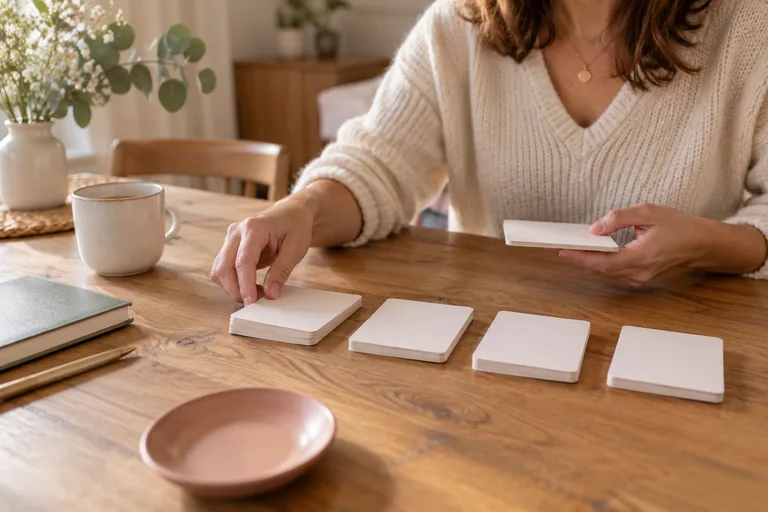
Close the document, cover the right-hand column, or turn the card over. Answer with a sentence, a sketch, or a short demonstration. You can speak softly if writing takes up too much space. The important thing is to produce an identifiable answer instead of thinking, “Yes, I know this,” while waiting to see the answer key.
Give yourself a little time to search your memory, without turning silence into a punishment. If nothing comes to mind, take a limited hint: the topic, the first step, or a category. Then note that you needed that hint. This information will be useful the next time you revisit the material and says nothing about your worth as a person.
5. Compare, correct, and rephrase
Then open the source. Identify what was accurate, incomplete, or incorrect. A different color can make the correction visible, but avoid rewriting the whole page over one small detail. Rephrase the correct answer in your own words, then check that you haven’t lost an important nuance by simplifying it.
When a mistake brings up a harsh thought about yourself, describe the fact instead: “I confused these two terms.” You can draw on a inner dialogue after a mistake. The goal of the session is precisely to discover these mix-ups before they become costly in a real situation.
 Read alsoThe Law of Attraction: What It Really Says and How to Use It
A ten-minute active recall session
Choose a short passage you already understand. First, spend a few minutes on three questions. Answer without looking, then compare each answer with the source. Finish with one decision: which question should you revisit, and in what context? Ten minutes is a practical format suggested here, not a universally validated duration.
If you find that you don’t understand the passage, switch tasks. Reread the explanation, look for an example, or ask for help before doing more tests. Making an effort doesn’t automatically mean you’re learning. A useful challenge stays connected to material you can access; a confusing question deserves to be clarified or broken down.
Workshop with no account or online entry
Workshop: Make a question that helps
Open the steps and answer in your notebook. This workshop doesn’t collect any answers; you can use it without JavaScript.
Choose a note
Copy only the concept you want to work on and the reference you can use to check it.
Turn it into a question
Ask for an explanation, a distinction, or a specific step. Avoid asking a question that contains its own answer.
Cover it and try
Write an answer on paper before opening the answer key. Make a note if you used a hint.
Check and plan what’s next
Identify a gap, correct it, and choose the next context for using what you learned.
You can prepare this session with a five-minute small step On busy days, two questions and their corrections make for a realistic check-in. Still, avoid breaking a hands-on task into pieces until it loses its meaning. Some actions require you to prepare the materials and continue through to a safe step.
Which format should you choose for what you’re learning?
For vocabulary, question-and-answer cards are useful, but also check how a word is used in a sentence. For reasoning, ask “why?”, “in what case?”, or “what’s the difference?” For a procedure, reconstruct the steps before carrying them out. These formats can be combined: they meet different needs.
In a creative activity, recall can involve a technique without dictating the work. You can remember a material’s properties and then freely explore its uses. Your creative project journal will preserve the experiments that don’t fit into a single right answer. Not everything that matters can be measured with a worksheet.
Flip cards
Choose the guideline that fits your situation
A definitionFlip
Explain the term, then give an example and a counterexample.
A procedureFlip
Describe the steps and checks before consulting the instructions.
A distinctionFlip
Explain when to choose each of the two options.
An applicationFlip
Solve a small case that differs from the one in the lesson.
How can you revisit your questions without building up a backlog?
Start with a small set of genuinely useful questions. After a session, sort them based on what you observe: answered independently, answered with a hint, or needs another review. This sorting isn’t an intelligence score. It shows where to focus your attention next time and which questions have become too easy or are poorly worded.
Come back later instead of doing only repeated practice within the same minute. Spacing and recall complement each other, but no schedule works for every kind of material. To set your next review, consider your deadline, the difficulty, and the time slots available. A if-then plan can serve as a cue: after Tuesday’s coffee, I’ll review three questions.
If you miss a session, don’t mechanically double the next one. Review a few questions to see what you can still recall. Archive cards that are no longer useful and keep those that support your current needs. The collection should remain a tool; an overdue pile of cards doesn’t deserve to become another disproportionate obligation.
Checklist
Prepare a practical exercise
0 / 5
The items are checked. Make sure they actually fit your situation before moving on.
How can you tell whether the method is really helping you?
Observe a situation different from the one in which you learned. Can you explain the idea with another example? Complete a small task without following the tutorial line by line? Identify what you need to check before continuing? These clues are often more telling than the number of cards reviewed or a streak of uninterrupted days.
Keep a brief note in your judgment-free goal review : one thing you can do, one point of confusion, and one next attempt. A difficult session after a poor night’s sleep doesn’t undo the previous ones. Compare situations that are similar enough, and adjust the difficulty of the questions before concluding that you’re “not cut out for learning.”
This questionnaire is a reflection guide offered by the editorial team, with no diagnostic value or psychometric validation. The result only helps you choose a direction in this article.
Self-assessment
Where could you simplify your approach?
For each sentence, choose one answer: the one closest to what you’ve experienced over the past few weeks.
I turn the card over before trying to recall the answer.
My questions combine too many concepts.
I don’t know where to check my answers.
I confuse familiarity with answering independently.
I leave a mistake uncorrected.
I never test what I know with a different example.
Your result appears once you’ve answered every sentence.
How to read your score (out of 18)
- 0–5 · A format you can already use Try an example that differs from the lesson now.
- 6–11 · A few useful adjustments Make the questions shorter and specify the sources.
- 12–18 · A session to simplify Start with three questions you understand, then get help with the unclear explanations.
What limitations should you keep in mind?
Active recall doesn’t mean you should stop using the documents you need. In an activity that involves risk, an official protocol, instructions, or a professional check takes priority over confidence in your memory. You can learn the role of verification without giving yourself permission to remove it later. Being competent includes knowing how to consult the right information.
The method also doesn’t address a memory disorder or distress related to studying. If new, significant, or persistent difficulties are interfering with your daily life, a health professional can help you understand them. For an educational need, seek a conversation with your instructor or a support service rather than a blaming explanation.
For a complementary perspective, watch this video from Tiny Medicine.
Frequently asked questions
How do I use active recall when I’m just starting out?
Choose a short passage you already understand, write three questions, and cover the text. Answer before checking, then correct any gaps. Save one difficult question for your next study session instead of immediately making dozens of flashcards.
Should I write down the answers or say them out loud?
Both formats can help you produce an answer before checking. Choose the one that lets you clearly verify what you remembered. For a diagram, formula, or procedure, drawing or carrying it out may be more suitable than giving an oral answer.
What’s the difference between active recall and flashcards?
Active recall is a way to work on your memory; flashcards are one possible tool. A blank page, a spoken question, or a demonstration without a model can also prompt you to recall information. Flipping a card right away doesn’t guarantee that you tried to retrieve the answer.
Is it normal not to remember the answer?
Yes, an attempt can reveal a gap in memory or an incomplete understanding. In that case, check the source, make corrections, and adjust the scope of the question. If everything still feels out of reach, revisit the explanation instead of simply increasing the number of tests.
How many questions should I prepare per session?
There’s no universal number. Three well-chosen questions may be enough to try the method with a short piece of content. Above all, leave time to correct your answers and apply what you’ve learned, because going through lots of cards doesn’t prove you’ll know how to use the answers.
Does active recall replace rereading?
No: rereading can help you understand, check, and correct. Recall adds a step without the material in front of you, so you can see what you can still bring to mind. Alternating between these roles means you don’t have to choose between two activities that can complement each other.
Sources
- Henry L. Roediger, Jeffrey D. Karpicke (2006). Test-Enhanced Learning Psychological Science. Read the reference.
- Jeffrey D. Karpicke, Janell R. Blunt (2011). Retrieval Practice Produces More Learning than Elaborative Studying with Concept Mapping Science. Read the reference.