
Contents
- Set up a limited space and a clear end point
- Set everything down without organizing it right away
- Turn vague words into next steps
- Give actions and things you’re waiting on different places
- Review your commitments before making more promises
- End the session with one item to act on
- Adjust the ritual to what actually comes up
- Frequently asked questions
A question to ask, an item to repair, a message to reply to, an idea without a destination: small reminders can pile up until it feels like everything needs your attention at once. Mental decluttering on paper means getting these items out of your head, then deciding where they belong. Some become actions, others wait for information, and still others can be set aside.
This ritual isn’t a promise to clear your mind completely. It offers a practical sequence for sorting reminders and bringing the session to a close. You can use it once a week, after a busy period, or simply when you no longer know where to start.
Set up a limited space and a clear end point
Take a sheet of paper or a notebook page, then choose an approximate amount of time. Ten minutes may work for a quick sort; adjust based on the actual number of items. The important thing is to keep a clear stopping point so the ritual doesn’t turn into reorganizing your whole life. Have your calendar or usual list ready too, but begin without opening every message and folder at once.
Write at the top of the page: “What’s been on my mind today.” This title sets a boundary. You’re not listing every task you could possibly do or rebuilding an entire year. You can keep a glass of water nearby and clear enough space to read what you write, without aiming for a perfect desk. Your surroundings should make it possible to sort things, not become another task you have to finish before you start.
Set everything down without organizing it right away
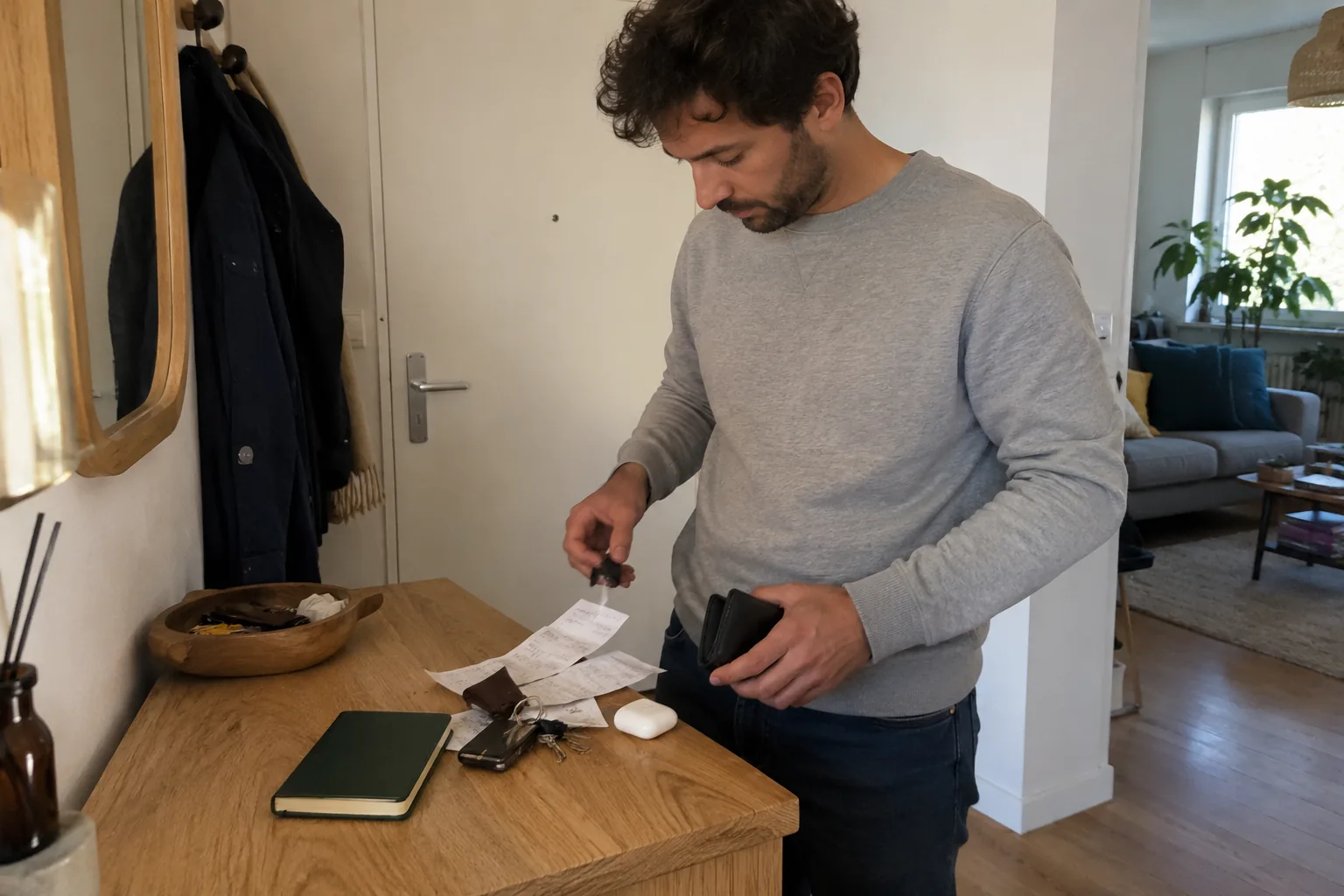
During the first pass, write short fragments: “reply to Léa,” “entryway light bulb,” “walk idea,” “document to find.” Don’t try to sort them yet. If you stop to resolve each item, the list will stay incomplete and sorting will become a series of interruptions. You can use one word per line so you can easily return to each item. Ideas, reminders, and questions can all appear together.
When the page starts to fill more slowly, scan a few simple areas: home, relationships, personal work, appointments. This scan is only meant to help you find a reminder that’s already there, not to invent obligations. You can also write “nothing else for now.” Don’t force the list until you’re exhausted. The first step ends when you have enough to review. You can add a forgotten item later; it doesn’t undo what you’ve already brought into view. If the words are hard to find, a written inner-weather check-in without a score can offer a temporary picture of how you feel right now.
Turn vague words into next steps
Go back to each line and ask yourself what it means in practical terms. “Entryway light bulb” might become “check the bulb type before buying one.” “Document” might become “ask someone where the latest version is.” An actionable task often starts with a verb and has an observable endpoint. You don’t need to spell out the whole project; just look for the next step that helps move something forward.
If you don’t know what needs to be done, turn the line into a question to clarify. That’s more honest than writing down a huge task you can’t begin. You might also realize that an idea doesn’t call for any action right now. “Walk by the water” can go on a wish list instead of tomorrow’s calendar. This distinction matters: not everything that crosses your mind needs to become a commitment or proof of future productivity.

Choose a place for a reminder
Fill in these prompts to prepare for your next attempt. Nothing is sent or saved.
Your prompt will appear here after you make your choices.
Give actions and things you’re waiting on different places
For each item, choose a simple destination: to do, waiting, save for later, or let go. An item to do joins your usual system with the information you need. For something waiting, note what’s missing and, if helpful, the date you’ll check again. An idea for later goes into a place you can revisit. You can cross off an item you’re letting go without a long explanation. Once you’ve sorted the information, you can also keep your judgment when faced with a very confident opinion.
Avoid adding so many categories that you spend more time thinking about where things belong than about their content. Four destinations are enough to start. You can use simple marks in the margin instead of four complicated charts. If there’s a real deadline, add it to your calendar. If there isn’t, don’t add artificial dates to everything just to make the page look under control. A list full of false urgencies quickly loses its value and makes real commitments harder to spot. If a daily list doesn’t work for you, you can practice gratitude on difficult days without forcing yourself.
 Read alsoEvening ritual: a gentle 20-minute routine to end the day feeling calm
Review your commitments before making more promises
Look at what you’ve already agreed to: a reply someone is waiting for, an appointment, a shared task. These commitments deserve a clear place because other people may be planning their time around them. You can check the original request when the details matter. Don’t rely only on a vague memory. If a promise is no longer realistic, the next step may be a conversation to adjust the timeline, rather than a silent effort to keep everything on track.
Sorting can also reveal tasks you’ve taken on without being asked or without a real need. Ask yourself what would happen if you didn’t do them now. This question isn’t permission to ignore a responsibility; it helps you distinguish a real consequence from a personal preference. You can keep some things you want to do and postpone others. The letting go takes a concrete form here: choosing what stays open, what you’re committed to, and what can truly come off the list. If one scene is taking up all the space, the journal of facts and interpretations helps you distinguish observation, feeling, and hypothesis.

End the session with one item to act on
At the end of the sorting process, choose a next action that fits the time you have available. It doesn’t need to be the most ambitious one. It should be clear enough to start without redoing the whole analysis. For example, check a reference, send a specific question, or put a document in the right place. If something urgent is a priority, it naturally comes before tidying for the sake of tidying. Use real constraints instead of an automatic “easiest first” rule.
Then put the page away or mark the session as finished. You can keep the transferred items by checking them off, then file the page away. Avoid keeping several competing lists with the same commitments if you don’t know which one is the source of truth. Sorting is useful when it clarifies what comes next, not when it adds another thing to keep track of. If you use Miraya, “My Small Steps” can hold an intention, an action, and a reflection; choose one place to refer to for what you want to track.
Adjust the ritual to what actually comes up
After a few tries, notice what builds up. If the same reminders keep coming back without making progress, check how they’re worded and where they’re going. Maybe they’re waiting for information; maybe you no longer want the project; maybe the next step is too broad. You can delete a line that’s no longer useful instead of copying it forever. Repetition points to a question worth examining, not automatically a lack of willpower.
Choose a frequency that fits how you use it. A quick sort after a busy stretch may be enough; some people find a weekly check-in works well. You don’t need to make it an evening ritual or aim for a perfectly blank page. For more personal writing between sorting sessions, the journal welcomes what lists can’t tell. Both formats can coexist as long as you keep commitments easy to find.

Frequently asked questions
Should I do everything right after sorting?
No. The intended outcome is a clear destination for each useful item. Some actions will be done later, some will wait for information, and others will be dropped. Trying to do everything right away would turn the ritual into an endless work session.
Can I use an app instead of paper?
Yes, if it’s easy to open and check. Paper is a practical option for getting started without notifications. Whatever medium you use, avoid scattering the same commitments across several lists when none of them is clearly up to date.
What if my list seems longer after I write it down?
Those items may have already been there but were less visible. Take a break if needed, then distinguish real actions from ideas and things you’re waiting on. You can sort through some of it now and set the rest aside, without expecting to resolve everything at once.