Contents
Free indirect discourse lets a character’s thought or speech enter the narration without framing it as a quotation. Context helps readers recognize whose voice they hear. Begin with a clear scene, then let the character’s question or judgment enter. Removing quotation marks alone does not create the effect.
How does it differ from direct and indirect speech?
Direct speech presents words as quoted speech or thought; indirect speech reports them within a construction. Free indirect discourse lets the voice emerge in the narration without that explicit introduction. The choice changes the distance from the character.
| Form | Original example |
|---|---|
| Direct | Nora thought, “He is late again!” |
| Indirect | Nora thought that he was late again. |
| Free indirect | Nora waited by the door. Late again! He could at least have called. |
In the final version, Nora’s situation helps readers recognize her impatience. In isolation, “he was late” could simply be the narrator’s statement. Alloprof discusses this contextual interpretation.
Which clues let you hear the character?
Look for a question, judgment, exclamation, or word that gains meaning from the character’s situation. None proves free indirect discourse on its own. The preceding sentence and viewpoint matter.
In the example, “again” implies previous waiting; “could at least have called” carries a reproach. Add a contextual action if needed: Nora folds the paper she had ready. That gesture does not universally mean anger; it becomes legible within this invented situation. Explore writing a scene without dialogue.
Compare three ways to narrate
Your text stays on this page and is not saved. Copy any result you want to keep.
On paper, use the table fields and check your result against the explained examples.
Is free indirect discourse tied to one verb tense?
Tense depends on the narration and sentence, rather than a recipe for changing every verb. Past-tense narration is common in examples, but the effect also depends on whose wording and perspective readers recognize. Check time relationships rather than mechanically replacing forms.
The Geneva study by Claude Rubattel examines perspective and interpretation in context. Our tool compares written examples; it does not automatically convert your grammar. For another exercise, rewrite a scene from three viewpoints.
 Read alsoScripting: Write your dream life to clarify what you want
How can you revise without explaining every thought?
Read the passage while asking whose judgment each sentence carries. If another person enters the scene, prepare a viewpoint change or stay with the first character. Moving between minds without a cue can create unintended confusion.
Compare an explicit version with the freer one. Keep the version that serves your intention; subtlety is not automatically better. Reading aloud helps compare rhythm, while character dialogue offers another way to make voices present. Finally, ask for feedback on one specific point rather than a verdict on the whole piece.

To prepare a voice before drafting the scene, explore a character’s desires and contradictions. A chosen writing constraint can then limit the exercise to one setting and viewpoint.
For a return to lived observation, journaling formats use another convention: distinguishing what you observed from what you invent.
Quiz
Check your understanding
Is removing quotation marks enough?
See the answer
No; examine voice, context, and sentence construction. A punctuation change does not guarantee a clear viewpoint.
Must an ambiguous judgment always disappear?
See the answer
Keep it if it serves your intention. Distinguish an intended effect from unintended confusion.
Flip cards
Three distinctions to revisit
SituationFlip
Who is present, and what can this character perceive?
VoiceFlip
Whose judgment or question does this sound like?
ConsistencyFlip
Does the passage keep its time and narrative cues?
Checklist
Before keeping this draft
0 / 3
The boxes record your actions; they do not grade your writing.
This resource offers a complementary approach to the topic. Adapt the choices to your own notebook or writing project.
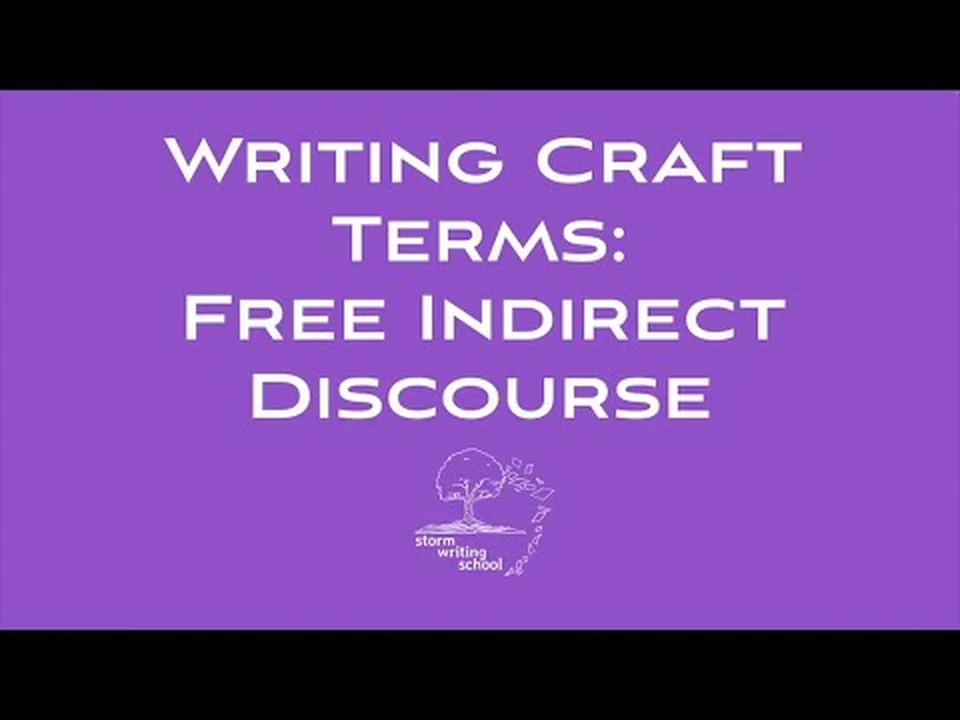
For a complementary perspective, watch this video from Storm Writing School.
FAQ
What is free indirect discourse?
A character’s voice enters narration without being framed as a quotation. Context shapes its interpretation.
Must I remove every thinking verb?
The free passage needs no explicit reporting frame, but surrounding context may establish a thought or situation.
Does a question identify the form by itself?
Consider who could ask it within the scene. A question can also belong to the narrator.
Can I keep an exclamation?
It can help carry the character’s voice. Check its purpose and the consistency of the viewpoint.
Does the tool convert my text?
It compares prepared examples. It does not replace checking tense, pronouns, and context in your own passage.
Is this form always better?
Choose it for the effect you want. Direct or indirect speech, or more distant narration, may suit another scene better.