Contents
- What’s the difference between a silent scene and a description?
- Define two intentions before removing the spoken words
- How do you write a scene without dialogue, step by step?
- Original example: the leaking pot
- Keep the sounds and choose how much access to thoughts to give
- Review the pacing and know where to end
- Prepare your silent scene
- A longer scene without dialogue: returning a coat
- Make the space clear before looking for tension
- Use sounds as actions, not as automatic background
- Revise without adding an explanation to every gesture
- How can you separate an observable action from an inner judgment?
- Frequently asked questions
- Sources
Writing a scene without dialogue means moving a situation forward through actions, objects, movement, and silences. You remove the spoken words, but keep a stake: something must change between the beginning and the end so the scene doesn’t become a mere description.
You can try it with two characters setting a table, waiting for a bus, or handing an object back and forth. This workshop offers a practical method, an original example, and four modules for working on gestures. The goal isn’t to learn to decode real people, but to build a clear narrative.
What’s the difference between a silent scene and a description?
A description shows a state: the kitchen is lit, two bowls sit on a table, and a window remains open. A scene sets that state in motion: one person moves a bowl closer, the other pushes it away, and then the window slams shut. The same elements become actions that change what the characters can do.
Dialogue is just one way to reveal what the characters intend. One person wants to leave; the other wants to finish a repair together. The tension can show in a coat already put on, a toolbox closed too soon, or a chair pulled up to the table. No gesture has a universal meaning: it’s the sequence of gestures that makes the situation understandable.
| Element | Still description | Narrative action |
|---|---|---|
| Door | The door is ajar | She holds it before it slams shut |
| Cup | A cup is empty | He fills only the other person’s cup |
| Bag | A bag rests on the floor | She places it between the two chairs |
| Window | It’s raining outside | They move the wet leaves together |
You can prepare the setting with the guide for describing a place with the five senses. Then return to the central question: which detail makes an action possible? A rich list of colors and smells can’t replace a progression, even when the scene is only half a page long.
Define two intentions before removing the spoken words
Write a preparation sentence for each character. Léa wants to get her plant and leave quickly. Camille wants to show her how well she has cared for it. Their intentions intersect around the same object. You already have several possible actions: examine a leaf, look for a cachepot, wipe away a trace of soil, or move the plant toward the exit.
The reader doesn’t need to see these preparation sentences. They help you choose the gestures. If Camille suddenly starts tidying the whole kitchen, ask yourself whether that serves her intention or whether you’re simply filling out the scene. A detour can work, but it needs to have an effect: delay the departure, avoid a glance, or clear a space.
If you’re unsure about the characters’ intentions, first write a brief dialogue between the characters, then remove it. Look for an action that could carry each essential piece of information. You don’t have to translate everything: some explanations can disappear, giving the text more room for an interesting ambiguity.
How do you write a scene without dialogue, step by step?
Set the characters’ positions and the central object
Place the characters clearly enough that their movements remain easy to follow. One sentence may be enough: Léa keeps her bag on her shoulder, while Camille stands behind the table where the plant sits. The contrast between someone ready to leave and someone still occupied already creates a direction without stating their emotions.
Choose one main object instead of a dozen props. The plant connects their intentions; a dish towel or saucer can accompany it if its role becomes clear. In your creative project journal, note the function of each prop. If an object serves neither the action nor the chosen point of view, you can leave it out.
Write an action and its response
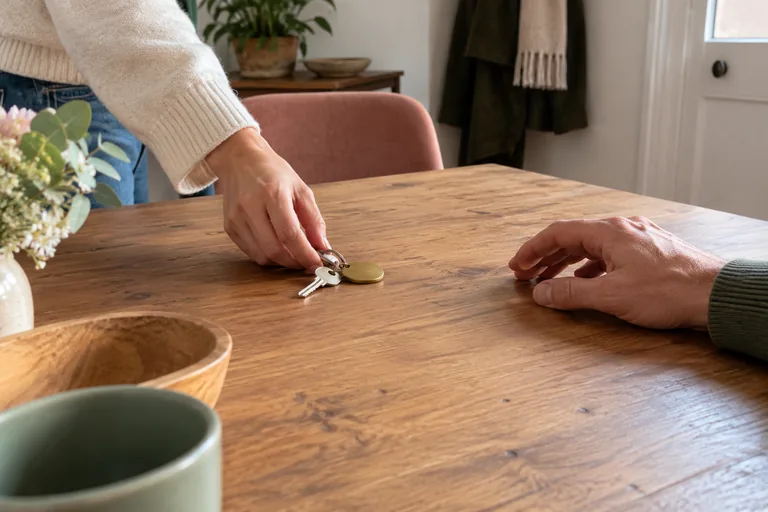
Léa lifts the pot. Camille slides a saucer underneath. Léa sets them back down. Each gesture changes what the other person can do. The scene is no longer a decorative alternation of glances; it has a chain of causes and responses. You can read it as a sequence of small actions to which the second character reacts.
The responses can still vary in nature. A character may continue what they’re doing, stop, move something else, or not respond right away. A lack of response becomes noticeable only if an expectation has been created. Without that expectation, a pause may be just a word added to manufacture suspense.
Introduce a physical obstacle
A leaf breaks, the saucer leaks, the bag falls, or the door won’t stay open. The obstacle forces the characters to make a choice and keeps the scene from repeating the same exchange over and over. Keep the difficulty in scale with the story. A short starting piece doesn’t need a spectacular accident to move forward.
Notice how resolving the problem changes their relationship in that moment. They may work together, get in each other’s way, or give up. You don’t have to conclude that they reconcile for good. A cooperative gesture is still a cooperative gesture; the text can give it weight without asking it to resolve an entire family history.
Original example: the leaking pot
“Léa lifted the plant. A drop fell on her sleeve. Camille held out the dish towel, but Léa had already set the pot on the floor. They bent down at the same time. Their hands stopped on either side of the saucer. Camille stepped back first, then placed the towel under the pot. Léa set down her bag.” Nothing is said aloud, but the final gesture changes the announced departure.
You can interpret this ending in several ways. Maybe Léa stays to wipe up; maybe she accepts help; maybe she’s simply looking for a better grip. If you want a more precise reading, add a consistent detail. If you want to leave it open, stop before explaining what each character feels.
To work on this difference, keep two endings and ask for feedback on their effect. Ask a focused question: “Does the departure seem merely delayed, or genuinely in doubt?” You’ll get an observation about how the text reads rather than a general rating of how beautiful it is.
 Read alsoScripting: Write your dream life to clarify what you want
Keep the sounds and choose how much access to thoughts to give
No dialogue doesn’t mean no sound. An engine, a zipper, or the scrape of a chair can set a rhythm and make a movement perceptible. Choose sounds connected to what’s happening. Describing every background noise would draw attention away from the main exchange, especially in a very short scene.
You can also include a character’s thoughts if you adopt that point of view. Just avoid replacing every line of dialogue with an inner monologue that explains every gesture. First, try a version that is entirely observable, then add a single thought. Compare what it clarifies and what possibilities for interpretation it closes off.
A observation walk or a film and exhibition journal can help you pay attention to actions. Take note of staging techniques without recording people without their knowledge. For films, observe the editing and the objects rather than copying an entire sequence.
Review the pacing and know where to end
Read the text while physically following the imagined movements. One hand can’t carry three objects at once; a character can’t instantly cross a cluttered room. These simple checks prevent inconsistencies that break the flow of reading. They matter more than piling on adverbs like “slowly” or “nervously.”
Next, cut redundant gestures. If three sentences already show that someone is reluctant to leave, the fourth should add something else. The learning journal can keep track of a specific point to work on, such as positions in the room. You don’t need to correct the narration, vocabulary, and all the punctuation at the same time.

End when the relationship to the object, the space, or leaving is no longer the same. To pick it up again later, set up a short creative session and a new situation. You can organize your drafts in your idea notebook based on the central action rather than an assumed emotion. This organization makes it easier to find a narrative pattern and transform it in another setting, with new stakes.
Prepare your silent scene
Generator
An exchange without dialogue
One person wants to return an item; the other is still looking for its packaging.
See all the phrases
Starting point
- One person wants to return an item; the other is still looking for its packaging.
- Two neighbors are clearing a table, but only one wants to prolong the moment.
Obstacle
- A suitcase won’t close just before a departure.
- Two people move a plant with a leaking pot.
Flip cards
Replace an explanation
She wanted to leaveFlip
Give her an action that leads toward the exit.
He wanted to helpFlip
Show a practical offer and the other person’s response.
They hesitatedFlip
Build a specific moment of anticipation, then interrupt a gesture.
They were reconcilingFlip
Show what becomes possible between them in this scene.
Quiz
What should you keep?
A scene without dialogue must remain completely silent.
See the answer
No. The sounds of the setting and the actions can contribute to the story.
A succession of glances is always enough to move the story forward.
See the answer
No. Gestures should change the situation or provide useful information.
Checklist
A clear scene
0 / 5
You can now reread the gestures instead of looking for another line of dialogue to add.
A longer scene without dialogue: returning a coat
Let’s take an original example: two neighbors meet on a landing to return a coat borrowed the day before. Lina holds the folded garment in her arms. Éva already has one foot on the stairs. The situation points in two directions: one wants to complete the handoff, while the other seems to be leaving. You can build an entire scene around their meeting without deciding right away whether they’re upset with each other or close.
First movement: Lina holds out the coat, but one sleeve slips. Éva leans over to catch it and sets her keys on the step. This simple adjustment interrupts her departure. Second movement: Lina searches a pocket. She pulls out a damp ticket, looks at it, and folds it back up. Éva doesn’t take the garment back yet. The scene builds anticipation because the returned item now contains a detail that doesn’t necessarily belong to the person returning it.
Third movement: Éva retrieves the ticket, then nudges the coat toward Lina. She picks up her keys and goes downstairs. Lina is left with the garment she had come to return. The relationship to the object has changed: a returned loan becomes an extended loan, or perhaps a gift. You can keep the ambiguity. If you want to make clear that it’s a new loan, a final action like showing the rain outside the window gives context without requiring an explanatory line.
Read this example again, successively removing the keys, the ticket, and the sleeve. Each removal changes the pacing or the information. The keys embody the pause before departure; the ticket prompts a choice; the sleeve provides the first point of contact. You can keep just two of these elements to make the scene more restrained. What matters is understanding their function, not piling on props to make the writing seem visual.
Make the space clear before looking for tension
Draw a rectangle for the landing, an opening for each door, and a line for the stairs. Place the characters at the beginning and the end. This preparation is rudimentary; it helps you check whether the actions are possible. If Éva is already holding a heavy bag, her umbrella, and her keys, she won’t be able to easily take a coat. You can use this awkwardness as an obstacle or simplify it, depending on the subject of the text.
Then describe the movements from a chosen point of view. A narration close to Lina might notice Éva’s hand before her face, because that hand will determine whether or not she takes the garment back. A more distant narration will show the positions of both bodies and the space left open. Both versions are valid. The problem arises when the text changes position without the reader knowing who sees what.
Don’t write every movement with the same level of detail. The walk to the door can take just a few words; returning the ticket may call for several sentences. Narrative time signals what matters. If everything is detailed, no gesture stands out. If everything is summarized, the encounter risks becoming a report of actions, with their hesitations and consequences no longer perceptible.
Use sounds as actions, not as automatic background
No dialogue doesn’t mean no language or sound. A lock can stick, an elevator can arrive too late, rain can start against the window. Choose a sound that shifts attention or changes what’s possible. The elevator noise might offer a way out to a character who was hesitating; a phone that vibrates can go unanswered, making that refusal momentarily visible.
However, avoid matching every assumed emotion to the weather. Rain doesn’t automatically express sadness; a bright kitchen doesn’t require joy. You can create a contrast: a silent conflict amid the everyday sounds of an apartment building, or an understanding in an unwelcoming room. The setting then retains an existence of its own instead of becoming merely a mirror for the feelings you want to convey.
Read the scene and underline only the verbs whose subjects are elements of the setting. Ask yourself whether each one adds an interruption, information, or duration. Remove those that only repeat the atmosphere already established. One well-placed sound can be enough to mark the time between two gestures. You don’t need to name every sound source on the landing.
Revise without adding an explanation to every gesture
On your first reread, note what you absolutely want the reader to understand: the coat is returned, the ticket delays the handoff, and Éva ultimately leaves the garment. These are the key points. The private reasons can remain open. If a reader thinks the coat belongs to Lina from the start, correct a concrete detail; if she’s unsure whether it’s generosity or embarrassment, that uncertainty may serve your project.
For a second read, look for sentences that immediately interpret a gesture: “she lowered her eyes because she was embarrassed.” Try removing the explanation and see what happens. You don’t have to cut it on principle. Sometimes a precise thought adds a valuable contrast with the action. What you want to avoid is systematically repeating the same meaning, first in a visible form and then in an abstract one.
Finally, you can write a version with just one line of dialogue, solely for comparison. Put it at the beginning, then at the end in another copy. Notice how it changes the interpretation of everything around it. You’re free to return to the silent scene: the experiment will have helped you check that silence is a narrative choice, not a rule whose consequences you have to suffer.
Workshop: Build a response without words
What changes with the first gesture?
Name what becomes possible or difficult after this action.
How does the second character respond?
Choose a reaction that changes the space, the object, or the departure.
Christelle Lebailly presents one way to build a scene around what changes for the character.
For a complementary perspective, watch this video from Diane Callahan - Quotidian Writer.

How can you separate an observable action from an inner judgment?
Check whether the sentence describes a visible action or gives access to thought. A scene without spoken words can include both, but their relationship depends on viewpoint. Closing a door does not automatically mean anger; context builds that interpretation.
| Original version | What it makes available |
|---|---|
| Clara closed the book and put down her bookmark. | An observable action |
| Clara wondered where the next part began. | An explicitly reported thought |
| Clara put down the book. That page! She had to find the continuation. | A possible inner voice, prepared by context |
These lines create different distances from the character. Choose first what readers should know. If the scene stays external, replace thought with a relevant action without treating a gesture as a universal psychological code. If you enter a thought, leave a cue for the reader.
The free indirect discourse workshop compares forms within a stable scene. Then read the voice without overacting, or use a list poem to explore another way of arranging observed objects.
Frequently asked questions
How do you write a scene without dialogue?
Give the characters intentions and have them act around an object or obstacle. The situation should evolve, even without a word being spoken.
Can you describe thoughts?
Yes, depending on the point of view you choose. Just make sure that inner commentary doesn’t consistently replace all the actions.
How can you show an emotion without naming it?
Build a context and use gestures that offer several consistent clues. A single gesture has no universal psychological meaning.
Is silence enough to create tension?
No. The reader first needs to perceive an expectation, a question, or a difficulty.
Can you use sounds?
Yes. A scene without dialogue can include the sounds of footsteps, rain, or objects, as long as they serve the moment being told.
How do you end the scene?
Look for the gesture that makes a change in the situation visible. You can stop there without explaining the characters’ whole story.