Contents
- Keep the essential references
- Start with what caught your eye
- Separate description, reaction, and interpretation
- Add information without erasing your first reading
- Connect two experiences with precision
- Prepare a recommendation without telling the whole story
- Observe a guided presentation
- Frequently asked questions
A cultural journal keeps a record of your encounter with a film, exhibition, or artwork. Start with three things: what you saw, one specific detail, and a question that stays with you. You don’t need to summarize the whole story or give it a rating. The journal can hold onto a curiosity, a reservation, or a surprise, even when you haven’t formed an opinion yet.
This format helps you distinguish what you actually observed from what you later read in a review or exhibition text. Both can enrich the page, as long as you keep track of where each came from. That way, you build a dialogue between your perspective, the work, and the information that helps place it in context. After observing an interaction on screen, you can explore in your own writing a scene carried by gestures and silences. You can extend your observation of a character with a fictional character profile focused on their contradictions, without turning it into a diagnosis. If an observation leaves you wanting to hold on to a question, you can keep a journal of wonder without requiring any particular emotion.
Keep the essential references
Write down the title, the artist’s or director’s name, the location, and the date of your visit or viewing. For an exhibition, add its exact title and the museum. For a film, the year or version may be useful if several works have similar titles. These details will help you find information again without having to rely on an incomplete memory.
You can keep a ticket or brochure, but avoid gluing everything in right away. Check whether the document adds information or a trace you care about. A journal overloaded with pamphlets can become hard to open and read. A personal photo of the title or a copied reference may be enough.
If you take notes during your visit, respect the venue’s rules and the other visitors. At the movies, keep your phone put away during the screening. You can jot down a few words afterward and develop them later. Your journal should support your attention, not disrupt your experience or that of the people around you.
Start with what caught your eye
Choose a scene, a frame, a material, or a relationship between two works. Describe what you saw before explaining what it means. “The character stays at the edge of the frame throughout the conversation” gives you a more precise starting point than “the direction is interesting.”
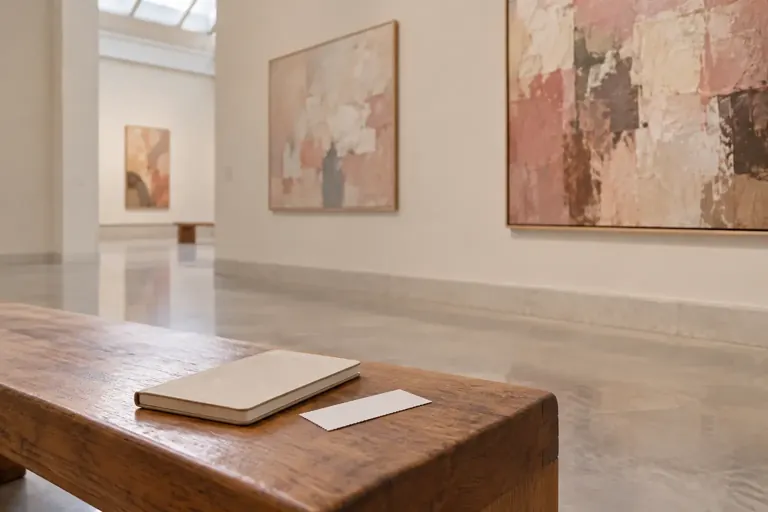
At an exhibition, you can observe the size, distance, lighting, or placement of an object. An artwork encountered in a gallery is not the same as a reproduction on a screen. Note the conditions that influenced your perspective: a crowded room, a place to sit, a dark gallery, or whether you read the wall text before or after.
You can limit the page to a single work. That doesn’t mean the rest wasn’t interesting. It simply lets you go beyond a list of titles. The French Ministry of Culture lists resources from the Louvre, including ones to learn how to observe a painting or sculpture, which may be useful if you’d like to explore this approach further.
Separate description, reaction, and interpretation
Description covers the observable elements. Reaction says what you felt or thought. Interpretation suggests a possible meaning. These three layers can follow one another on the page, but they are not interchangeable. “This scene seemed slow to me” describes your experience; “the director wanted to bore the audience” attributes an intention you haven’t verified.
You can write a hypothesis as a question. “Does the silence make the disagreement more visible?” opens up a line of thought. Then look for another moment in the work that supports or contradicts this idea. You move from a general impression to an interpretation you can explain with examples.
You also have the right not to understand. A work can interest you before you know why. Note what you find puzzling and what you’d like to revisit. Your journal isn’t an exam where every page has to contain the right interpretation or a specialist’s vocabulary.
Flip cards
Three ways to make an opinion more specific
I say “beautiful”Flip
What color, shape, or relationship makes me use this word?
I say “difficult”Flip
Is it the subject, the pace, the missing information, or my viewing situation?
I say “surprising”Flip
What expectation was shifted, and at what specific moment?
I don’t know yetFlip
What detail would I like to revisit before reaching a conclusion?
 Read alsoScripting: Write your dream life to clarify what you want
Add information without erasing your first reading
After the visit or screening, you can read a label, an interview, or a review. Note the source and keep this addition separate from your initial notes. Historical information or a technical explanation can change your understanding; it’s interesting to keep track of that change instead of rewriting the page as if you’d always known it.
Prioritize sources close to the work when verifying facts: the museum catalog, the credits, an interview with the artist, or an official press kit. Reviews offer interpretations that can be debated. You can be convinced by an argument without adopting the author’s entire conclusion.
If you keep a short excerpt, include its reference and your comment. The quote journal offers a method for avoiding sentences separated from their context. It can complement your cultural journal without turning every page into a collection of quotes.
Connect two experiences with precision
A film can remind you of a photograph, an exhibition of a book. Note the specific point they have in common: a color, a motif, a way of showing a place, or a question. “This reminds me of this film” becomes more useful when you explain what makes you draw the connection.
Look for differences, too. Two works can approach the same subject with opposite effects. One shows a place from a distance, the other through details; one tells the story of a day, the other of several years. These contrasts enrich the comparison and keep you from reducing every new encounter to something you already know.
You can create an index of motifs: windows, meals, departures, landscapes, voices. It can remain personal and evolve over time. Your reading journal can join this collection, while your idea notebook can hold the creative ideas these encounters inspire in you.
Prepare a recommendation without telling the whole story
If you’d like to talk about the film or exhibition with someone, start with what might interest them. Share a detail about its form or subject, then explain your own point of view. “I liked the way the pieces respond to one another in the gallery” is more informative than an unqualified enthusiastic recommendation.
Ask whether the person wants to know the plot before revealing an important detail. You can keep a section with the details in your notebook and a short version to share. For a temporary exhibition, check the dates and practical information on the official website before recommending a visit.
End your page with a possible next step: revisit a scene, look for a related artwork, compare two descriptions, or simply hold on to the memory. Not everything has to become research. A cultural experience can remain meaningful even if it doesn’t lead to a project, expertise, or a recommendation to publish.
Over time, reread a few pages to notice how your perspective has changed. Works you didn’t enjoy much before may interest you in a different way, and those that impressed you may no longer hold the same place. Date these new comments. Your notebook will then preserve several encounters with the works over time, rather than a fixed ranking of your tastes.
Observe a guided presentation
For a complementary perspective, watch this video from Cozy Hobby Time.
Frequently asked questions
Should I give it a rating?
Only if that kind of reference point works for you. Above all, add a reason and some context. A rating alone won’t tell you, a year from now, what interested or bothered you.
Can I write before reading the gallery text?
Yes. You can save your first observation and then add information from the caption or catalog entry. The two steps complement each other without needing to blend together.
What if I have almost nothing to say?
Choose one detail and one question. A short entry can remain open-ended. You don’t have to write a full review after every outing.