Contents
A quote journal brings together short excerpts you want to revisit, along with their source and your own comments. To get started, choose a line, note where you read it, and write why it gives you pause. This third step turns a collection of beautiful phrases into a personal reading journal.
You don’t need to save only lines you agree with. A phrase that surprises you, challenges you, or feels incomplete can open up a more interesting page than a maxim that immediately appeals to you. The journal is a way to continue your reading, not to assemble a set of definitive truths.
Choose an excerpt for a specific reason
When a line draws you in, ask yourself what’s at work: the idea, the rhythm, an image, an unexpected word, or its connection to a situation in your life right now. Note the reason in one line. That way, you can remember what caught your interest even if the line loses some of its shine a few months later.
Keep the excerpt as short as possible for your purpose. If you feel you need a whole passage, start by noting its reference and writing a summary in your own words. You can return to the book instead of copying several pages. Choosing a fragment helps you clarify what you really want to keep.
Avoid choosing only lines that seem easy to share. An unusual expression or a hesitation in a dialogue can enrich your reading without becoming a post. A private journal lets you choose what moves you without having to make every entry immediately clear or appealing to an audience.
Note a reference that lets you return to the text
Include the author, title, edition, and page when that information is available. For a translated book, also note the translator’s name if you’re saving the French wording. Different translations can express the same idea with different words; this detail will help you find the version you read.
For an online article, save the title, the author’s or organization’s name, the page address, and the date you accessed it. A link alone can become hard to interpret. For a video or interview, add the timestamp if you found it, and note whether the wording is an exact transcript or a paraphrase.
If you come across a quote on a shared image, look for its source before attributing it. You can save it temporarily with the note “attribution to be verified.” Don’t treat a signature repeated across several sites as proof. Catalogs and original editions can help you check, but sometimes it’s more honest to leave the origin uncertain.
Keep enough context
Add one or two sentences about the passage’s situation. Who is speaking? To whom? Is it a narrative, a hypothesis, irony, or a conclusion? A character’s line doesn’t necessarily express the author’s opinion. Context keeps you from making it say something else once it’s separated from the book.
You can note what comes before and after as a summary. For example: “The character has just given up on leaving, then contradicts themself in the next chapter.” This reference can change how you read the excerpt. It also makes your journal more useful when you want to discuss the book with someone.
If you cut part of a passage, mark the omission in your transcription and check that it doesn’t change the meaning. If you paraphrase, remove the quotation marks and indicate that it’s your summary. These simple steps clearly distinguish the text’s voice from your own.
Checklist
An entry you can easily find again
0 / 5
The entry now preserves a reading experience, not just an isolated phrase.
 Read alsoCultural journal: talking about films and exhibitions
Write alongside the quote
Start your comment with a personal sentence: “This passage makes me notice…,” “I’m not convinced by…,” “I’d like to compare this idea with….” You don’t have to produce a complete analysis. A well-posed question may be enough to extend your reading.
Avoid repeating the quote in other words without adding anything. Instead, look for an example, an objection, or a limitation. If the sentence is about time, ask yourself what kind of time it means: waiting, working, remembering? Being specific makes your comment more vivid than general agreement.
You can also look at the form. Why this word instead of another? What does the sentence’s length change? Which detail creates an image? The personal reading journal invites you to connect the book to your experience, while this journal can focus on short excerpts and how they’re put together. An expression can keep its original language in a journal between two languages, accompanied by a personal explanation. To turn reading into something you create, our guide helps you find inspiration without copying while preserving the sources. If a piece reminds you of a particular scene, you can compose a personal soundtrack for a chosen moment.
Connect passages without forcing them to agree
As you read, several excerpts may touch on the same subject. Create a page reference or a simple index: places, memory, work, creativity, relationships. Keep the categories broad enough that you don’t spend more time organizing than reading.
Two texts can respond to each other in disagreement. Place them side by side and note what differs in their contexts. A sentence from a novel and one from an essay don’t serve the same purpose. The comparison becomes interesting when you preserve that difference instead of looking for an artificial synthesis.
You can also connect an excerpt to a project idea. In that case, note what you want to try in your own words and keep track of the source. The idea notebook helps distinguish the reference that inspires you from the idea you develop from it. Alongside attributed quotes, you can keep a notebook of your own metaphors to explore original connections.
Review and share thoughtfully
Read a few entries again after some time has passed. Which phrases still speak to you? Which now seem too general? Add a date to your new comment rather than routinely replacing the first one. You’ll see how your reading evolves without claiming that one version was the only correct one.
If you’d like to publish an entry, check the rights and reuse terms that apply to the text or image. A document’s presence in a digital library doesn’t mean every use is treated the same way. The BnF distinguishes, in particular, between its data reuse terms and uses of reproductions; consult the notice for the specific document.
For a simple share, you can often prioritize your comment and a link to the source over reproducing a long passage. This also gives more room to your own reading. The notebook remains a place to engage with works, not a collection meant to replace consulting them.
A very short version can fit on one line: reference, keyword, and question. If you prefer this format, the one-sentence-a-day journal offers a simple way to keep a record. You can expand on the entries that deserve it whenever you feel like it.
How can you keep a quotation with an uncertain attribution?
Keep the uncertainty on the card instead of choosing the most plausible author. A sentence on a shared image does not become reliable because a famous name appears beneath it. Look for the passage in the work or a source that actually locates it.
| Note status | What you can record |
|---|---|
| Passage located | Checked work, edition, and location |
| Only similar wording found | Personal paraphrase, without quotation marks |
| Attribution not found | Unverified origin; do not assign an author |
Invented example: your notebook says “the day waits for me to begin,” but you cannot match it to a book. Keep it as a recorded sentence of unknown origin. Neither assign it to an author nor claim certainty that you invented it. If you find the source later, place the correction beside the old entry.
A notebook index can connect the pages without erasing the change. If the passage mainly holds a word you want to understand, use the vocabulary notebook card. This separates source, meaning, and response. When alternating books, keep a return note separate from chosen quotations.
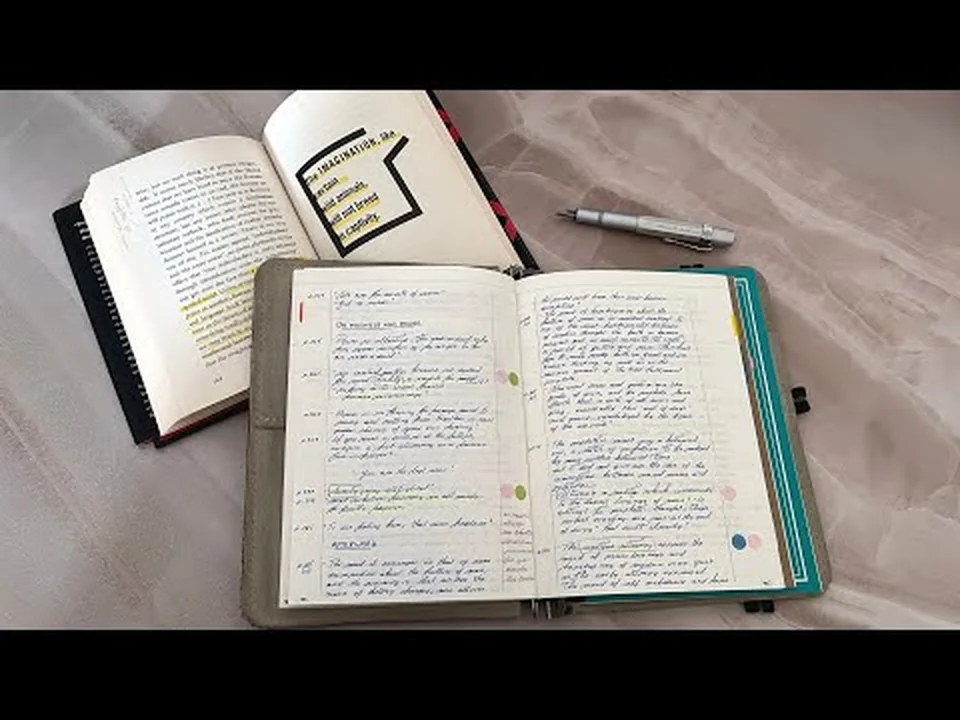
For a complementary perspective, watch this video from Yngrid Eilis. Notice the distinction between the source page, a quotation, and personal notes; the creator’s full system is optional.
Frequently asked questions
Can I mix books, movies, and conversations?
Yes, if you clearly indicate the type and source of each entry. For a personal conversation, consider paraphrasing and respect the people’s privacy.
Do I have to copy things by hand?
No. Choose the format that lets you find the source again and add your comments. Handwriting can be enjoyable, but it isn’t a requirement for success.
What should I do with a misattributed quote?
Correct the attribution when you have a reliable source. If the origin remains unknown, say so. You can keep the idea as something to reflect on without assigning it a presumed author.