Contents
- Capture enough context to understand later
- Choose a system you can maintain
- Reread to make connections, not to tidy everything up
- Turn a possibility into a small experiment
- An example of a living notebook
- Keep the system lightweight
- How can you archive an idea without making it a task?
- Frequently asked questions
To organize an idea notebook, separate three actions: capture ideas quickly, find them easily, and choose what you want to try. Don’t try to carry out every note. A notebook can hold ideas without turning into a list of obligations. Start with a date, a specific title, and a sentence explaining why the idea interests you. Keeping an idea doesn’t mean you have to act on it now; a temporary list of things not to do can make this distinction clearer. A starting point can become a very short story when you give it an action, a turning point, and an ending. Already-written texts need a different kind of sorting than simple ideas: here’s how to rework your old drafts.
The problem often comes less from a lack of ideas than from having them scattered everywhere. A sentence on your phone, a photo without a caption, a piece of paper in a bag: each trace exists, but none tells enough of its context. A lightweight system should let you find an idea after several weeks without requiring a sorting session every night.
Capture enough context to understand later
When an idea comes to you, write down what it would make possible. “Shelf” is too vague. “A small shelf near the entrance to keep papers off the table” describes a use. You can add what sparked it: a difficulty you encountered, an image you saw, a conversation. The context helps you tell a passing wish from a response to a real need.
If the idea comes from a work, an article, or a person, note the source. Write down the name, title, and a link or page number when you know them. You’ll be able to return to the reference without confusing your idea with someone else’s. This habit is useful even for a private notebook when you don’t plan to publish anything.
Keep your notes brief. One or two sentences may be enough as long as they’re clear. If you can’t develop the idea, add a question: “What would this be useful for in my home?” You’ll have a starting point for reviewing it. Don’t force yourself to answer right away when you’re in the middle of doing something else.
Choose a system you can maintain
A paper notebook can work with an index on a few pages and page numbers. A digital system can use a single folder and keyword search. In either case, start with just a few categories. If you spend a long time deciding where to file a note, the category is probably too specific for how you use it now. Before building your system, compare the ways you might use a paper or digital journal to choose a format that’s truly practical. Before adding a new category, take time to choose a resource suited to your next use.
You can sort ideas into “home,” “creative projects,” “learning,” and “outings,” then add a category only if several ideas call for one. The same words will naturally recur in your titles. Don’t try to anticipate every future project: a notebook evolves as you use it.
Set aside a temporary place for quick notes. It could be the last two pages of your notebook or a digital inbox. This keeps you from getting stuck while capturing an idea, but the place should be easy to identify. When you review your notes, move only the ideas you want to find again. You can clarify notes that no longer make sense or set them aside.
Reread to make connections, not to tidy everything up
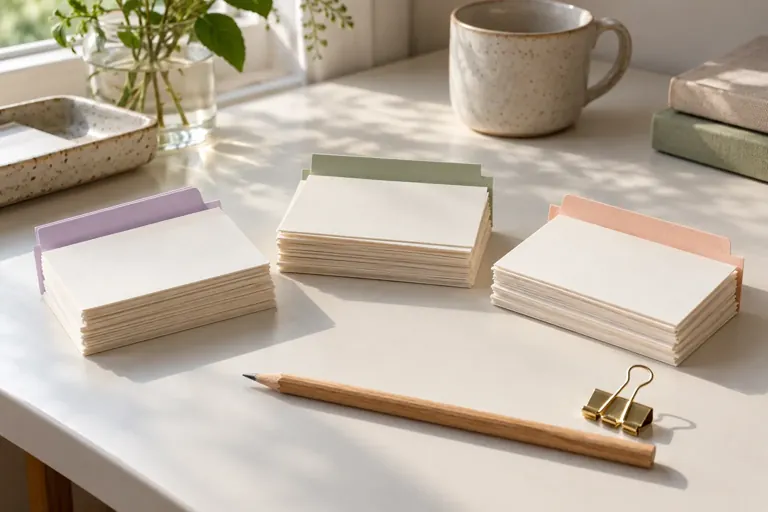
Revisit your notebook at a pace that suits how you use it: after adding several new notes or before starting a project. Look for ideas that address the same problem. A storage idea, a photo, and a materials list can form a set, even if you noted them on different dates.
Connect them with a page reference or a shared keyword. You don’t need to copy everything over. A sentence like “see also page 18, desk lighting” is enough. This link preserves the original contexts and saves you from creating multiple versions of the same note.
Reviewing your notes can also help you notice that some things you wanted no longer interest you. You can cross them out lightly, archive them, or let them sit for a while. An idea you set aside isn’t wasted time: it may have clarified what you don’t want to do. The written mind dump helps when notes get mixed in with urgent tasks and worries.
Flip cards
What should you do with this idea?
I want to keep itFlip
Add a clear title and the context that gives it meaning.
It connects to another ideaFlip
Add a reference instead of copying both pages.
I want to try itFlip
Set up a short experiment that will give you useful information.
It no longer interests meFlip
Archive it without feeling obligated to find a new project for it.
 Read alsoNew moon ritual: set your intentions for the month
Turn a possibility into a small experiment
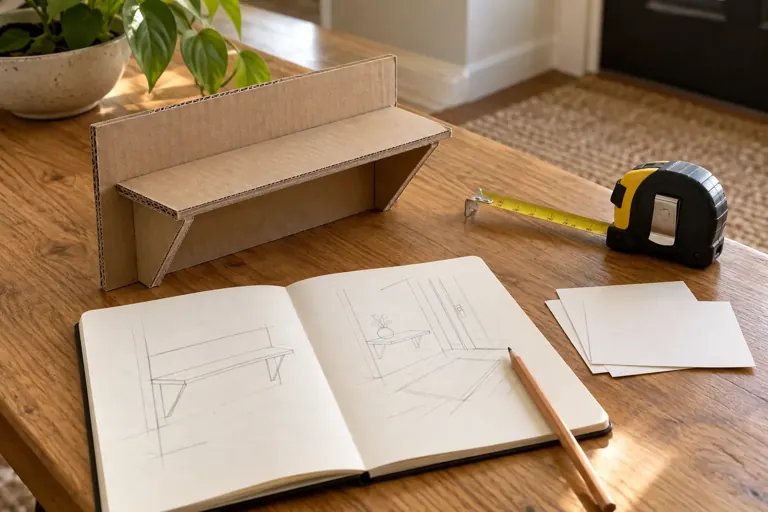
An idea becomes a project when you decide to devote resources to it. Before then, a test can answer a specific question. For a shelf, measure the space and sketch its dimensions on paper. For a creative workshop, make a simple sample. For an outing, check the route and how much time you have before putting together a detailed itinerary.
Write down what you want the test to teach you. “Will the object fit without blocking the door from opening?” is more useful than “see if it’s good.” Set a time or materials limit, too. An experiment that keeps expanding can become a full project before you’ve decided to start it.
After the test, keep the result even if you don’t continue. “The size is too large for the space” can save you from doing the exact same research again. If several ideas appeal to you, the guide to choosing a priority among several projects helps you compare constraints instead of following only your enthusiasm in the moment.
An example of a living notebook
Imagine you want to create a reading nook. One note describes the noise in the living room. Another saves a photo of an armchair and its source. A third says you mostly read near the window. When you bring them together, you realize the main question may be about light and quiet, before choosing the furniture.
The small test is to move an existing chair there for a few days. You note when you use it and what’s missing. The notebook helped you shape a question and keep track of your observations. It didn’t turn a beautiful photo into an automatic purchase. This fictional example shows how a collection of inspirations can support a concrete choice.
Later, you can revisit an old thread under new circumstances. Add a date instead of replacing the whole note. You’ll see what has changed: an opening, a skill, a desire. The guide to resuming an abandoned project helps you distinguish what’s still useful from what needs rethinking. Keep ideas separate from the open questions if you want to distinguish what’s being proposed from what still needs exploring.
Keep the system lightweight
Before adding a new filing rule, ask yourself what problem it solves. If you can easily find your ideas, there’s no need to build a more elaborate system. A brief index, dates, and specific titles may be enough for a long time.
Also, avoid copying every note into a neat version. Spending time making your notebook look beautiful can be enjoyable, but it’s a different activity. You can choose to do it without making it mandatory. Your system is working when you can find a thread, understand why it interested you, and freely decide what to do with it.
How can you archive an idea without making it a task?
An archived idea remains a possibility rather than a promise. Record what interested you and where to find it. There is no need to invent a deadline when you do not want to act.
Invented example: you write “a series of drawings of neighborhood windows.” You have neither the wish nor the time to do it now. The entry can become: “Windows—contrast between curtains and light; two sketches on page 18; return only if the subject interests me again.” The note preserves the possibility without creating a commitment.
| Decision | Useful record |
|---|---|
| Test | A chosen action and its context |
| Keep | The reason for interest and a location |
| Drop | Nothing to catch up; keep or remove freely |
A paper notebook index holds the address, rather than the whole idea. For a thought from a book, retain the source and keep the book in its own alternating reading plan. An unclear word belongs in a vocabulary notebook, with the question visible. Return to ideas when they serve you, rather than proving every note was productive.
For a complementary perspective, watch this video from Overall Adventures.

Frequently asked questions
How many ideas should I keep?
There’s no right number. Focus on how easy it is to find a note. If the notebook becomes difficult to browse, add an index or archive an entire period instead of sorting every sentence.
Can I mix personal and professional ideas?
Yes, if doing so respects the confidentiality of the information. Avoid copying sensitive data or work documents into an unauthorized personal tool. Separate notebooks may be simpler.
Does an idea have to be original?
It can be an adaptation, a question, or a personal association. Keep track of your sources and clearly distinguish what you found from what you’re proposing. You can then develop your own response without erasing where it came from.