Contents
- Why recycle drafts?
- Start with a batch you can handle in one session
- Read a draft to find what’s still at work
- Recycle drafts with three transformations
- Combine fragments without forcing an invisible seam at all costs
- Keep sorting from becoming another way to put things off
- End the session with a clear record
- Sort without reworking everything
- Tell a promising fragment from a memory of the work
- Frequently asked questions
- Sources
Recycling drafts means choosing what deserves to be reworked, transformed, or simply kept as a record of your work. You don’t need to save every sentence: start with a small batch and give each fragment a clear destination, without deleting the originals during the first round of sorting.
An old text may contain a useful image, an unfinished scene, or a question you no longer want to pursue. This guide offers a method for distinguishing among these cases, creating a new attempt, and stopping the sorting before it takes the place of all creative work.
Why recycle drafts?
Drafts preserve the attempts that the final version no longer shows: abandoned openings, moved sentences, variations, or research. The BnF’s resources on writers’ archives recall this variety, on paper and in digital formats. They don’t say that everything must be reused. Keeping a record and producing a new text are two distinct projects.
So your first choice is the purpose of the session. Do you want to find a scene to continue a story, make room in a folder, or build a page from fragments? If you mix these goals, each document will trigger a new task. Note your intention in your creative project journal then limit the batch you review.
| Destination | Criterion | Next action |
|---|---|---|
| Revisit | An active question and a clear desire | Schedule a specific trial |
| Reference | A useful detail with no current project | Note where it might be useful |
| Archive | A record to keep without reworking | Name and file |
| Review later | A decision that feels too weighty today | Set one question, not a full reread |
The sorting an idea notebook organizes ideas. Here, you review material you’ve already written, along with its choices and dead ends. You can keep the two systems separate: an idea index points to the original draft instead of multiplying copies without context.
Start with a batch you can handle in one session
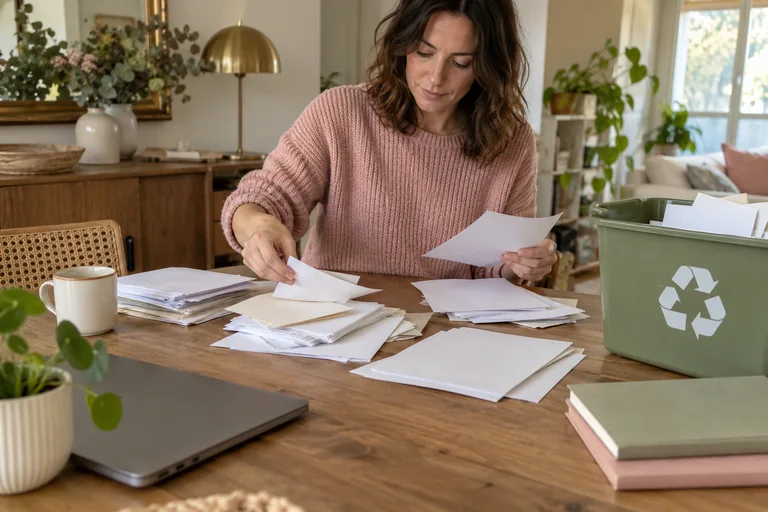
Choose five pages, a short folder, or the writing from a single project. Don’t immediately go through your entire writing history. The larger the batch, the more likely you are to jump from one period to another without making a decision. A solo creative session can be devoted solely to sorting, with an end time set before you get tired.
For digital files, first identify the versions and avoid changing the only original. For paper, use bookmarks or a tracking sheet instead of cutting anything up right away. You can work from a copy and preserve the original context. This simple choice protects against an enthusiastic revision that could erase the very sentence whose making you wanted to understand.
If a draft contains private information about other people, note that boundary before looking for a new use for it. An old text didn’t become public with time. You can draw out a technique, a general situation, or a rhythm without reusing identifying details. For memories, the guide writing about a specific memory helps distinguish observation, reconstruction, and invention.
Read a draft to find what’s still at work
Read each text once without correcting any mistakes. Mark an image, an action, or a question that holds your attention today. You’re not yet asking whether the text is good as a whole. A project that no longer interests you may contain a precise sentence; a fluent text may no longer fit what you want to write.
Add a sentence explaining why: “I’m keeping the sound of the shutter,” “the character’s decision still interests me,” “the place makes me want to return.” This reason helps you avoid keeping everything out of fear of losing some hypothetical value. The learning journal can record what you recognize now that you couldn’t see when you first drafted it.
If nothing calls to you, the archive is still a valid destination. The draft records a stage, even if it has no immediate future use. You can give it a name and date, then leave it alone. The goal isn’t to get a return on every past effort by forcing it to have a second life.
Recycle drafts with three transformations
1. Give a fragment a different purpose
A description of a kitchen that slowed down a story can become the center of a short scene of waiting. Keep the interesting detail and change the question around it. You’re not just recycling words; you’re giving them another purpose. To see this change, write one sentence about their role in the old text and another about their role in the new one.
2. Change the point of view
A scene told from a distance may benefit from following a character; a deeply inward scene may be easier to follow through the eyes of a witness. The three points of view provides a comparison protocol. Keep the facts stable during this test; otherwise, you won’t know whether the improvement comes from the point of view or from a completely different story.
3. Change the scale
An unfinished chapter can contain a flash fiction complete. Conversely, an enigmatic line may call for a longer scene. Choose what needs to become visible and adjust the space. Making something shorter doesn’t mean summarizing every event; making it longer doesn’t mean adding adjectives around a sentence that already worked on its own.
 Read alsoScripting: Write your dream life to clarify what you want
Combine fragments without forcing an invisible seam at all costs
Place two fragments side by side and look for a connection: a place, object, question, or contrast. You can preserve their difference in tone if it serves the project. But check the tenses, points of view, and signposts. A sentence drawn from a personal memory and another from fiction shouldn’t be joined as if they had the same status without a conscious decision.
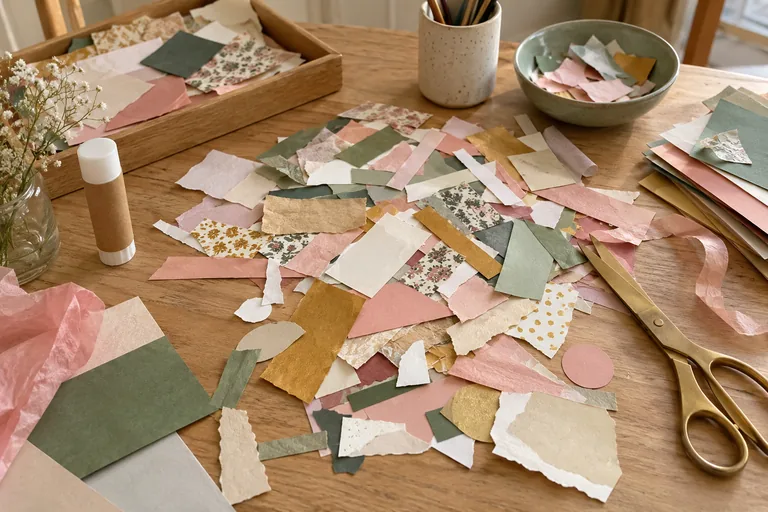
For a journal page, the creative collage makes it possible to present the fragments visually. For a continuous story, the transitions may require more substantial rewriting. Don’t keep a sentence only because you liked it in its old context. Its value must be reassessed within the new whole.

Workshop: choosing where a fragment belongs
I have an active question
Define a revision in terms of one action: change the point of view, write the answer, or move the scene.
I only like one detail
Keep the fragment with its context and note a possible purpose, without forcing it into an immediate project.
I mainly want to keep a record
Archive the text with a date and a descriptive title. It doesn’t need to be reworked.
Keep sorting from becoming another way to put things off
If you spend several sessions renaming files without writing, choose one fragment and close the others. Your sorting doesn’t need to be perfect before you try. You can return to the abandoned project with a focused question, without promising to finish everything you once started.
Also set a limit on how many revisions are active. One may be enough. Keep the others in reserve along with their purpose. This distinction helps you avoid turning every discovery into an obligation. You can appreciate an old text and still decide that it’s no longer your current project.
End the session with a clear record
For every text you work on, note its destination and link to the original or its location. Ask for feedback targeted feedback only on the chosen transformation, not on all your archives. A reader can tell you whether the new scene stands on its own or still depends on information left in the old project.
Finally, close the day in your notebook by writing down what has actually been decided. “One scene to revisit, three fragments in reserve, two texts archived” describes an outcome. You can then put the batch away. Repurposing is complete when you’ve made the material usable, not when every draft has found a new reason to exist.
Sort without reworking everything
Generator
A transformation to try
Make an old description the center of a scene.
See all the phrases
Role
- Make an old description the center of a scene.
- Keep an object and change the decision around it.
Scale
- Reduce a chapter to a single visible choice.
- Expand a sentence into a meeting that lasts a few minutes.
Quiz
Do you have to save everything?
A saved draft has to be reused.
See the answer
No. The archive can preserve a record without becoming a new project.
Working from a copy helps preserve the original context.
See the answer
Yes. You can compare versions without losing the original.
Flip cards
Moving past indecision
I keep everything without a reasonFlip
Note one detail or specific question for each item in reserve.
I want to rewrite everythingFlip
Choose just one piece to revisit actively.
The fragment depends on the old storyFlip
Add the necessary context or give it a different purpose.
The text contains private informationFlip
Adapt the technique without sharing identifying details.
Checklist
A batch processed
0 / 5
Your archives become easier to navigate without requiring you to rework everything.
Tell a promising fragment from a memory of the work
An old draft may move you because it reminds you of the place or period when you wrote it. That personal value doesn’t require the text to work in a new project. Note the attachment separately: “written on the train after the move” can explain why you want to keep the page without obliging you to reuse a scene that no longer interests you as a writer.
Conversely, a sentence from an unremarkable moment may be useful today. Read it outside its original folder and see whether it opens up an action or image that stands on its own. You can give the same document two destinations: the original in your personal archive, and a copy of the fragment in your creative reserve. This separation honors the memory while letting the new work choose what it needs.
For a complementary perspective, watch this video from Dana Gioia.
Frequently asked questions
What should you do with your old drafts?
Choose whether to rework, set aside, or archive them. Start with a small batch and keep the originals during the first round of sorting.
How can you tell if a fragment is worth revisiting?
Name what still interests you and the action you want to try. A vague desire not to lose anything isn’t always enough to start a project.
Can you combine several texts?
Yes, by checking how they relate, their context, and their status. Autobiographical and fictional fragments call for a clear decision about the final form.
Should you delete weak texts?
You don’t have to decide right away. A dated archive may be enough; any permanent deletion deserves a separate, considered decision.
How can you avoid spending all your time organizing?
Set a small batch and one active rework task. Stop sorting when each item has a destination, even if the system is simple.
Can a draft remain private forever?
Yes. Keeping a text creates no obligation to publish or show it.