Contents
To write about a memory, start with a short scene rather than an entire period. Choose a place, an action, and a detail you remember clearly. Then write what you recall, leaving the uncertain parts visible. You can create a vivid piece without claiming to reproduce every word or every minute exactly. For a fiction exercise based on an action, you can write a scene without dialogue and observe what the gestures make clear. If you’d like to keep scenes instead of organizing them into categories, you can tell the story of your year without a score or New Year’s resolutions. When you’d like to accompany an activity without making therapeutic promises, you can compose a personal soundtrack for a chosen moment.
A departure, a kitchen, a trip, or a visit can offer a starting point. The scene doesn’t need to be extraordinary. What gives it a sense of presence often comes from a specific gesture: someone folds a towel, a door stays ajar, a bag is left in the wrong place. These details let you enter the memory before explaining why it matters.
Choosing a scene small enough
Avoid starting with “my childhood” or “my school years.” Look for a defined moment: a lunch, an arrival, a wait in a hallway. You can broaden the story later if needed. A narrower frame helps you decide what belongs to the scene and what is context.
Write a very simple opening sentence: “I’m in…,” “We’re waiting…,” “I’ve just….” It doesn’t have to become the first sentence of the finished piece. It helps establish the point of view. You can use the present to bring the scene closer or the past to keep some distance; above all, keep the tense consistent and easy to follow.
If several memories feel alike, note that in your notes. You can write that you remember a repeated habit rather than a specific day. A scene composed from several moments can work in a creative piece, as long as you don’t present it as an exact account of a single event.
Taking stock of the details available
Note what you see in your memory: where objects are, the light, the clothes, the gestures. Add a sound or a sensation only if you truly remember it. You don’t need to fill out a list of all five senses. One precise detail is better than a pile of smells and colors chosen because they seem literary. A familiar object can be a starting point: our five-object personal journal connects ordinary things with the scenes they bring to mind. A memory doesn’t need to be extraordinary: the everyday journal teaches you to choose a small scene.
Separate three levels: certain, probable, unknown. A date may be confirmed by a photograph; a season may only be a guess; a sentence may be gone. This small distinction keeps you from reshaping your memory to make it seem more complete. You can keep phrases like “I think” or “I don’t remember anymore” when uncertainty belongs in the story.
Documents can help: a planner, a letter, a ticket, a photograph. Use them as sources to compare, not as an obligation to start an investigation. If an image contradicts your memory, keep both pieces of information in your notes. The piece can describe that discrepancy instead of choosing a definitive version too quickly.
Moving from information to gestures
A list of facts becomes a scene when something unfolds. Who enters, waits, searches, or moves an object? In what order? Choose two or three actions that carry the moment. You can remove unimportant movements and slow down around the one that interests you.
Compare these two fictional sentences: “The meal was warm” and “My uncle pulled the last chair closer so no one would be left at the end of the table.” The second offers an action the reader can imagine. By itself, it doesn’t prove a harmonious family relationship; it describes a specific gesture. You can then say how it made you feel.
Dialogue calls for the same care. If you no longer know the exact words, summarize the exchange or say that you’re reconstructing it. You can write “she asked me to stay” instead of inventing a precise line. A personal story doesn’t need quotation marks at every encounter to feel vivid.
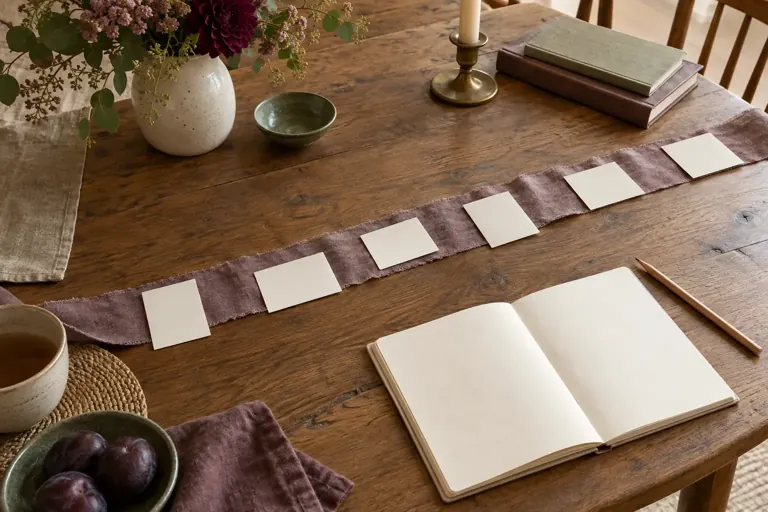
Flip cards
Opening a scene
The thresholdFlip
What changes when someone enters or leaves?
The objectFlip
What object passes from one hand to another, is left behind, or catches your eye?
The techniqueFlip
What tiny action best sums up this moment for you?
The blankFlip
Which part of the memory would you rather leave uncertain than fill in?
 Read alsoRecipe notebook: preserving techniques and memories
Distinguishing what you experienced from what you understand today
Your present-day perspective can enrich the text, but it isn’t the same as the perspective of the person you were then. In a first draft, tell the scene as closely as you can to what you perceived at the time. In a second paragraph, add what you notice today. This separation keeps you from giving your former self knowledge they didn’t have.
You can write: “At the time, I thought we were running late. Today, I wonder if that pause was intentional.” The question remains open. It gives the story depth without confidently assigning an intention to someone else.
If you want to connect this memory to your journey, do so after writing the scene. The journal can hold the reflection, while the scene keeps its own shape. You can also write a few lines to your future self in a letter to yourself, without turning the memory into a lesson you have to learn. If the words come back to you in several languages, you can welcome them in a bilingual journal without translating everything.
Rereading to remove anything that overexplains
As you reread, notice the sentences that repeat what a gesture already shows. If you’ve described a long wait, you may not need to say three times that it felt endless. Keep the explanation that truly adds new information: what was at stake in the wait, what you didn’t know, or what changed afterward.
Check the transitions, too. The reader should understand where the scene begins and when it ends. A simple sentence can signal a jump in time. You don’t have to describe every minute between two moments, but a cut should be clear.
Read the text aloud at the end if you feel comfortable. Listen for repetitions and sentences you can no longer understand without looking at your notes. You can simplify a passage without erasing its personality. The goal is to make the scene shareable, even if you ultimately choose to keep it private.
Choosing what you can share
A personal memory may include other people’s private information. Before publishing it or reading it to a group, ask yourself what information the story needs. A first name, an address, or an intimate detail can often be removed without weakening the scene. Changing these details doesn’t mean you can skip thinking about how someone might still be recognized.
You can prepare two versions: a complete version for yourself and a version to share. Don’t let uncertainty about sharing turn into an obligation to censor everything in your journal. Instead, choose the right audience and level of detail. For memories of a trip, the travel journal also suggests distinguishing between a personal record and a public account.
If a scene feels difficult to write about, you can choose another memory or stick to describing an object. Writing doesn’t require you to explore anything in particular. A cup, a bench, or a window can give you enough material for a complete piece without opening up a subject you don’t want to discuss.
To use a smell as a starting point, the olfactory journal separates the sensation, the memory, and the details you choose to make up.
Frequently asked questions
Can I write if I no longer know the date?
Yes. Give an approximate time period or leave out the date. The context may be enough. Just avoid giving a level of precision you haven’t verified.
What if someone close to me remembers it differently?
Note the difference without automatically assuming that one version cancels out the other. You can present several points of view and indicate where each comes from. For an important factual claim, look for verifiable evidence.
Does it need a conclusion?
Not necessarily. A final gesture or a return to the place may be enough. You can end the scene without explaining what it should mean to everyone.