Contents
To keep a travel journal, choose one scene, one detail, and one question each day. Jot them down on the spot in a few words, then expand only on what you want to preserve. This method keeps you from spending your evenings retracing the itinerary or returning with a beautiful but nearly empty journal. A two-day trip is enough to get started.
Your journal doesn’t have to compete with your photos. It can preserve what they don’t capture well: the wait before a departure, a sentence exchanged, a moment of hesitation over a menu, the feeling of discovering a street after the rain. You’re building a personal memory of your stay, not a complete guide to the destination.
Prepare a journal that won’t become extra baggage
Choose a format you can easily open while sitting on a bench or at a small table. A flexible notebook and a pen are enough. If you prefer your phone, create a single note or a clearly named folder. Adding apps and categories before you leave can make it harder to find your memories when you return.
Use the first page for the dates, main stops, and what you hope to discover. Avoid filling in every day in advance. Plans change, and a blank two-page spread isn’t a failure. If you’re traveling with someone, make clear that your journal reflects your point of view: you don’t have to remember the same moments.
Set aside a slim envelope for two or three selected papers. Not every receipt needs to become a keepsake. Ask yourself what each item tells you: a particular visit, an unusual trip, an encounter. Leave out documents with contact details, booking numbers, or other information you don’t want to keep in a journal that could easily get lost.
Write on the spot without stepping away from the trip
In the moment, jot down reminders rather than perfect sentences. “Station, blue bench, smell of coffee, departure announced twice” already contains a scene. Add a date and a specific enough place so you can find your way back to it later. You can develop the passage during a break without trying to remember a whole week on the last night.
Choose a small moment for it: after lunch, on the train, or before putting your bag away. You don’t need to write every day. One page midway through the trip and another when you return may be enough. If your journal starts distracting you from what you’re visiting, close it. You don’t have to document an experience to have the right to live it.
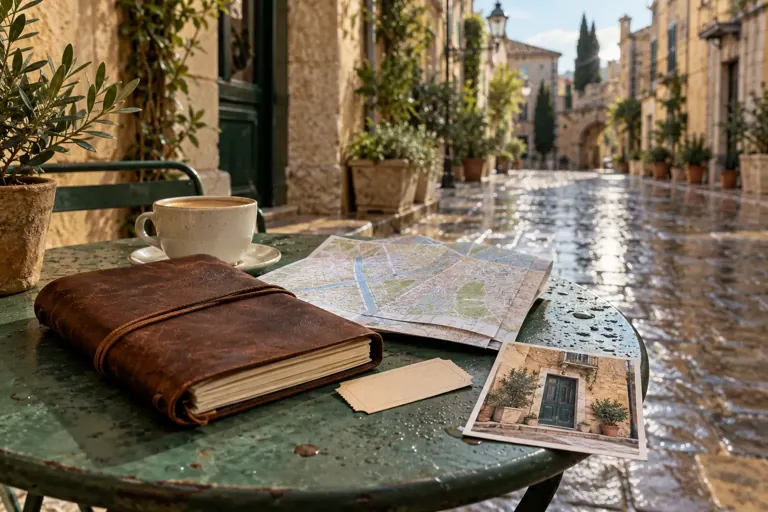
A photo can serve as a reminder, but don’t expect it to bring everything back. Add a personal caption: why you framed that detail, what had just happened, what surprised you. “Green door beside the café where we waited out the downpour” will say more than the city’s name alone.
Build a page around a scene
Start by setting the scene. Where are you, when is it, and what are you doing? Then add two details you actually noticed. End with what gives the moment a personal touch: a surprise, a preference, or a question. This structure works just as well for a hike as for a day in a nearby city.
For example: “At noon, I sat under the market awning. Chairs scraped against the paving stones, and a vendor kept rearranging the same three bouquets. I ordered too quickly, then took the time to watch what the neighbors were eating.” This fictional passage doesn’t tell the whole morning. It preserves a moment the reader can imagine.
You can add a small hand-drawn map. It doesn’t need to be accurate: three landmarks and an arrow can show your route. Still, keep this personal map separate from a map meant for navigation. To find your way, use a reliable map and local directions, not a sketch made from memory.
Flip cards
Choose a travel angle
An unexpected detailFlip
What object, sound, or gesture would you never have thought to notice before you arrived?
A change of paceFlip
When did you wait, slow down, or change your plans?
A preference you discoveredFlip
What did you enjoy without expecting to, and what exactly did you like about it?
An open questionFlip
What would you like to understand instead of explaining too quickly?
 Read alsoDescribing a place: choosing the details that bring it to life
Describe encounters with care
A conversation can be memorable without you writing down the person’s full name. Keep what the exchange taught you or made you notice. If you don’t remember the exact words, write “in essence” or paraphrase. Quotation marks give the impression of an exact quote; save them for words you actually wrote down.
Avoid drawing conclusions about a population from one encounter or incident. “This shopkeeper offered me a taste” describes an experience. “Everyone here does this” generalizes something you haven’t verified. Your journal can preserve your impressions while recognizing their limits.
If you want to publish a page or a photograph, the situation changes: other people become visible. Check that you have the necessary permissions and remove private information. The CNIL outlines precautions related to image rights online. Keeping a personal journal and sharing a public story are two distinct choices.
When you return, choose what to keep instead of trying to catch up on everything
Open your notes early enough to recognize the abbreviations, but don’t pressure yourself to reconstruct everything. Choose five traces that still make you want to write. Some will remain lists or fragments. Others will become a fully developed page. You can add a note saying “uncertain memory” rather than filling a gap with an invented detail.
Add a page called “What I’ll keep in mind for a future trip.” Separate practical information from things you’d like to do: pack less, plan a morning with no reservations, return to a neighborhood. This page will be more useful than a pile of tips you won’t reread. For the ordinary details you enjoyed, take the idea further with a journal of little pleasures. When you return, a separate page can help you choose which discovery from the trip to adapt to everyday life, without turning every memory into a resolution. You can set aside a separate selection of images that make up a series around a single theme, without including every memory from the trip. In a clearly fictional exercise, you can turn the idea of a journey into imaginary map without confusing it with the account of the real trip. As you return to everyday life, you can plan a realistic end to your vacation. To choose where your camera fits instead of banning it, you can savor a moment without having to photograph it.
Finally, give your journal a personal title. “Three days searching for covered passageways” already tells your story from your perspective. A date on the spine or in the file name will make it easier to find. If you want to keep writing after your stay, the basics of journal are flexible enough to make room for these fragments.
You can also create a page of very concrete contrasts: what you had planned and what actually happened, the place you expected to visit and the detour you liked best, the item you packed and the one you missed. Keep these contrasts descriptive. They don’t have to prove that the unexpected is always better. Some plans unfold exactly as you hoped and deserve a place in the story of your stay, too.
Frequently asked questions
I don’t draw. Will my journal still be interesting?
Yes. Words, lists, arrows, and a few chosen images are enough. Drawing is an option, not a measure of success. A precise detail is worth more than decoration added out of obligation.
Can I write several weeks later?
Yes, by distinguishing between notes you took on the spot and what you’re reconstructing today. That distance can become the subject: what remains clear, what fades, and what takes on a different importance.
How can I keep my journal from being only about sightseeing?
Add the in-between moments: the ride, a simple meal, laundry, a break, the weather you experienced. These are often the details that make your stay different from a standard itinerary. You can also note a book you read during the trip in a reading journal.