Contents
An imaginary map can spark a story by connecting places, distances, and obstacles. Start with three places and a route: ask yourself who needs to get from one to another, why, and what makes the journey difficult.
You don’t need to draw a realistic continent or master cartography. This workshop turns a sketch into storytelling questions. You’ll build a setting that serves the story, choose what information to show, and write a first scene from a point on the map.
What is an imaginary map for?
The BnF explores the links between cartography and the imagination: maps give shape to fictional territories, interpret reality, or extend it. A map can be more than a way to find your bearings. In a writing project, it makes relationships visible: near and far, accessible and forbidden, known and assumed.
To begin, choose a scale that fits your story. A house, a neighborhood, and an island call for different decisions. A locked hallway can be enough of an obstacle in a short story; there’s no need to add a mountain range to make the conflict feel important. The creative project journal can keep the map with the scenes it inspires.
| Scale | Storytelling question | First sketch |
|---|---|---|
| House | Who has access to which room? | Three spaces and a door |
| Neighborhood | What route connects two people? | A street and a detour |
| Island | What does the passage to the outside make possible? | A harbor and a path |
| Wider world | What distances separate the stakes? | Just a few regions |
A map doesn’t have to depict the territory exactly as it is in the story. It may have been drawn by a character who doesn’t know about a passage or exaggerates a danger. In that case, make clear the difference between your working map and the object the characters use. This distinction opens up possibilities without making travel arbitrary.
Draw an imaginary map in five choices
1. Place three locations with a purpose
Choose a starting point, a place to reach, and a location that forces a stop. For example, a house by the water, a workshop on a hill, and a closed bridge. Each place contributes to an action. You can add details later, when the story reveals what’s missing.
Avoid starting with thirty names. A name can create an atmosphere, but it can’t replace a connection between places. Draw simple shapes and write each place’s role in the margin. If you’d like to enrich the feel of a place, the guide to describing a place with the five senses helps you turn a map into a tangible experience.
2. Draw a route and a detour
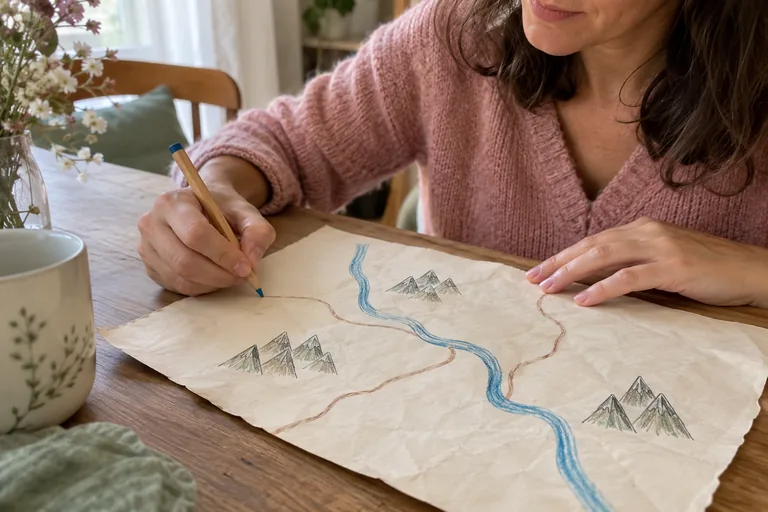
Connect the starting point to the destination, then block off part of the way. The detour forces a choice: pass through an unfamiliar place, ask for help, wait, or give up. You’ve created a narrative challenge without inventing a dramatic event yet. Geography becomes active because it changes what the character can do.
Keep distances reasonably consistent. If the detour takes all day in one scene, it can’t become a trip of a few minutes later without explanation. You can note approximate travel times instead of using a precise scale. Fantasy allows for special rules, but you need to establish them so readers can understand what’s at stake.
3. Decide who knows the way
One character may know the old path, while another knows only the main road. This difference distributes information and creates a relationship. Asking for directions may require talking to someone they’ve been avoiding. A dialogue between characters can then build on a concrete need instead of being added just to explain the world.
You can use multiple points of view to compare the territory. The port seems close to someone with a boat and far away to someone who has to go around the bay. The map doesn’t necessarily change, but the experience of the place does. Avoid confusing the distance shown on the map with how accessible a place actually is in the story.
4. Add a resource and a limitation
Mark what the characters need: water, shelter, a tool, a message, or a meeting place. Then decide on a constraint: opening hours, weather specific to your world, a door that locks, or a passage too narrow for an object. Each addition should raise a question. If an element doesn’t change any action, you can save it for later instead of cluttering the first sketch.
5. Choose a name that suggests without telling the whole story
A name can come from a shape, a purpose, or an invented local history. “The Low Footbridge” points to a useful feature; “The Detour of the Three Lamps” sparks curiosity. Avoid systematically copying the sounds of a familiar fictional world. The guide to choosing a title for a creative work offers tests of promise and tone that can also be used for place names.
Write from the map instead of describing it all
Choose a specific point and place your character there with a task. She is carrying a fragile object to the workshop, but the bridge is closed. The scene can begin when she discovers the obstacle. You don’t need to introduce every village before this first action. The map is still available to you; the text reveals only what becomes useful in that moment.
Here’s an original opening: “The sign was new. She set the box on the dry stone and looked at the opposite bank. The workshop light was already burning, less than a hundred paces away, but the path now led over the hill.” The contrast between visible closeness and the distance still to travel creates a sense of stakes. You can develop the scene or keep it as flash fiction.
Revise the rules of the territory
After the first scene, check the characters’ positions and how they can travel. Why doesn’t the character cross somewhere else? What can they see from the bridge? Who is waiting for them, and what information do they have? These questions aren’t meant to eliminate all invention, but to avoid an obstacle that would disappear if you looked more closely at the map.
If you change a place to improve the story, make a note of the version. Your idea notebook can keep the discarded variations, while the current plan remains easy to identify. A heavily decorated map can sometimes be hard to revise; start with a rough draft, then decide later what deserves a polished version.
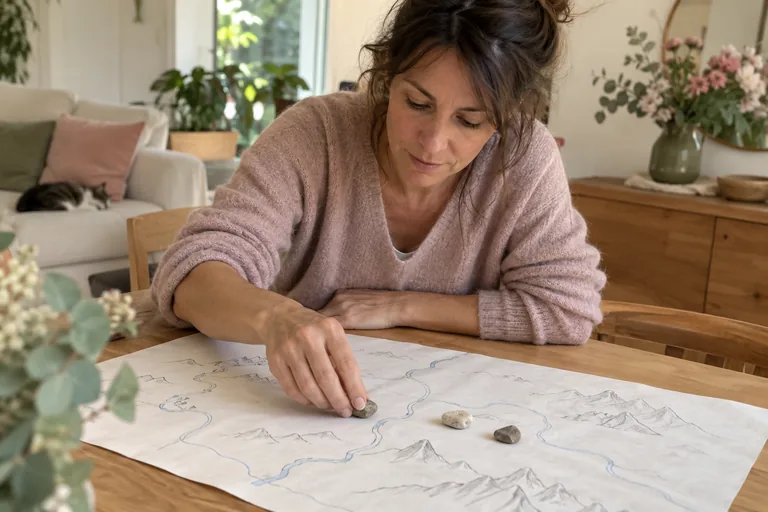
Workshop: Turn a Place into a Scene
Who needs to get through?
Choose a character and an object, message, or appointment that makes the journey necessary.
What gets in the way?
Add a clear geographical obstacle, then check why the detour matters.
What choice emerges?
Offer two routes with different costs. Write the moment when the character decides.
 Read alsoScripting: Write your dream life to clarify what you want
Keep a personal map instead of borrowing a world
A collection of visual references can show conventions for legends, terrain, or representation. Note where they come from and the principle being explored. If you want to present the result as your original world, don’t reproduce an existing fictional landscape by changing only its names. Instead, start with a route, a constraint, or a place you’ve observed as your own point of departure.
You can also choose a deliberately unrealistic map: a spiral-shaped building, a street that changes length, or an archipelago of rooms. In that case, establish a clear rule and explore its consequences. The strangeness becomes more interesting when the characters have to act within it, rather than when it remains an impossible-to-understand decoration.
Finish a first map without finishing the world
Ask for targeted feedback along the route: is the starting point, destination, and cost of the detour clear? A reader doesn’t need to know every name. If these relationships are clear, you can stop working on this version and devote a solo creative session to writing the scene.
In your learning journal, note what the plan set in motion: a meeting, a wait, or a choice. The success of this map isn’t measured by the number of mountains drawn. It has done its job if it helped you ask a narrative question you want to explore.
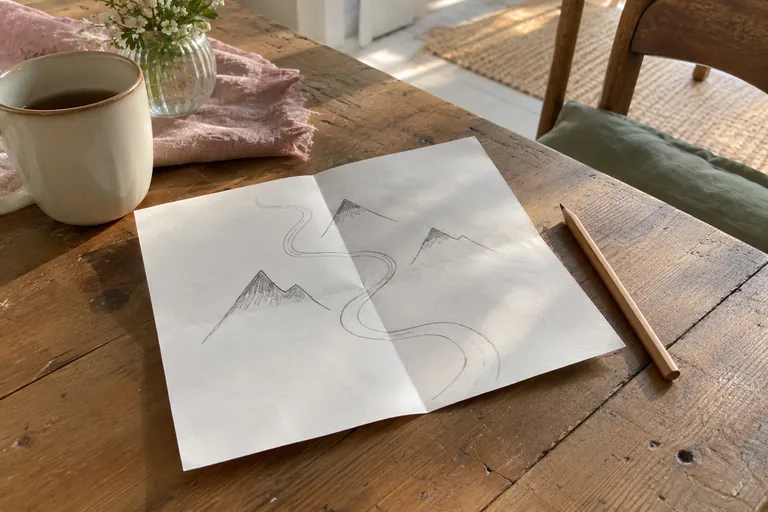
Map out a story
Generator
Three Places to Begin
A house, a workshop, and a closed street.
See all the phrases
Neighborhood
- A house, a workshop, and a closed street.
- A library, a square, and a covered passage.
Island
- A harbor, a spring, and a path accessible at low tide.
- A lighthouse, a garden, and a hill that hides the coast.
Quiz
Map and Story
A map must show the entire fictional world before the first scene.
See the answer
No. A few useful relationships are enough to set an action in motion.
A detour can create a character choice.
See the answer
Yes. Geography changes the options, encounters, and time available.
Flip cards
Unlock the Territory
The map is decorativeFlip
Add a necessary route.
The obstacle is easy to get aroundFlip
Check its cost or change its function.
I’m adding too many namesFlip
Keep three places and write down their roles.
The character knows everythingFlip
Distinguish the character’s plan from what you know as the author.
Checklist
A Map That Sets a Scene in Motion
0 / 5
Your territory can grow from the story rather than before it.
For a complementary perspective, watch this video from Lynn D. Jung.
Frequently asked questions
How do you create an imaginary map?
Place three locations, connect them, and add an obstacle. Then ask who needs to travel this route and why.
Do you need to know how to draw?
No. Simple shapes and temporary names are enough for a working map. Clear relationships matter more than decoration.
Do you have to follow real-world geography?
You can make up rules, especially in a fantasy world. Just keep their consequences consistent throughout the story.
How do you come up with place names?
Start with a shape, a use, or an invented local story. Check that the name suggests the tone you want without drawing on a familiar fictional world.
Can you draw a deliberately inaccurate map in the story?
Yes, if it belongs to a character or comes from a limited source. Keep this map distinct from the territory you define for yourself.
When should you stop working on the map?
When you understand the relationships needed for the scene you want to write. You can add places later when the story needs them.