Contents
- Distinguish an observed pleasure from an ideal day
- Start with the senses without using all five every time
- Add the context that makes the memory useful
- Make room for pleasures that cost nothing
- Return to one scene instead of adding more lines
- Reread to choose an accessible opportunity
- Keep a journal that feels alive and private
- Frequently asked questions
The sound of a door you recognize, an orange that’s easy to peel, a lighthearted conversation in a line: some pleasant moments are nothing spectacular. Yet they often pass too quickly to become a distinct memory. A small pleasures journal is a place to jot down a few of them, along with their concrete details. It doesn’t ask you to declare that everything is fine. Nor does it replace the day’s difficulties with a more presentable list.
This journal can become a collection of personal observations: what you truly enjoy, under what conditions, and what you’d like to experience again. Here’s how to build it without turning every walk or cup of tea into a required exercise.
Distinguish an observed pleasure from an ideal day
Start with a moment that really happened. “A perfect morning” is a general judgment; “the sun on the rim of my bowl while the house was still quiet” paints a scene. The detail helps you recall what you enjoyed: the warmth, the light, the silence, or simply not having to rush. You don’t need to exaggerate its importance for it to deserve a line.
A small pleasure can last a few seconds and coexist with a difficult day. That can be true at the same time: enjoying a piece of fruit doesn’t resolve a conflict, but the conflict doesn’t stop you from noticing the fruit. So the journal isn’t for making a positive assessment at all costs. If nothing catches your attention today, leave the page alone. A blank space is better than a phrase copied just to keep a streak going or fit a happy image of yourself. Observing what you enjoy can help you express a preference in a small choice.

Start with the senses without using all five every time
You can look to ordinary sensations: a texture, a smell, a color, a sound, a taste. You don’t need to fill in all five categories. Choose the detail that’s actually there. Maybe you notice voices and soundscapes most; maybe gestures and materials speak to you more. Adapt the words to how you perceive things, without looking for an experience identical to everyone else’s.
Write, for example: “The bench back was still warm” or “I heard the rain from inside the laundromat.” One sentence is enough. If a sensation is uncomfortable, you don’t have to turn it into pleasure. You can also note a practical relief, like finding a seat, or a modest satisfaction, like fixing a zipper. This journal welcomes what truly works for you, not just the objects usually photographed in wellness routines.
Add the context that makes the memory useful
After the detail, name a condition. The tea was enjoyable because you had ten minutes to spare; the walk because it had no destination; the music because you already knew the song. This small clarification keeps you from thinking the object alone explains the whole experience. Buying the same cup won’t necessarily recreate the unhurried feeling of that morning. The context is often part of what you want to find again. If you’d like to briefly switch activities, you can choose ten minutes without a screen, your way.
You can use three fragments: “what I noticed,” “where I was,” “what mattered.” For example: “Smell of warm bread; passing by the bakery; I was walking without making a call.” This format stays light and doesn’t call for a full analysis. It mainly helps you later distinguish a desire to shop from a desire for time, attention, company, or a change of pace.

Keep a pleasure alongside its context
Fill in these prompts to prepare for your next attempt. Nothing is sent or saved.
Your prompt will appear here after you make your choices.
Make room for pleasures that cost nothing
If your first pages look like a catalog of cafés, restaurants, or products, simply broaden what you observe. Notice what’s already there: an open window, the comfort of a worn garment, a joke someone sent you, a ride where you were able to sit. You don’t have to devalue things you’ve bought and enjoyed. The idea is to keep this journal from becoming a list of more things to get.
Try a short walk in a familiar place without a photography assignment. When you get back, write down one detail instead of monitoring every minute while you’re out. You can also notice what you liked about an ordinary task: folded laundry, the color of a chopped vegetable, the space cleared on a table. If the task itself weighs on you, keep that nuance. “I liked this detail” doesn’t mean “I like everything this situation asks of me.”
 Read alsoKeeping a journal: how to get started and stick with it over time
Return to one scene instead of adding more lines
A journal filled with fifty vague entries may say less than a scene described in a few sentences. Sometimes choose one moment and develop it: what made it different? What did you do just before? Was anyone with you? What detail might you have forgotten if you hadn’t written it down? You may discover a specific preference, like enjoying conversations while walking more than long, noisy evenings.
Still, leave your observations open. An enjoyable experience doesn’t create a general rule. You can enjoy a terrace one day and want to head home quickly the next time. The journal gathers possibilities; it doesn’t give you a fixed definition of your tastes. If you want to explore your feelings more broadly, the journaling prompts offer other starting points. Here, focus above all on precise details of the scenes and on not having to assign them great significance.

Reread to choose an accessible opportunity
After a few pages, notice a pleasure you could revisit without forcing it. If you enjoyed reading for ten minutes by the window, leave a book there. If you enjoyed talking with a friend while running an errand, suggest sharing a ride when it works for both of you. The goal isn’t to recreate an emotion exactly, but to make available a favorable condition you’ve already enjoyed. A familiar pleasure can become a quiet gesture to acknowledge a milestone.
Choose just one opportunity. A list of twelve pleasures to fit into the week would quickly become another demanding schedule. Also, allow for the next experience to be different. It might rain, the café might be full, or you might not feel like reading. That doesn’t mean the practice has failed. You’ve made room for a possibility; you can’t control every part of the moment or how you’ll experience it.
Keep a journal that feels alive and private
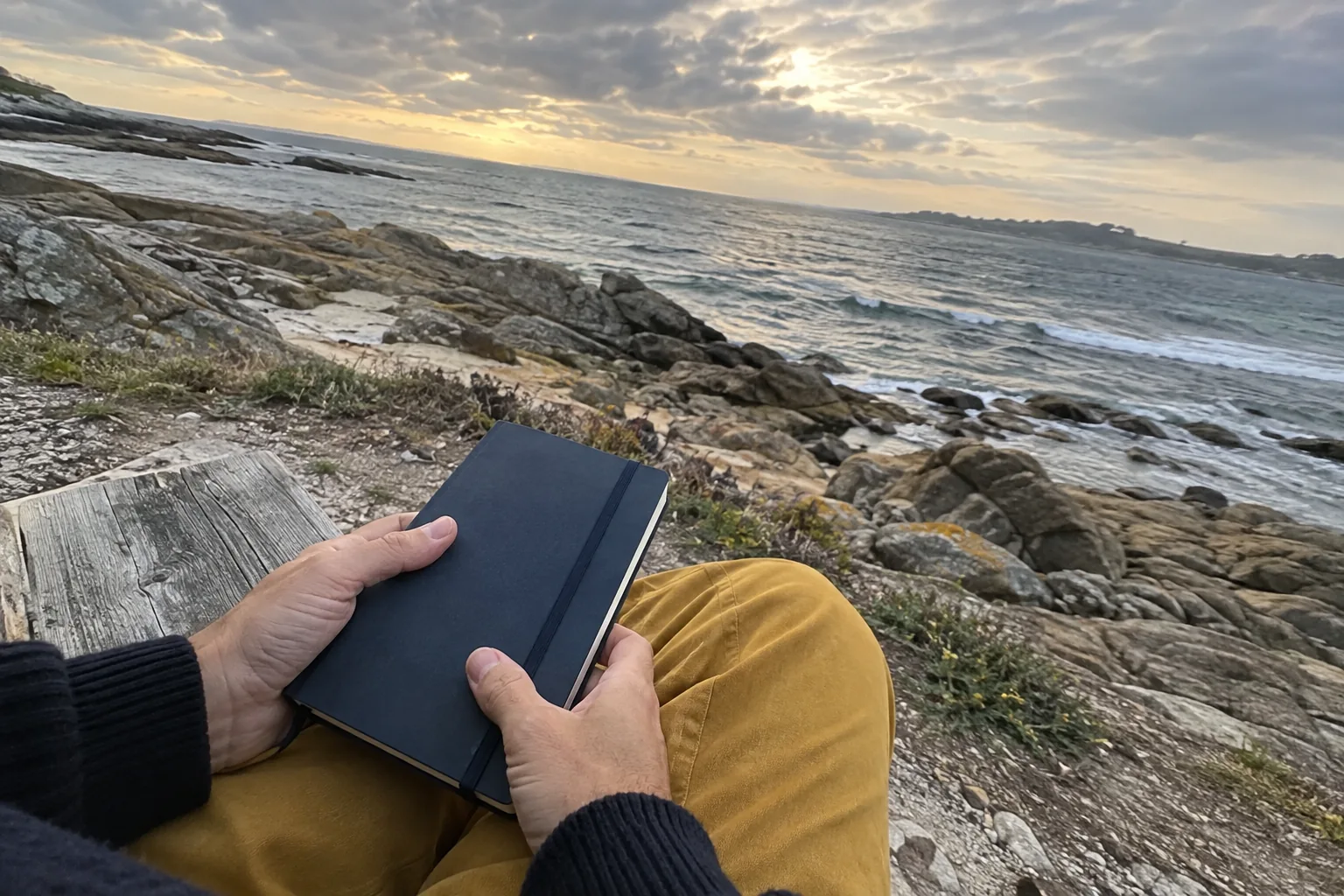
A pocket notebook may be enough. You can jot down a word in the moment and add more later, or set aside a page after a few days. Try not to spend the whole experience searching for the perfect wording. The note serves the moment you lived. It doesn’t need to be shareable or beautiful, and it doesn’t need a photo. You can draw a simple symbol if that helps, without turning the notebook into a mandatory creative project. When keeping a record starts to take priority over the experience, you can savor a moment without having to photograph it.
This format can complement a gratitude journal, but the two approaches differ. Here, you mainly notice a pleasant experience and the conditions around it; gratitude is more about recognizing what you’ve received. You can keep both types of pages in one notebook or choose just one. The right format is one you can use without having to justify every line or pretend to feel something.
Frequently asked questions
Can I write down the same pleasure more than once?
Yes. The details may vary: who was there, the weather, the time you had. You can also simply write that you still enjoy it. You don’t have to be original, and your notebook doesn’t need to entertain an outside reader.
Do I need to take photos?
No. A photo can accompany a scene if you feel like it, but a few words are enough. If taking photos pulls you away from the moment or makes you look for a prettier setting, put your phone aside and write later.
What if this search feels forced?
Do it less often or stop. You can save the journal for times when a detail comes to you spontaneously. The exercise isn’t proof of good intentions, and it shouldn’t make you deny a difficult period.