Contents
- What’s the difference between smelling, remembering, and imagining?
- What does research say about smells and memories?
- What starting point can I choose without turning it into a whole experiment?
- How can I fill out the six prompts in my scent journal?
- What words can I use when a smell seems indescribable?
- How can I reread without correcting who I used to be?
- What small action can I choose after writing?
- Frequently asked questions
- Sources
A olfactory journal is a journal where you start with a smell, present or remembered, to describe a sensation and the scene it brings to mind. First note what you perceive, then what comes back to you, leaving room for doubt. You don’t need to identify a perfume or recall an exact date.
A page can fit into six lines: the starting point, a few sensory words, the place associated with it, an action, what remains uncertain, and what you want to keep. The exercise below brings together your own answers. It doesn’t fill in the blanks with an invented story or turn a memory into proof.
What’s the difference between smelling, remembering, and imagining?
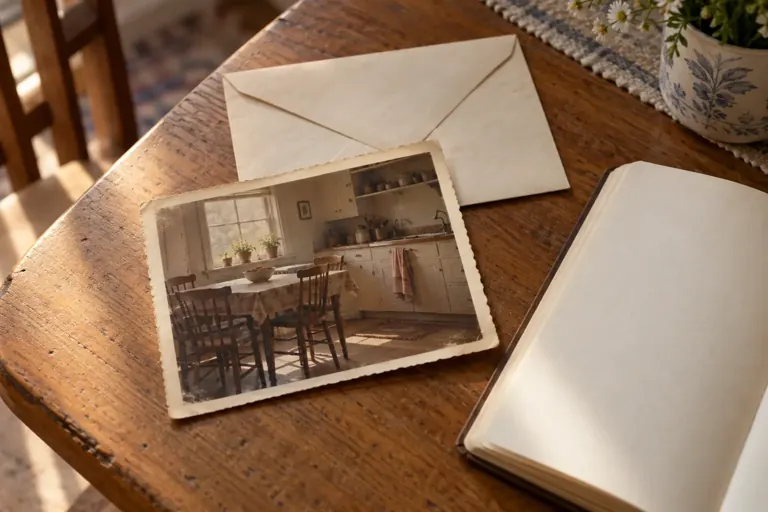
These three actions can follow one another on the same page. Today, you smell bread. It brings to mind an old kitchen. To make the scene flow more smoothly, you then add an open window, though you’re not sure it was there. The problem isn’t the addition itself; it’s only presenting it as a detail you certainly remembered.
So keep three phrases at hand: “today, I smell…,” “it reminds me of…,” and “to tell this scene, I imagine….” The first describes your experience in the moment. The second signals a personal association. The third makes room for creativity explicitly. You can mix them, as long as you know what you’re doing.
| In the page | Made-up example | What the sentence lets you say |
|---|---|---|
| Present sensation | This smell seems sweet to me, then a little smoky. | What the narrator perceives now. |
| Personal memory | It reminds me of returning to a kitchen on a cold evening. | An association, with no guarantee of date or accuracy. |
| Uncertain detail | I think the coat was draped over a chair. | An image whose status remains open. |
| Acknowledged invention | In my written version, the chair becomes red. | A narrative choice, not a historical discovery. |
This distinction keeps you from asking too much of your journal. A vivid impression doesn’t mean you have to know every fact about a scene. If you want to tell a family story, you can look up a date separately in a letter or photo. Our page on facts and interpretations in a journal offers another way to keep these columns separate.
What does research say about smells and memories?
In a comparative study published in 2002, Rachel Herz and Jonathan Schooler studied the emotional qualities of memories prompted by olfactory, visual, and verbal cues. In that study, memories associated with smells were described as more emotional. This finding concerns how participants experienced recalling them; it doesn’t show that the memories were more accurate. The distinction matters for your writing: an emotional scene can remain partly uncertain.
The review by Saive, Royet, and Plailly, published in 2014, distinguishes several approaches to olfactory memory: recognizing a smell, associating it with an event, or recalling an autobiographical episode. These tasks aren’t interchangeable. Writing a page at home doesn’t replicate their protocol or an assessment of memory. You can keep in mind the variety of associations without attributing universal power to a scent.
A 2016 review by Rachel Herz also examines research on memories prompted by smells and their possible links to emotions. It discusses individual differences and conditions of use. It does not validate our workshop as a treatment. The goal here remains literary and personal: to find words, build a scene, and choose what you want to do with it.
For a complementary perspective, watch this video from RMIT University.
Quiz
Smell, memory, or certainty?
A deeply moving scene is necessarily accurate in every detail.
See the answer
No, I can hold on to the emotion and acknowledge what I’m unsure about. A vivid impression is no substitute for historical verification.
Do I need to identify the exact name of a perfume to write?
See the answer
No, a personal comparison or a simple word may be enough. The journal describes your starting point; it does not provide an identification result.
Can I start with a word without looking for an actual smell?
See the answer
Yes, by making clear that I’m recalling or imagining the scene. You can write from a recollection and make that choice clear.
What starting point can I choose without turning it into a whole experiment?
Start with something already part of your everyday life: preparing food, clean laundry, the wood of a piece of furniture, or a word you came across in a book. You don’t need to buy anything to build a collection. Don’t search for an unfamiliar smell in a cleaning product or an unlabeled bottle. The purpose of the page is to describe, not to deliberately expose yourself to a smell.
You can also write without a smell being present. Write “recalled smell: orange” or “imagined scene: entering a bakery.” This small note is enough to guide the reader. It keeps a mental image from being mistaken for a present-day observation. If you’d rather use another sense, the personal audio journal opens a path through voice and sounds.
Choose one starting point for this page. If several scenes come to mind, write their titles in the margin and return to the first one. You don’t have to decide which one is the most profound. A modest detail, like the sound of a spoon paired with a kitchen smell, often gives you more to write about than a general statement about your entire childhood.
 Read alsoScripting: Write your dream life to clarify what you want
How can I fill out the six prompts in my scent journal?
1. Name the starting point
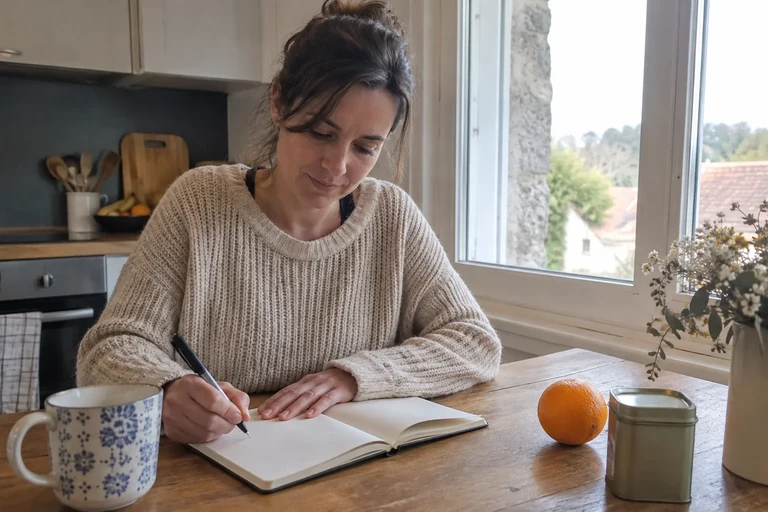
Write a few words about the situation at hand: “making a drink,” “opening a box,” or “reading the word vanilla.” Indicate whether the smell is present, evoked, or imagined. You don’t need to rate its intensity on a scale. What matters is being able to remember later why this page began.
2. Describe before explaining
Look for two or three words that match your impression. A concrete comparison can help: dry as paper, round like a ripe fruit, smoky like fabric near a fire. These comparisons are personal. They don’t prove what a product contains or what someone else should perceive.
3. Set the scene
Note the place or moment that comes to mind, even if it’s vague. “A hallway, maybe during a vacation” is more faithful than adding a date to fill in the page. You can also write “no place comes to mind.” This answer leaves your writing open; it doesn’t signal a memory failure or a lack of imagination.
4. Find an action
Ask yourself what someone is doing in this scene: setting down a bag, folding a sleeve, turning a page. An action helps you move from the label “pleasant smell” to a story. The guide to write a scene without dialogue offers more pointers for moving a piece of writing forward through actions and objects.
5. Make room for uncertainty
Add a sentence about what you don’t know: the season, someone’s identity, or the color of a room. You can leave this section blank, but it deserves to be there. If you later turn the text into fiction, choose the details you add deliberately. The writing exercise with a constraint can help you explore that other version.
6. Choose an ending
End with what you want to keep: an expression, an object to draw, or a question to leave for later. You don’t have to draw a lesson from the scene. A final descriptive sentence may be enough. To make the format even shorter, you can keep a single sentence in your journal, with the starting point and one chosen detail.
Your workshop
Bring together six lines in your own words
Each answer is optional. Blank sections remain marked as blank; no memory is filled in automatically.
My page to reread
Nothing is sent or saved automatically. Copying requires an action from you; reloading the page clears the fields.
Create the page on paper
- The starting point: present, evoked, or imagined
- My sensory words
- The place or moment that comes to mind
- An action in the scene
- What I don’t know or what I imagine
- What I choose to keep
Write one sentence for each section. You can leave a line blank, distinguish facts from invention, or stop. There’s no score or psychological result.
The workshop preserves your wording, including when you’re unsure. It doesn’t try to automatically produce a more dramatic memory. Review the output before copying it to the medium of your choice. You can replace people’s or places’ names if you want to work on a scene without keeping that information in the text.
What words can I use when a smell seems indescribable?
You don’t have to find the technical adjective. Start with a contrast that genuinely helps you: light or dense, near or far, familiar or unexpected. Then replace one of the words with a personal image. “Dense like the kitchen entrance after a meal” already tells a story about a context without claiming to identify molecules.
The following cards are writing prompts. Their associations are neither a ranking of scents nor a mandatory match between a smell and an emotion. The same evocation may feel welcoming to you, neutral to someone else, or bring no scene to mind at all.
Flip cards
Comparisons to try
MaterialFlip
Do the words paper, wood, fabric, or fruit help you? You can write “none of these words.”
DistanceFlip
Does the sensation seem close, diffuse, or hard to place? Describe your impression without assigning it a measurement.
MovementFlip
What happens in the scene: a door opens, a cup is set down, someone leaves again?
ContrastFlip
Which detail doesn’t fit the general idea: a cold room with a kitchen smell, a new object connected to an old scene?
If nothing comes to mind, write about the surroundings right now or choose a different starting point. You can keep a page titled “a word I can’t describe yet.” To work directly with the memory rather than its sensory entry point, the guide for writing about a specific memory offers a way to define the boundaries of an event.
How can I reread without correcting who I used to be?
First, reread your text to understand it for yourself. Underline what describes a sensation, then what tells a scene. You can leave any uncertainty as it is. You can add a dated note when you reread it in the future: “today, I’d tell it differently.” The two versions don’t have to cancel each other out.
If you’d like to give the page a visual form, add a color or a small drawing. The creative journal with collage offers another medium for bringing materials and words together. You can photograph an object, but its image doesn’t have to become proof of the whole story. A recipe and memory journal can also hold a scene connected to cooking.
The text is yours. Decide separately whether you want to share it, with whom, and in what form. The guide for protect your journal’s privacy helps you think about the format and access. If a scene becomes distressing, you can close the notebook, switch to a neutral description, or stop. There’s no creative benefit to forcing yourself to continue.
Checklist
Before you keep this page
0 / 5
You’ve reviewed your choices. This list doesn’t verify the truth of a memory or measure any psychological state.
What small action can I choose after writing?
You can simply close the notebook. If you’d like to continue the page, choose a concrete action that’s up to you: write down a question for someone close to you, draw the object, or set aside a page for another version. These are writing possibilities; there’s no obligation to act or to feel a particular emotion.
Miraya can support you in choosing an intention and a small step. The app is not a scent journal and cannot authenticate your memories. This feature highlights existing tools to help you prepare an action you choose after this page, if that feels right for you at the moment.

Frequently asked questions
Do I need to smell something to keep a scent journal?
No. You can start with the name of a smell or an imagined scene. Note that choice at the top of the page. The goal is to write an evocation, not to pass a sensory test.
Is it the same as a fragrance journal?
A perfume journal can compare products and how they seem to change over time. Here, the focus of the page is a personal or imagined scene. You can write without buying perfume, using specialized vocabulary, or trying to rank anything.
Why doesn’t the same scent bring back a memory for the people around me?
Associations depend, among other things, on each person’s history and context. Your evocation doesn’t have to become a rule for others. If you discuss the page with someone, invite them to describe it freely rather than asking them to confirm your own account.
Does a vivid emotion mean my memory is reliable?
It doesn’t verify every detail of the scene. Keep phrases like “I think,” “this reminds me of,” or “I can’t remember.” If a date or fact needs to be established, look for a source separate from the feelings described in the journal.
Can I write if no memory comes to mind?
Yes. Describe the object, room, or word that served as your starting point. You can also invent a scene and say that it’s invented. Not making an association doesn’t call for any interpretation of your memory or personality.
Does the exercise save my answers?
The fields are neither sent nor saved automatically. The copy button works only when you choose to use it; you then decide where to paste the text. Reloading the page clears the fields. Your browser and the place where you paste the text may have their own retention features.
Sources
- Herz, R. S., and Schooler, J. W. (2002). Comparative study of autobiographical memories evoked by olfactory and visual cues. DOI: 10.2307/1423672.
- Saive, A.-L., Royet, J.-P., and Plailly, J. (2014). Review of the neural bases of episodic memory for odors and the different approaches to studying it. DOI: 10.3389/fnbeh.2014.00240.
- Herz, R. S. (2016). Review of odor-evoked memories, emotions, and their limits in application. DOI: 10.3390/brainsci6030022.
- CNRS. How smell unlocks memory | RMIT University · RMIT University. Audiovisual content distinct from our creative exercise.