Contents
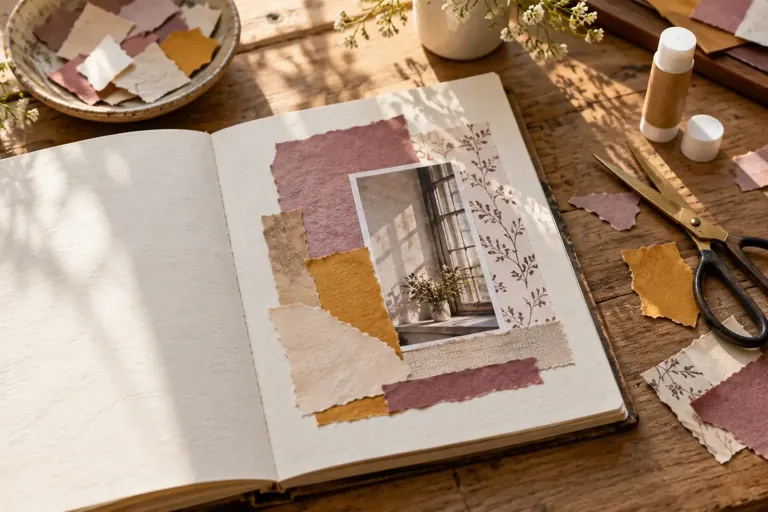
To start a creative collage journal, choose one page, three pieces of paper, and a focused subject. Arrange the elements before gluing them down, then add a few words that explain your choice. You don’t need to know how to draw or fill the whole space. Collage can simply give shape to a detail from your day, a color, or a question.
The value of this sketchbook lies in combining different kinds of traces. A texture can sit alongside a phrase, a small drawing, or a personal photograph. The result doesn’t have to look like a magazine page. You can look for an arrangement that brings something to mind, even if its meaning isn’t immediately clear to someone else.
Gather a limited set of materials
Choose a sketchbook with pages that can handle a few layers, glue suitable for paper, and a pair of scissors. Recycled paper is enough: envelopes, clean packaging, colored scraps, or copies of your own images. Avoid documents that contain private information. An old letter may seem interesting for its color while still showing an address. Collaged images and papers can reveal private information: also think about your journal’s privacy. To make your own graphic textures, you can explore the texture-rubbing sketchbook on suitable surfaces.
Test the glue on a small scrap before using it in your sketchbook. Some papers wrinkle or let the adhesive show through. A thin layer and drying the page flat can limit surprises, but the results depend on the material. If you want to preserve an original photograph, use a copy instead and keep the original separate.
Choose a small selection of materials for the session. Too many papers can shift all your attention to choosing. An envelope with a few colors and textures makes it easier to get started. You can add to your materials later, once you know which elements you really need in your compositions.
Find a subject that fits on one page
A concrete subject helps you choose: a commute, a room, a meal, a wait, or a color you noticed. “My whole life” asks too much of a first page. “The light in the kitchen this morning” already suggests shapes, contrasts, and a few words. The subject can be ordinary without making the collage insignificant.
Write down three words before looking for papers. For a windy walk, you might choose “lines,” “movement,” and “gray.” These words aren’t rules you have to follow to the end. They simply give you a direction if you’re unsure what to do with your materials. You can replace them along the way if another detail becomes more interesting.
If you start with an image you found, keep its source in your idea notebook. If you plan to share a page, also check the terms for reusing that image. A photograph available on the Internet isn’t automatically free to publish in a personal composition.
Arrange before you commit
Place the largest element first. It can serve as a background or an anchor. Then add a smaller element and see what happens between the two: a repeated color, a difference in texture, an aligned or offset edge. The open space contributes to the page as much as the papers you’ve glued down. When the table also serves other purposes, you can set up a portable writing nook in a small space.
Try two layouts before choosing. You can photograph the first one so you won’t be afraid of losing it. In the second, change just one element: its placement, orientation, or size. This simple comparison helps you see what you prefer without looking for a universal rule of composition.
Once the arrangement feels right enough, glue the pieces down gradually. Start with the elements that go underneath the others. If you make a mistake, notice what’s still possible: move another piece of paper, add a margin, keep the offset. You can also stop the page here. Your journal can hold your experiments and accidents, not just the compositions you consider successful.
Flip cards
Three ways to get unstuck on a page
Everything feels too crowdedFlip
Remove one element and see if the subject becomes clearer.
The papers don’t feel connectedFlip
Repeat a color or add a small line that crosses two areas.
I’m torn between two versionsFlip
Keep a photo of each layout and choose the one that better captures your starting point.
 Read alsoSolo creative date: choose a real break
Add words that bring something more
Words can set the scene for a page or give it tension. Instead of writing “a window” under a picture of a window, note what the image doesn’t show: “I was waiting for the rain to stop.” A short sentence can connect elements that seemed separate. It doesn’t have to explain the whole composition.
You can write by hand, glue on a cutout word, or add a small caption on the back of a flap. If you use words that are already printed, check that they don’t say something other than what you want. A catchy slogan can give the page a tone you didn’t choose.
Date the collage in a corner or on the next page. You might also add a note about the process: what you removed, which paper you want to reuse, a technique to try. These observations may come in handy during a future session, without turning your journal into an evaluation workbook.
An example inspired by a rainy day
Imagine a page made up of torn gray paper, a yellow rectangle, and a small photo of your entryway. The gray recalls the sky, the yellow the light of a lamp, and the photo places you at home. A sentence like “the shoes stayed by the door” adds a lived detail instead of a general comment about the weather.
You could make another version with the same materials: yellow fills almost the whole page, gray becomes a narrow strip, and the photo disappears. The focus then shifts to the light indoors. Neither version is automatically better. Comparing them helps you figure out what you want to keep from that day.
This fictional example shows how collage can be a way of choosing. You don’t represent every event; you choose an angle. The same freedom exists in the journalwhere a few lines can be enough to preserve a scene.
Keep the sketchbook going without overloading it
Let some pages be simpler than others. A strip of paper and a sentence can make a complete entry. If every session requires a complex composition, you may put off opening your journal until the perfect moment. Keep a simple version for days when you have little time or few supplies.
Also plan for the physical space your collages will take up. Very thick elements can keep your journal from closing. You can spread them across pages, use separate supports, or choose a journal designed to hold additions. Avoid forcing the binding: the journal’s format should suit what you keep in it.
Finally, decide freely whether or not to share your pages. Creating a journal doesn’t mean you have to photograph it to post it. If you’re just starting, you can keep your practice private for a while. The guide on confidence in a new activity suggests separating exploration from the search for approval.
Frequently asked questions
Does my collage need to have a specific meaning?
No. You can start with a choice of colors or textures. A phrase added later may reveal a connection, but you can also keep the page as a visual exploration.
Can I use only reclaimed paper?
Yes. Choose materials that are clean, dry, and suitable for your journal. Check any printed information before gluing it in, and keep separate any documents you don’t want to alter.
What if I don’t like the finished page?
Let it rest before you decide. You can note what you would change, create a second version, or turn the page. A sketchbook doesn’t need to erase every hesitation.