Contents
- Writing nook: think in terms of a function, not a room
- What a prepared environment can change
- Set up your writing nook with what you have
- Share the space without having to negotiate every sentence
- Three setups that don’t require a desk
- Don’t let setting things up replace writing
- Adjust the space when your needs change
- Frequently asked questions
- Sources
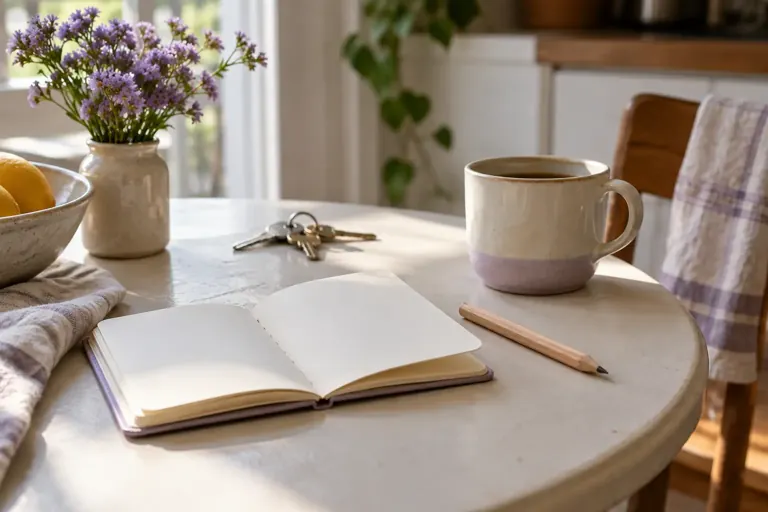
A writing nook can be portable, shared, and put away after each session: you don’t need a room of your own to keep a journal. A usable surface, an accessible tool, and a way to close up your pages are enough to create a space that fits your daily life.
The goal isn’t to create a miniature office setup. It’s to remove practical obstacles when it’s time to write, while respecting the other uses of your home and the privacy of what you write down.
To check these choices with your own inputs, use Writing Goal Planner: Your Exact Daily Schedule. The method and limits stay visible, and the worksheet exports without an account.
Writing nook: think in terms of a function, not a room
Start with what actually happens. Do you write a few lines at the kitchen table, work on a longer piece on your computer, or take notes while you’re out? The answer changes what you need. A daily journal can fit in a pouch, while a long session calls for more comfort and space. Avoid choosing your setup based on a photo that shows neither storage nor a shared living space.
The guide to keep a personal journal helps you choose a purpose. Here, the question is practical: can you get started without searching for your supplies in several places? You don’t have to dedicate a surface permanently. A writing nook can exist for twenty minutes, then become a shared table again.
| Use | Possible setup | What to check |
|---|---|---|
| A few lines | Pouch placed on a table | Quick access to your journal |
| Creative project | Session box | Visible note to help you pick up where you left off |
| Writing on the go | Small kit | Household rules and privacy |
What a prepared environment can change
Research on habits, including work by Lally and colleagues, looks at how behaviors are repeated in a stable context. It does not show that a particular desk makes you more creative or that a pretty journal improves your writing. You can simply test whether supplies that are easy to find make it easier to get started.
The five-minute small step is a good trial: take out your supplies, write a few lines, then put everything away. Notice what you actually needed. This hands-on experience is more useful than a shopping list made before you’ve tried writing in the space you have. You can tell whether it’s comfortable by using it, not just by looking at it.
Quiz
Check your understanding
Do you need a separate room?
See the answer
No, a temporary setup may be enough. Choose a surface that suits the activity you actually do.
Does a pretty desk guarantee creativity?
See the answer
No, you can test comfort by using it. You don’t have to buy anything to do this.
Set up your writing nook with what you have
Choose the most practical surface
Find a surface stable enough for the activity you’ve chosen and a seat that works for you. Try different positions without forcing yourself to stay in an uncomfortable posture. If you feel pain, adjust or stop the session; decorating advice is no substitute for guidance tailored to a persistent issue. You can also shorten your writing time and change positions.
The light should let you read without unnecessary strain. Move what you already have before considering a purchase. A window may work at certain times, and an existing lamp at others. Also check for glare if you use a screen. The best spot in the morning may not be the most pleasant in the evening.
Put together a minimal kit
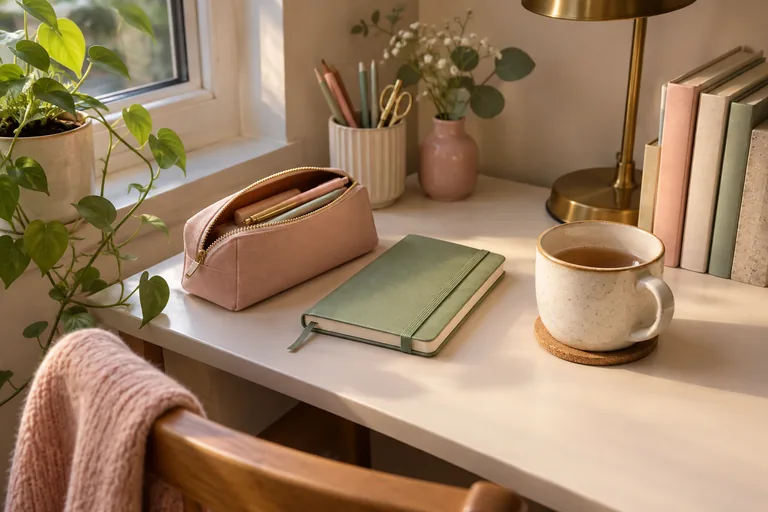
Choose a notebook or a few sheets of paper, a working writing tool, and a container you already have. A sturdy envelope, pouch, or box may be enough. Add only what you actually use: glasses, a bookmark, or a small stand. Optional accessories can stay elsewhere so taking out the kit doesn’t become a complicated task.
If you keep several notebooks, the idea sorting can save you from carrying your whole collection. Keep the one that suits your current purpose in the kit. A reading journal doesn’t need to come along to every journaling session, and a creative project can have its own container.
Plan how to put it away
Think about where the pages go after your session. A temporary nook works better when putting it away is as simple as setting it up. You could use an elastic band, a pouch, or a closed file with suitable protections for your device. Don’t accidentally leave a private page visible on a shared surface.
Privacy sometimes calls for an explicit conversation: “This journal is personal, and I don’t want anyone to read it.” Making this request alone doesn’t guarantee protection in every situation. If you don’t trust your surroundings, choose less sensitive content, a different medium, or another place. Your writing should be compatible with your safety.
Flip cards
Choose a starting point
Set upFlip
Choose a usable surface and a seat that’s comfortable for you.
GatherFlip
Keep your journal and a working writing tool together.
Put awayFlip
Decide where to put your personal pages after each session.
 Read alsoNew moon ritual: set your intentions for the month
Share the space without having to negotiate every sentence
If a table is used a lot, agree on a realistic time slot with the people involved. A specific request is easier to understand than a general need for “quiet.” You can suggest using the space briefly and then putting everything away. The guide to setting a boundary can help you express this need without turning the discussion into a defense of the value of your activity.
It may also be easier to choose a time when the surface is already free. Observe how the household actually moves through the day: meals, remote work, people heading out. You’re looking for a workable arrangement, not exclusive rights to the room. A portable setup lets you change locations when the day calls for it.
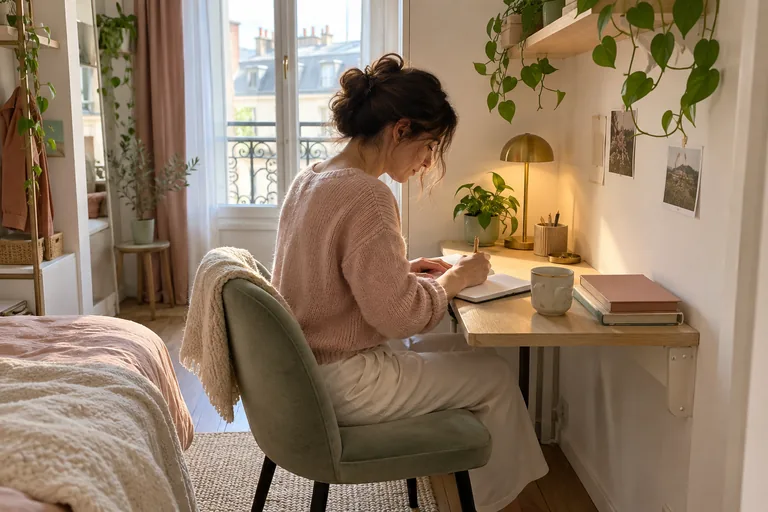
Three setups that don’t require a desk
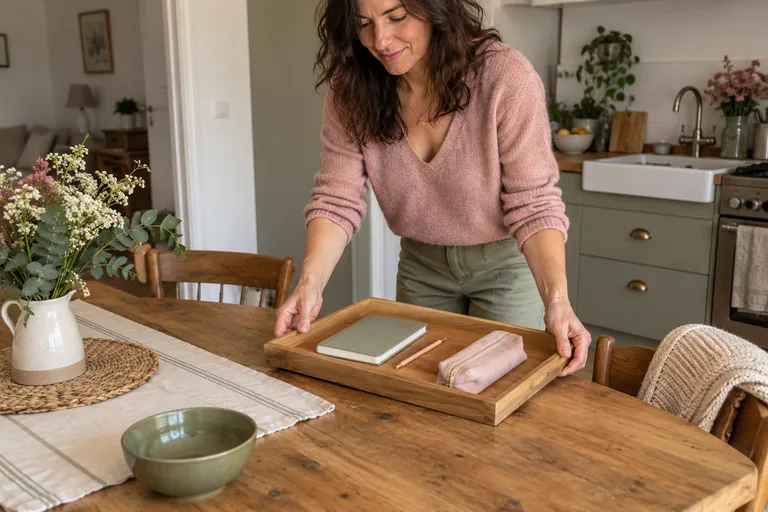
For a short writing session, you can set a pouch with your notebook and a pen beside a spot you use regularly. Write one sentence, then put it away. The one-sentence-a-day journal works well for this format, even if you don’t write every day. The setup should suit the size of your practice.
For a project, a box can hold the notes and materials for the current session. The creative project journal holds the next action, so you don’t have to spread everything out to find your place. At the end, leave a clear note about where to pick up again. The box doesn’t need to be perfectly organized to stay useful.
For an outing, take only what you need. A solo creative session can take place somewhere accessible where writing is allowed. Respect the rules, hours, and people around you. A café or library doesn’t guarantee that a screen or page will be private.
Generator
A wording to adapt
Choose a usable surface and a seat that’s comfortable for you.
See all the phrases
Starting point
- Choose a usable surface and a seat that’s comfortable for you.
- Keep your journal and a working writing tool together.
Adapt
- Decide where to put your personal pages after each session.
- I can keep what works for me and remove the rest.
Don’t let setting things up replace writing
If you spend several sessions looking for the perfect container, return to the initial test. Write using the temporary setup and note one specific inconvenience. Maybe the pen doesn’t work, the surface is occupied, or the pages slide around. Fix that issue before adding decorative items.
The creation through observation reminds you that a project can begin away from your desk. Your writing nook is for gathering, developing, or rereading; it doesn’t have to hold your entire creative life. You can keep an idea with you while you’re out and return to it in your temporary setup.
Adjust the space when your needs change
After a few sessions, remove what you never touch and move closer what you look for every time. A nonjudgmental review can be limited to these two observations. You don’t have to conclude that you lack discipline because a setup didn’t fit your schedule.
Your nook can also disappear for a while. You can pick up your journal again after a break with a different setup. Continuing to write doesn’t depend on keeping a particular setting in place. It can mean using a modest kit, a temporary spot, and the freedom to start again without rebuilding everything.
Checklist
Keep only what works for you
0 / 4
You’ve set your reference points. You can adapt or stop this practice.
Personal workshop
Set up your version: writing nook
Answer the three prompts below, or use them aloud. This workshop works without JavaScript. This workshop does not offer a save feature. Copy anything you want to keep into your journal, and avoid entering sensitive information on a shared device.
How do you finish this workshop?
Review your answers and keep only a next step that seems doable to you. You can also decide not to pursue anything today. This decision creates neither a score nor a commitment.
For a complementary perspective, watch this video from K.A. Emmons.
Frequently asked questions
How can I create a writing nook without a desk?
Use an available surface with a small portable kit. Plan where to store it so the space can serve its other purposes.
What supplies do I need to buy?
You don’t need to buy anything to get started. Try a journal or some sheets of paper and a tool you already have before deciding what’s missing.
Where should I store a personal journal?
Choose storage that suits the level of privacy you need. A shared surface doesn’t protect a page left open.
How can I write in a small shared home?
Suggest a time slot and a limited activity. A setup you can put away may be more realistic than a space reserved all the time.
Can I write away from home?
Yes, in an accessible place where it’s allowed. Keep the venue’s rules in mind, as well as whether your pages will be visible.
What should I do if the setup no longer works for me?
Notice what specifically feels uncomfortable and change one thing. The space can evolve with how you use it, without your having to start all over.
Sources
- Lally, P., van Jaarsveld, C. H. M., Potts, H. W. W., and Wardle, J. (2010). How are habits formed: Modelling habit formation in the real world. European Journal of Social Psychology. DOI verified.