Contents
- Choose a simple, accessible route
- Choose just one lens to start
- Observe before naming things too quickly
- Save a few traces, with enough context
- Turn your observations into something when you get back
- An example focused on thresholds
- Revisit the same route with a different question
- Frequently asked questions
A creative walk means choosing a lens for observing as you travel, then saving a few traces when you get back. You can look at thresholds, shadows, colors, or how people use a place. The goal isn’t to find a brilliant idea on every outing, but to notice details that your usual route sometimes leaves in the background. When you stop in a safe place, you can extend the walk with a page of sound journal. To explore a curiosity that arose elsewhere, the travel reflection journal helps you find a realistic local version of the discovery. To explore a detail from the walk, try an observation haiku while keeping a record of the place and moment. A detail from the walk can then become a short observational drawing exercise. To make room for a moment away from screens, you can choose ten minutes without a screen, your way.
The route can take ten minutes and stay close to home. You can also adapt the exercise to a seated trip, a window, or an accessible indoor space. What matters is the attention you choose to give and how you translate it into words, images, or questions afterward.
Choose a simple, accessible route
Choose a route you can take comfortably, with the usual access and precautions. Avoid planning a complicated outing just for the exercise. A familiar path lets you pay more attention to details because you don’t have to keep figuring out where to go.
Set a duration or a point to return to. This limit keeps the walk compatible with your day. It can also help you choose instead of taking more and more detours. If the place is crowded or uncomfortable to stop in, observe as you move, then take notes later from a suitable spot.
You can stay indoors: a media library, an authorized gallery, a public lobby, or a familiar room. Respect the venue’s rules and the people there. An observation walk doesn’t give you permission to enter a private space or photograph everything that catches your interest.
Choose just one lens to start
A narrow focus makes observation more concrete. Look for passages between two spaces, objects left near doorways, vertical lines, or signs of repeated use. You don’t need to find every possible example. Three details may be enough to build a small series.
Avoid choosing a theme that’s too abstract, such as “beauty,” if you don’t know what to look for. You can turn it into a question: What catches my eye in this street’s colors? What materials have changed with use? The question stays open, but gives you a way to observe.
If you’d rather follow living things and the changes they go through, the nature journal offers another framework. Here, you can focus on a creative reading of places without trying to identify species or make comparable naturalist observations.
Observe before naming things too quickly
Pause on a detail and describe its shape, place, or movement. “A lighter mark where a poster was removed” is more precise than “an interesting wall.” The general term can come later, but the description preserves what actually made you stop.
You can also observe relationships: a small door in a large wall, a plant spilling over a fence, a new object placed on a worn surface. These contrasts offer material to work with without requiring you to immediately assign them a symbol or a story.
When you imagine an explanation, distinguish it from what you observed. You can write “this makes me think of…” or “I imagine that…”. A creative journal welcomes invention, but it’s still useful to know when you move from the real place to a personal interpretation.
Generator
A perspective to try
Notice three lines that cross, continue, or come to an end along your route.
See all the phrases
Lines
- Notice three lines that cross, continue, or come to an end along your route.
Thresholds
- Notice what changes between two spaces: light, material, noise, or movement.
Traces
- Look for a sign of use without immediately inventing the story of the person who left it.
Colors
- Choose a color and notice the different forms in which it appears.
Rhythms
- Notice a repetition: windows, footsteps, poles, sounds, or intervals.
 Read alsoNew moon ritual: set your intentions for the month
Save a few traces, with enough context
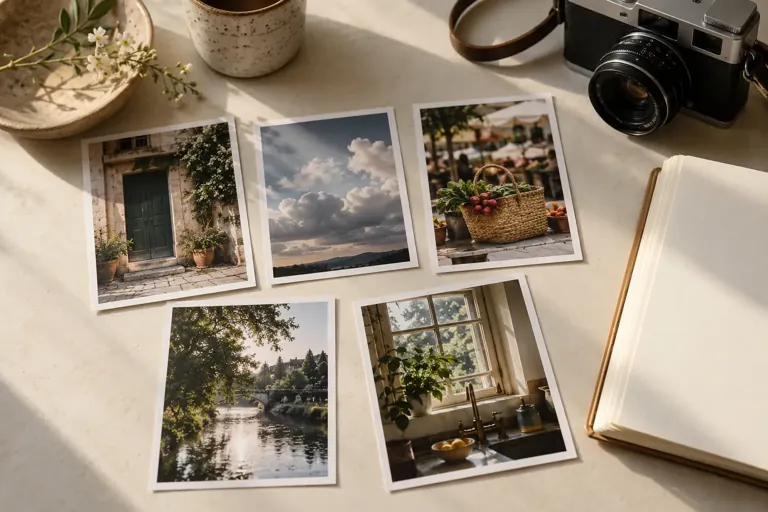
You can jot down words, sketch, or take a photograph when appropriate. Add the location and what caught your attention. An image without a caption can be hard to understand if the important detail is small or outside the frame.
Don’t try to capture everything. Choose three different traces: a detail, a relationship, and a question. This selection leaves room for the walk itself. If you spend the whole outing behind a screen, you can decide to keep your phone tucked away and take notes only when you get back.
The photographic journal offers a way to pair images with captions. Think about the information visible in the frame and the people who can be recognized before sharing an image. A private record and a public post call for different choices.
Turn your observations into something when you get back
Choose one trace and give it a concise form. You could write five lines, sketch a composition, create a color palette, or pose a project question. The goal isn’t to produce a finished work after every walk. It’s to see what the detail becomes when you move it onto the page.
Try two different transformations of the same element. A shadow could become a description, then an abstract cutout. A rhythm of windows could inspire the layout of a notebook. Note what comes from the place and what you add. This distinction preserves the source of the reference and makes room for your own invention.
The workshops by François Bon offered by the BnF on writing about the city show another way to draw on places and shapes as starting points for writing. You can consult these ideas as starting points for your work, then choose an exercise suited to your own route.
An example focused on thresholds
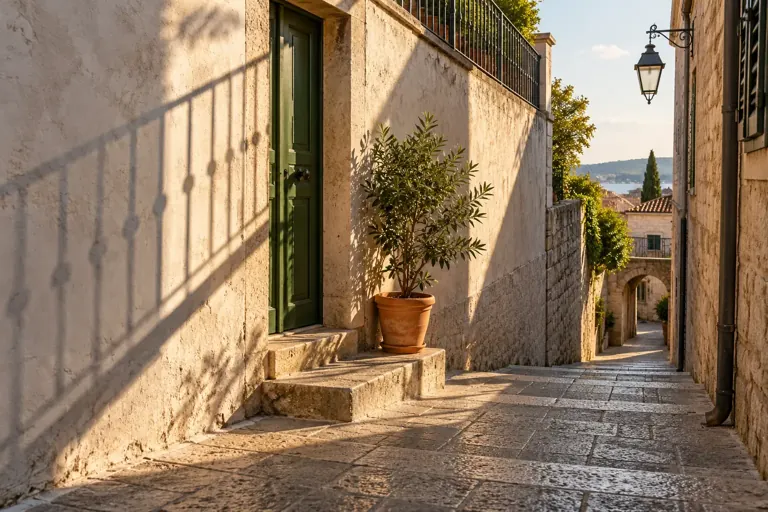
Imagine a route where you notice a half-open door, a change in the tiling, and a strip of sunlight at the entrance to a courtyard. For each detail, note what changes from one side to the other: sound, light, texture, or visibility. The three observations share a perspective without telling the same story.
When you get back, you could write a short scene that begins as you cross a threshold. You could also arrange three colored rectangles or draw a map of the route’s transitions. Observation becomes a store of forms, not an instruction to reproduce the place exactly.
This fictional example shows that an idea can come after the outing. You don’t need to force it during the walk. Traces that don’t lead to a project can stay in your notebook or be set aside. They don’t have to justify the time you spent outside.
A a journal entry about a tree revisited in the same place can extend this route: keep the date and the visible detail, without automatically attributing a change to the season.
Revisit the same route with a different question
A repeated route can offer new details when you change your angle or the time of day. You can observe the shadows one day, the sounds another, and how a bench is used on another occasion. Note the conditions so you don’t mistake a difference in perspective for a definite transformation of the place.
You can also return to the same angle and compare what has changed. Be careful with your conclusions: a shop that’s closed during one visit isn’t necessarily closed for good, and an empty place isn’t always deserted. Your journal benefits from keeping the limits of your observations in view.
Creative ideas that emerge can become part of your idea notebook. Give them a title and a possible purpose, then decide later whether you want to try them out. This lets the walk remain open-ended while giving your projects a separate place to develop.
You can extend a familiar image in a journal of scents and memories, or write from a word without looking for a real scent.
Frequently asked questions
Do I have to walk alone?
No. If you go with others, you can choose the same lens and then compare what each person noticed. Avoid turning your observations into a competition or looking for a single right way to read the place.
What if I don’t notice anything?
Narrow your focus: a color, a door, a sound. You can also come back without noticing anything in particular. The exercise doesn’t guarantee a discovery on every outing.
Can I adapt the exercise without going outside?
Yes. A window, a room, or an accessible indoor route can offer details to notice. Adapt the duration and way of observing to what’s actually possible for you.