Contents
- What kind of place should you choose to start a nature journal?
- What should you note to separate observation from hypothesis?
- How can you observe if you don’t know how to draw?
- How can you compare two visits without jumping to conclusions?
- How can you keep a record without disturbing wildlife?
- How can you turn an observation into a poem without rewriting the facts?
- Add the viewing conditions to your observation
- Frequently asked questions
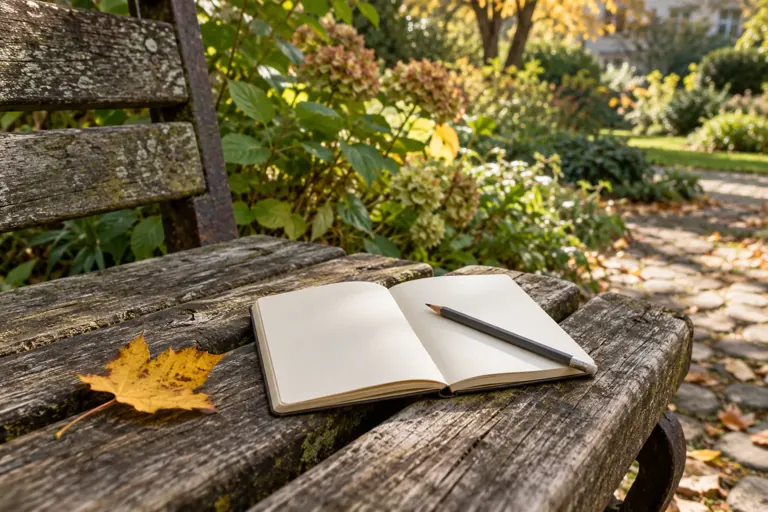
A nature observation journal lets you keep a record tied to a specific place, even without naming every species. For example, write “a yellow leaf on the branch in front of the bench” rather than “the tree is turning yellow.” The first sentence describes what you see; the second extends a conclusion to things you may not have observed.
You don’t need to explore a spectacular place. A balcony or a small park can raise plenty of questions. The key is to distinguish what you observe, what you assume, and what you’ll check later. This distinction makes the journal interesting to reread and keeps a first impression from becoming a certainty.
A field journal preserves an observation made outdoors. The dream journal upon waking keeps an incomplete inner memory: separating these two formats helps you avoid presenting a dream scene as an observed fact.
What kind of place should you choose to start a nature journal?
Choose a place you can return to without much planning. Make sure access is allowed and that you can stop without blocking the way. A nearby place has a practical advantage: you can visit at different times without waiting for a special outing. Note a stable landmark so you can find roughly the same observation spot again. To observe what changes in a familiar place, you can return to a familiar place and observe how it changes.
Narrow your focus. Observing “all of nature” is too broad for a first page. Instead, choose the shape of a tree, the plants on a low wall, or the traces visible on a path. You can devote several pages to the same subject. Returning to the same place doesn’t mean repeating the same text: your questions can change with each visit.
Bring a journal, a pencil, and, if you like, a camera. A firm backing can be useful when you’re standing. Choose supplies suited to the outing’s length and conditions. Don’t carry accessories you’re not using yet: you’ll gradually discover what’s actually missing from your way of observing.
What should you note to separate observation from hypothesis?
An observation describes what was visible during your visit. A hypothesis proposes an explanation that still needs to be checked. This table gives an example of how to phrase each for your pages.
| Notebook entry | What it allows you to say | What remains a question |
|---|---|---|
| A bird landed on the railing | A moment seen during the visit | Its species and the reason it was there |
| Yellow leaves on a branch | A color within the area you looked at | The color of the entire canopy |
| No birds spotted that day | Nothing seen from this spot during the visit | Whether it is present at another time |
To follow the same subject instead of adding more locations, start a tree journal through the seasons : each visit keeps its date, its detail, and its uncertainties.
Start each entry with the date, approximate time, and location. Add a few simple conditions: overcast skies, recent rain, noticeable wind, a shaded area. These details provide context for the differences you notice later. They do not prove what caused a change; they simply help you describe the circumstances more clearly.
The Muséum national d’Histoire naturelle also recommends dating and locating observations in its educational notebook. You can adapt this approach to an adult practice: a short page, consistent reference points, and room for what you cannot name yet. To work with textures without touching a fragile surface, our guide to creative rubbing also shows you how to make your own textures.
Then write an observable description. “Three small birds landed on the railing” remains true even if you do not know their species. “They came looking for food” is an interpretation to check. To help, use two columns: “observed” and “question.” You do not have to fill in the second one on every visit.
How can you observe if you don’t know how to draw?
A sketch can isolate what you want to understand. Trace the general outline of a leaf, then use an arrow to point to a serrated edge or a vein. If the drawing is approximate, add words to clarify it. A note such as “underside lighter” provides information your pencil does not need to reproduce perfectly.
Keep a relative scale when it helps: smaller than a coin, about as wide as the notebook, three times longer than it is wide. If you take a precise measurement, note how you got it. Otherwise, use “about.” An observation notebook benefits from showing its uncertainties instead of displaying figures more precise than the measurement itself. A precise observation can inspire a first haiku in English, with attention to detail rather than an added moral.
You can also draw a silhouette or a sequence of positions. For a moving animal, a few strokes made from a distance are better than chasing it to get a clear image. The notebook should adapt to the observation, not force the animal or the place into a scene that is convenient for your drawing.
Flip cards
Look at a detail differently
ShapeFlip
What parts can you make out? What outline can you describe without knowing its name?
PositionFlip
Where is the subject in relation to the ground, the light, or the other elements?
MovementFlip
What did you actually see move, and for about how long?
UncertaintyFlip
What information are you missing to go further?
 Read alsoSeasonal journal: adapt your wishes to daily life
How can you compare two visits without jumping to conclusions?
Compare only what your two visits make comparable. A detail you did not look for, one that was hidden, and one you looked for but did not see are three different situations. This table records that limit before any explanation.
| Situation across two visits | What you can record | Conclusion to avoid |
|---|---|---|
| Same landmark, similar duration and light | Detail seen on both dates, with its limits | The place did not change between visits |
| Subject hidden by leaves | Not verifiable from this spot | The subject has disappeared |
| You looked elsewhere | You did not look for this detail | Nothing changed |
| You looked for the subject but did not see it | Not observed during this time window | Absent from the place at all times |
For a moving subject, the birdwatching journal separates description, a proposed name, and the next check. Its downloadable note does not turn a visit into a scientific survey.
On your next visit, reread only the landmarks from the previous one. Look for what seems unchanged before noting anything new. A photo taken from a nearby spot can help, but differences in light or framing can change the impression. Describe these limits if you compare two images.
If you no longer see an animal you spotted before, write “not observed during this visit.” That is not the same as “gone.” How long you stay, the time of day, and the conditions can change what you see. Likewise, a single visit isn’t enough to explain why a plant has changed in appearance.
A small table can bring together the dates, approximate duration, and one notable detail. There’s no need to assign a success score to each outing. A page with few new details also documents your visit. Later, you can choose a question to explore: shadows at different times of day, the development of a bud, or how a water source is used.
Generator
A question for your next visit
Which edge or vein could you describe from the same spot?
See all the phrases
Leaves
- Which edge or vein could you describe from the same spot?
- Which part of the branch will actually be visible this time?
Birds
- What movement did you see, without assuming an intention?
- Which detail was missing from your description last time?
Conditions
- Do the framing and light let you compare your two pages?
- Which difference in duration should you note before comparing?
Quiz
What can you compare?
You did not look for a bird on your second visit. Which note is accurate?
See the answer
Subject not looked for this time. An empty field does not explain why the bird was not recorded.
A branch hides the subject. Can you conclude it is absent?
See the answer
The observation point does not let you check. Limited visibility is a limit, not a finding about the whole place.
The two photos have different framing. What should you keep?
See the answer
The difference in framing alongside the comparison. Context helps explain what the images actually let you compare.
Should you fill in missing dates?
See the answer
Restart with the actual date and note the gap. A visit you did not make cannot become an observation afterward.
How can you keep a record without disturbing wildlife?
Observe without disturbing anything, stay on permitted paths, and take your trash with you. Avoid picking or moving anything to compose your page. Don’t handle an unfamiliar plant or animal. A journal isn’t a foraging guide: a tentative identification doesn’t tell you whether a plant or mushroom is edible.
If you photograph a nest, a sensitive species, or a fragile place, think before sharing its precise location. To contribute to a nature survey program, follow its own guidelines rather than improvising your method. The French National Museum of Natural History features, among other resources, INPN Species and sharing observations, with contextual data and validation by specialists.
Your personal journal can remain separate from this contribution. You can mix in an impression from a walk, a memory, or a color while keeping observations intended for sharing clearly separate. If you prefer freer writing, the journaling prompts offer other ways in. To vary your observations without recording the people around you, try a written sound journal using words. To note what catches your eye, you can keep a journal of wonder without requiring any particular emotion.
Checklist
Before closing your journal
0 / 5
Your page can be short: it already contains an observation tied to a place and time.
One simple way to vary your pages is to choose a different focus without changing locations. On one visit, observe colors; on another, shapes on the ground; another time, sounds you can describe. Always note your focus, since it influences what you notice. You won’t have observed less because you weren’t paying attention; you’ll have chosen a particular area to focus on. This detail makes your comparisons more honest and may make you want to return with a new question.
A small sketch of the place can complement the description. Draw a few fixed landmarks, such as a low wall, a bench, or a path, then mark your observation point. It will be easier to find the same framing again without noting an overly precise personal location on a page intended for sharing. If you change your position on another visit, note that move before comparing the visible details.
For a complementary perspective, watch this video from Cornell Lab of Ornithology. This Cornell Lab lesson uses North American birds to explain relative size and shape. It helps you describe an observation; it does not validate your identification.
How can you turn an observation into a poem without rewriting the facts?
Keep the field note intact and write the poem beside it. A poetic image can transform a detail; that does not make it an observation to submit to a nature-recording program.
| What you reread | What stays in the note | What you can move into the creative text |
|---|---|---|
| A branch moved during your visit | The movement you saw, the date and the conditions you recorded | A comparison clearly presented as imagery |
| A color brings back a memory | The color described without explaining its origin | The memory, identified as a personal association |
| You invent a scene after the walk | No later additions presented as observations | The scene in a section marked “fiction” |
To try a short form, the workshop on writing a personal acrostic checks the initials and lets you export your draft. You can choose an ordinary word linked to the place, then keep two columns: “original note” and “poetic transformation.” This separation lets you find what you actually saw before rereading what you made from it.
This table suggests a way to organize your notebook; it is not a scientific protocol. If you share data, return to the factual record and the program’s instructions. Neither rhyme nor a coherent poem validates an identification.
Add the viewing conditions to your observation
A nature journal is easier to reread when the entry keeps the context of the visit. Add the time, the part of the place you visited, and anything that limited your view. You can record rain during your visit without claiming to describe the whole day. This helps explain why two pages may not show the same things.
Separate direct observation from copied information. If a weather service reports a temperature, record its source and reference location. That is not a measurement you took beside the plant. If you only remember feeling cold, keep it as an impression instead of giving it a numerical value.
In a fictional entry, “leaves seen from the path, brief visit after a shower” is more precise than “nature changed today.” The second sentence may belong in a personal reflection, but it states neither place nor duration. A weather journal offers a way to keep these conditions in a separate section.
When rereading, compare viewing points and times first. A missing entry does not mean there was no rain, no bird, or no change. Keep gaps in the sequence and resume without filling them from memory. The notebook remains useful even without being a scientific record: it also shows what you were unable to observe.
Frequently asked questions
Do I need to know the scientific names?
No. You can start with a description and look it up later in a reliable resource. Keep the original note and add the identification separately, along with its source and your degree of certainty.
What if I miss several weeks?
Start again with the actual date and note the gap. Do not invent missing stages. Compare the two visits with their limits, without reconstructing what happened between them.
Can I mix observations with the pleasures of a walk?
Yes. You can use a separate box for a lovely light or a moment you enjoyed. You’ll find this approach in the journal of little pleasures, without confusing an impression with a nature observation.
What should I write in a nature journal on my first outing?
Note the date, the general location, the conditions, and one detail you actually observed. Add a question if an identification or explanation is still uncertain. A few lines are enough; you don’t need to make an inventory of every species.
What if nothing seems to have changed?
Describe what you can compare from the same point. A lack of visible change is still a useful note. Don’t confuse “not observed during the visit” with “absent from the location.”
Do I need a scientific protocol to keep a personal journal?
A free-form journal can remain personal. To share observations with researchers, follow the protocol of the program you choose: species, location, dates, and stages. A photograph or an export alone isn’t enough to make the data comparable.