Contents
- What should you record in a birdwatching journal?
- When should you take notes: during or after the outing?
- What equipment can you start with before buying more?
- How can you prepare a reusable observation sheet?
- How do you describe a bird you cannot name?
- Which number belongs in a birdwatching journal?
- How can you keep an uncertain identification without giving up?
- How can you compare two outings without inventing a disappearance?
- How can you observe without disturbing birds or exposing a sensitive site?
- How does the video support this first practice?
- How can you continue your journal after the outing with Miraya?
- When no bird is visible during your visit
- Frequently asked questions
- Sources
You spot a bird from a bench. It leaves before you find its name. Your page can still keep something precise: its position, a movement, what the light allowed you to see, and the question that remains. An empty “species” field does not mean your journal has failed.
This guide is for a beginner who wants to keep observations and reread them. A wildlife survey, expert identification, or scientific contribution requires the chosen program’s instructions. The personal sheet here does not replace any validation.
What should you record in a birdwatching journal?
A useful sheet places the encounter in context and separates description from a proposed name. Leave a field blank when you do not have the information. Inventing a sex, age, or species would make the note less honest, not more complete.
| Section | Sample personal note | What it doesn’t prove |
|---|---|---|
| Date and time window | A dated outing, from start to finish | Continuous presence outside that time window |
| General location | The bench beside the path in a park | Permission to enter the whole area |
| Description | A small, dark bird perched on the railing | Its exact species |
| Observed behavior | It moves from the railing to the ground | The reason for that movement |
| Identification to check | A possible name with a question | A validated identification |
| Next visit | Look at the bill’s shape again if it is visible | An obligation to find the same individual again |
The LPO notebook listing shows one example of detailed fields. Our template leaves explicit room for unknowns. For a broader practice, the nature observation journal also includes plants, colors, and changes in a place.
When should you take notes: during or after the outing?
Write a few reference points during the observation, then mark anything added later. A description made in the field and an identification researched at home have different status. Both can stay on one page if you separate them clearly.
The eBird Help Center recommends recording what you observed at the time of the encounter. Back home, expand an abbreviation or consult a resource. Avoid turning a detail missing from your first note into a certain memory after seeing an attractive reference photo.
For example, write “belly color not visible in the shade,” then “possibility to compare in the guide.” This keeps your reasoning visible. If you enjoy describing the walk more freely, leave a separate space for your personal impression, as in the travel journal.
What equipment can you start with before buying more?
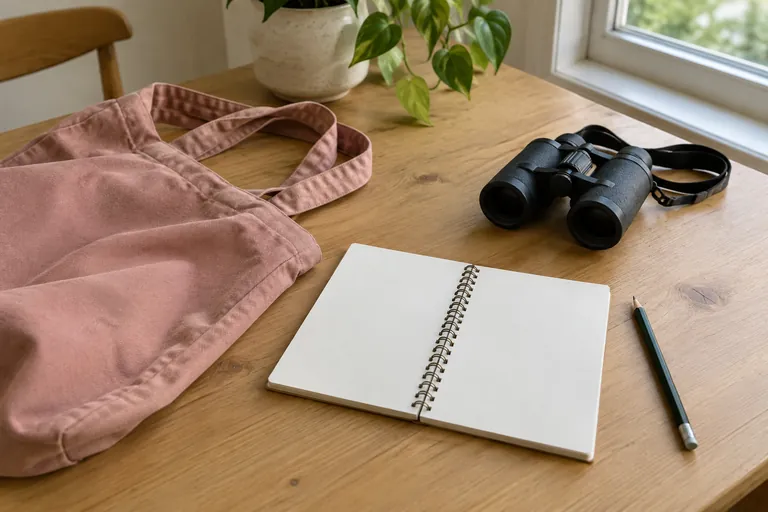
A small notebook and pencil may be enough to keep descriptions. Binoculars can help you see details from a distance, but this guide does not choose a model or magnification for you. Use equipment you can carry and handle without blocking the path.
QuébecOiseaux suggests making your own observation notebook. Keep the idea of a portable notebook with space to write and draw. You do not need to repeat every decoration or collecting suggestion: here we favor written records and photos taken without disturbance.
Plan for the weather and the site’s access rules, too. Stay close to home and choose a duration that fits your day. A solo creative session helps you make that time available; an observation walk then broadens the practice without requiring you to see many species.
How can you prepare a reusable observation sheet?
The sheet below separates facts, a proposed name, and the next check. It stays on this page until you choose a download. This tool does not send your entries or save them automatically.
The JSON file lets you restore your fields in this sheet, including from another language version of the article. Your free text stays as you wrote it; it is not automatically translated. A TXT download helps with rereading or printing; it is not an observation certificate.
Personal workshop · nothing sent
Prepare your observation sheet
The article’s table remains your paper template. The fields below prepare a local file; they do not validate any species.
“Compared” describes your work, without an expert’s validation. Remove private information before sharing a file.
 Read alsoScripting: Write your dream life to clarify what you want
Without JavaScript, use the visible table and paper example. Copy only the fields you need. If you are unsure which medium to keep, the guide to a paper or digital journal compares uses instead of declaring a universal winner.
How do you describe a bird you cannot name?
Describe a feature you actually distinguished, without filling in an outline from memory. Relative size, shape, position, and a movement can already make your note worth keeping. “Smaller than the pigeon beside it” is a comparison in context, not a measurement in inches.
Add a quick sketch and arrows if useful. If you cannot see the bill, say so. If you hear a sound without locating the bird, keep the sound and the bird you saw separate. A plausible connection does not prove they belong together.
The eBird’s description guidance prioritizes distinctive features and explanations of possible confusion. It does not ask you to force a name. To practice looking without chasing a perfect image, you can also draw to observe.
Flip cards
A question before you look for a name
OutlineFlip
Which shapes did you actually see? Keep “not distinguished” when a part was hidden.
PositionFlip
Where was the bird in relation to the site’s landmarks? Avoid sensitive location details if you will share the page.
MovementFlip
Which movement or gesture did you observe, without immediately assuming an intention?
CheckFlip
Which resource or detail might separate the possibilities without changing your first note?
Which number belongs in a birdwatching journal?
A number’s meaning depends on the method. A simultaneous maximum, a total number of sightings, and an estimate of different individuals are not interchangeable. State what you counted instead of leaving a number on its own.
For the French count described by the Muséum on May 21, 2026, the instruction is to keep the highest number of each species seen at the same time. In a fictional example with successive groups of two, five, and three birds of the same species, that maximum is five. The sum of ten sightings answers a different question.
This named protocol is not the rule for every journal or platform. Your personal journal can simply describe “a group seen from the bench,” with its limits. To submit data, open the program’s current instructions instead of inferring its method from this example.

How can you keep an uncertain identification without giving up?
An identification can remain open. Record what suggested a name, then what is missing before you can accept it. Your journal shows a line of inquiry instead of a list that must appear certain at any cost.
Use three personal labels: “unidentified,” “possibility to check,” and “compared with a resource.” The last describes your checking, not an expert’s validation. An app’s result does not become certain when the visible evidence is insufficient to assess it.
This flexibility is similar to keeping a question journal without an immediate answerYou can also accepting being a beginner without turning every outing into a test. Your next question can stay small: check the tail, compare two sketches, or ask for an opinion while keeping your reservations.
Quiz
What does your note really establish?
No bird appears on my page. Which conclusion remains accurate?
See the answer
I did not record any during this visit. Your viewpoint, time window, and search focus limit the conclusion.
I find a name in an app. Can I erase my original description?
See the answer
I keep the description and add the possibility separately. The first note shows what was actually visible.
I am preparing data for a scientific program. Which method should I use?
See the answer
The current instructions for that program. This article’s sheet remains personal and does not validate a contribution.
A bird moves away as I approach. What should come first?
See the answer
Keep my distance and accept an incomplete note. A good journal never justifies disturbing wildlife.
How can you compare two outings without inventing a disappearance?
First compare your visits’ conditions: viewpoint, time window, duration, and search focus. A difference in the list does not by itself show a population change. You did not watch the site continuously between the two dates.
“Not seen from this spot during this visit” says less than “disappeared.” Note any change of path or viewing area. The comparison becomes clearer when you also record what was not comparable.
The tree journal through the seasons uses this same idea of returning to one subject. Your weekly check-in can then keep a question to explore without turning the number of birds you saw into a success score.
How can you observe without disturbing birds or exposing a sensitive site?
Stay on authorized paths and keep your distance. An incomplete page is better than repeatedly approaching a nest. The American Birding Association’s code of ethics emphasizes limiting disturbance, protecting sensitive sites, and respecting private property.
This guide does not suggest playing calls to attract a bird. It does not ask you to move a branch, animal, or anything at the site to improve a photo. Follow local rules and give up an image if getting it would mean crossing a boundary.
Before sharing a page, remove any private address or sensitive location detail that is not needed to understand it. A notebook given to a loved one and data submitted to a wildlife program have different audiences. The guidance on preparing a journal of memories to pass on can help you decide what to keep private.
Checklist
Before closing your sheet
0 / 6
A sheet can be short and incomplete. It does not measure your worth or your wildlife expertise.
How does the video support this first practice?
For a complementary perspective, watch this video from Cornell Lab of Ornithology. This Cornell Lab lesson uses North American birds to explain relative size and shape. It helps you describe an observation; it does not validate your identification.
The video complements the reading; it does not validate identifications. Return to your sheet with one thing to look at, keeping your uncertainties. The article’s photos are AI-generated illustrations, not wildlife evidence or species identification references.
How can you continue your journal after the outing with Miraya?
Keep a factual observation in the field notebook and a personal impression in your journal. “I enjoyed that light” describes your experience; it is not data about a bird’s behavior. Both types of writing belong when you can tell them apart.
The journaling section offers other ways to reread your pages. Miraya can support an intention or a small step in your day. The app does not identify birds or replace a wildlife tool. After a walk, simply choose what you would like to notice next time, without setting a performance target.
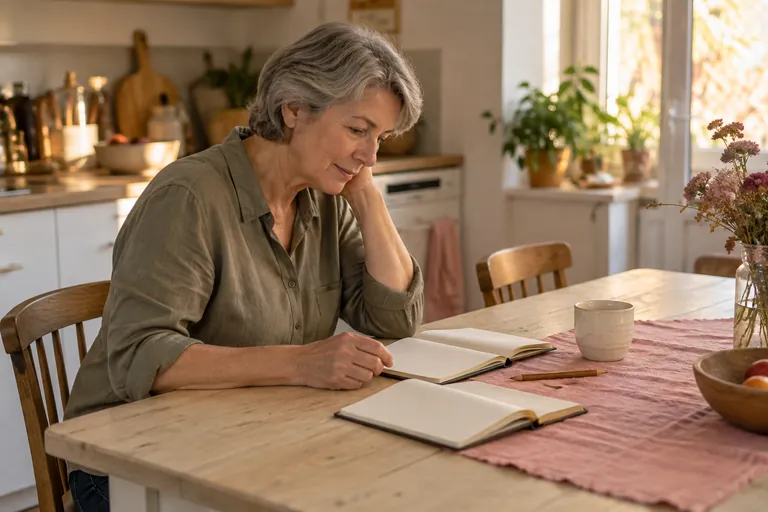
When no bird is visible during your visit
A page can record an observation without a sighting. Write the place, approximate length of the stop, and what you could actually see. “No bird seen from this bench during my break” does not mean “there are no birds left in the park.” The distinction keeps the record faithful without requiring a more impressive result.
Noise, viewing angle, or a brief stop can limit what you notice. Describe these conditions without naming them as a certain explanation. If you heard a sound but could not identify its source, mark it as unidentified. Do not add a species to complete the page or infer a count from an uncertain memory.
You can include a simple sky observation from the same moment. A weather journal distinguishes what you see from a copied temperature or forecast. It cannot establish by itself why a bird was present or absent. An assumed relationship remains a question to explore, not a conclusion about the species’ behavior.
If you return to the same place, keep differences in timing and duration visible. A personal notebook does not impose a counting protocol. If you join a survey, follow its own instructions and identification criteria; do not automatically treat earlier free-form pages as data collected under that protocol.
Frequently asked questions
What goes in a birdwatching journal?
Record the date, general location, time window, a description, and your uncertainties. Keep any proposed name separate. An empty field is better than an invented detail.
Do I need to know the species before starting?
Start without naming the bird. Describe what you saw and keep a question to check. Your journal does not have to look like a list of certain identifications.
Can I observe from a window or balcony?
A safe, accessible spot can work. Record what it actually lets you see, without drawing conclusions about the whole neighborhood. Respect local rules and the people around you.
How should I count repeated bird sightings?
State your method. A simultaneous maximum and a total number of sightings mean different things. For a scientific contribution, follow the chosen program’s protocol.
Does this online sheet send my observations anywhere?
This tool does not send your entries or save them automatically. Its buttons only prepare a local file. Downloading it does not validate an identification.
Can I share my journal with an organization?
Ask for the program’s or organization’s instructions. Keep your descriptions and state your doubts. A personal sheet does not replace the required fields, methods, or checks.
Sources
- QuébecOiseaux: make an observation notebook.
- LPO: example fields in a birding notebook.
- eBird, Cornell Lab: documenting an observation.
- Muséum national d’Histoire naturelle: Oiseaux des jardins program.
- MNHN: counting instructions presented May 21, 2026.
- American Birding Association: birding code of ethics.
Sources consulted October 24, 2026. Fictional counting example; calculation checked by script. The article’s original illustrations are not records of bird observations.