Contents
- Which tree should you choose so you can return to it?
- What should you note on your first visit?
- What changes should you look for across the seasons?
- How can you keep a record if you don’t know how to draw?
- How can you compare two visits without making up what happened in between?
- What should you do with a missed visit or an almost blank page?
- When should you move from a personal journal to community science?
- What can you conclude about the climate or the tree’s health?
- How can you observe without disturbing anything, and pick it back up when going outside is difficult?
- What small step can you keep after closing your journal?
- Separate a visible change from its assumed cause
- Frequently asked questions
- Sources
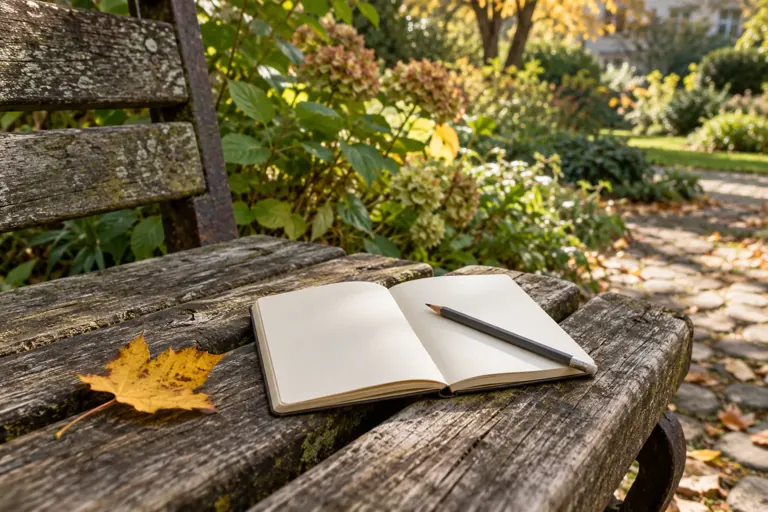
The chestnut tree in front of a library, a tree glimpsed from a window, one that marks a turn on a walk: you can choose an ordinary subject. The value of the journal lies in returning. A branch that seemed to have nothing to tell becomes easier to describe when you find an old page, a familiar viewpoint, and an open question.
This guide offers a mindful journaling practice, not professional monitoring of tree health. You can record a personal impression without treating it as a measurement. To explore several subjects rather than a single tree, start with the nature journal and its observation tips.
Which tree should you choose so you can return to it?
First, choose a tree that’s easy to find again from a place you’re allowed to access. The nearest, most visible one will often be a better fit than a spectacular subject that requires a complicated outing. A bench, path, or window can serve as a reference point, without carving or attaching anything to the trunk.
It should be the same tree from one page to the next. “The big tree in the park” can become ambiguous when several trees look alike. A sketch of the path and a fixed landmark can help you find it again. If you plan to share a page, avoid writing your address or a sensitive location on it: a general place name may be enough for the story.
A deciduous tree makes some changes visible: leaves appear, change color, then fall. An evergreen offers other details, but it doesn’t follow the simplified pattern of losing all its leaves each fall. You don’t have to choose a species whose every stage is easy to photograph. To work this into a route you already take, find ideas for a creative walk along a familiar path.
Find your path
Your observation spot
Where can you observe without putting yourself in a difficult situation?
Choose the closest match: the corresponding path will appear here.
A public path
A stable landmark
Choose a place where you can pause without getting in anyone’s way. Keep the same feature in your frame, such as a fork in the path or a bench.
A window
A visible boundary
Describe the part you can actually see. Note that the window, distance, and light limit the details; don’t claim to observe the entire crown.
An accessible garden
A simple return
Find the same tree again without compacting the soil around it. A nearby subject doesn’t need a label attached to its trunk.
No safe access today
A preparation page
Choose a question and a place for later. A page prepared at home isn’t a field observation.
What should you note on your first visit?
A first page benefits from placing your point of view before describing the tree. Write the date, general location, where you’re looking from, and the visible conditions. “Side light, wind, branch partly hidden” is more useful when revisiting a photograph than a judgment like “beautiful day.”
Then choose a specific detail: the branch above the bench, the lower leaves within view, the entire silhouette. You can combine text and drawing, but make their scope clear. One mostly yellow branch doesn’t let you describe the whole tree as yellow. This small qualification keeps a polished page from conveying certainty it doesn’t contain.
| Section | Sample personal note | What it doesn’t prove |
|---|---|---|
| Subject | The tree by the bench, species name to be verified | A certain botanical identification |
| Observed detail | Several yellow leaves on the lower branch | The proportion across the whole crown |
| Conditions | Same bench, side light, wind | The cause of the color change |
| Question | Will this leafy branch still be here on my next visit? | A future date when the leaves will fall |
Leave space for your feelings, clearly labeled “impression.” You can write that you like this light without drawing a conclusion about the tree. To find precise words instead of feeling obliged to come up with a pretty phrase, the guide describing a place with the five senses offers other starting points.
What changes should you look for across the seasons?
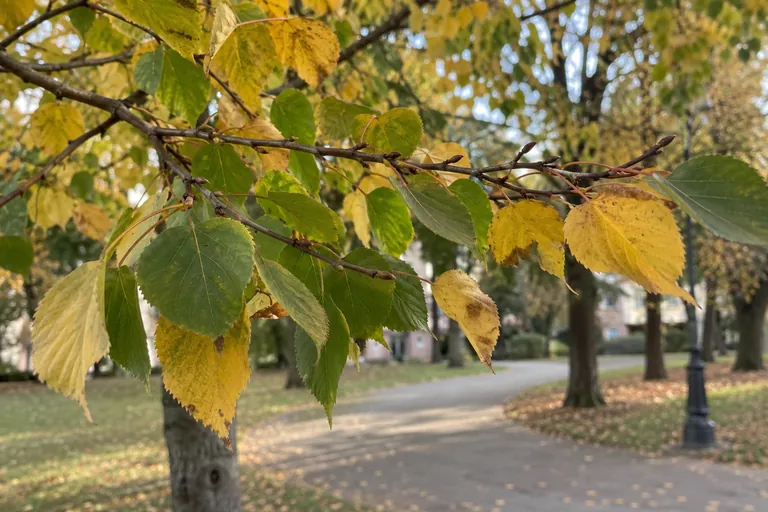
Buds, leaves, flowers, and fruit offer possible points of focus; they aren’t a calendar that applies to every tree. The species, location, and conditions shape what you can observe. It’s still possible to begin in October: your first page doesn’t have to coincide with spring.
The INRAE defines phenology as the study of periodic events in living organisms in relation to seasonal climate variations. Its fact sheet, updated on September 25, 2024, mentions flowering and autumn coloring, among other examples. In your notebook, this word can name a curiosity; it doesn’t turn your informal notes into standardized measurements.
In winter, a silhouette or visible buds can give you a subject. In spring, look at what is actually opening. In summer, describe the foliage or fruit you can make out. In fall, keep a record of the colors and the parts that have already lost their leaves. These suggestions are ways to approach your writing, with no required start date. A journal for the change of season can make room for a separate account of what this period changes in your own daily life.
Flip cards
A question for your next page
A leafFlip
What outline can you describe from where you are, without detaching it? If it’s too far away, choose another visible detail.
A branchFlip
What landmarks will help you find this branch again? Also note what obscures it.
A silhouetteFlip
Which part can you see in full? Compare similar framing rather than a close-up photograph with a distant view.
Something missingFlip
What couldn’t you verify today? A well-framed question deserves a place even without an immediate answer.
 Read alsoScripting: Write your dream life to clarify what you want
How can you keep a record if you don’t know how to draw?
A few annotated lines are enough if you can tell later what they represent. A line for the trunk, a fork, and an arrow pointing to a branch can serve as a guide for finding your way around. The sketch doesn’t need to look like a botanical plate; its purpose is to help you find a detail again.
You can also choose just words, a photograph, or a mix. An image taken from another angle changes the comparison, so note that change in perspective. A photographed color varies with the lighting and the camera settings; don’t use it as an exact measurement. If taking a picture isn’t possible, “branch obscured by construction” is already a useful note.
To learn a drawing technique without making your notebook depend on a beautiful result, the guide drawing when you think you can’t draw is a better fit than buying supplies. You can keep your practice sketches elsewhere and save this page for observations. A short note can later inspire an observation haiku, without asking the tree to offer a moral about your life.
How can you compare two visits without making up what happened in between?
Compare what the two pages actually allow you to compare. Find the subject, the point of view, and the detail you tracked. If any of these reference points changes, note the limitation before interpreting the difference. “Today, this branch looks less leafy from the bench” is more precise than “the tree has lost its leaves.”
A dated observation describes what was visible during your visit. It doesn’t automatically tell you the exact date when an event began. If you saw a leafy branch one day and then found it bare on a return visit, your notebook preserves both observations. It can’t tell you when each leaf fell between those two visits.
The worksheet below preserves this distinction. It creates text and a CSV file from the fields you fill in. Nothing is saved automatically; keep your export if you want to find it again. The worksheet doesn’t send any observations to a scientific program or identify a species.
Your record to keep
On paper: a general reference point, the actual date, what you see, the conditions, and a question. Fictional example: “Low branch visible, yellow leaves; overall color to be checked.”
Read the text to copy
Nothing is saved automatically or sent anywhere. Save your export to keep the record.
A fictional example: “previous visit, leaves present on the marked branch; next visit, branch hidden by a tarp.” The documented change is about visibility, not necessarily the foliage. For the next page, your question can simply be whether you can find the same detail. The ritual around a familiar place also explores this return without requiring a discovery each time.
What should you do with a missed visit or an almost blank page?
Let the missed visit remain missed. A new date and a sentence about what you see now are better than a reconstruction presented as real. You can describe what you imagine in a margin, as long as you label it as such. A missing note is neither a failure nor evidence of absence.
If nothing seems different to you, describe one stable detail and close your journal. “Same marked branch, no visible difference from this spot” is enough. Your perspective has limits too: distance, time available, light, your interest in the moment. You don’t have to record personal progress at every visit.
You can pick it back up after a long break by rereading only the last page. The guide pick up a journal without catching up on the missed pages helps you keep that freedom. Avoid turning the activity into a mandatory daily streak if that rhythm doesn’t suit you.
When should you move from a personal journal to community science?
A scientific contribution requires the protocol of the program you choose, not just an illustrated page. The Observatoire des Saisons explains its approach : species, site, individuals being monitored, and stages to record. Its estimates for the start and peak of an event should not be replaced with a general impression or a rule made up for this journal.
The CNPF also provides a protocol and a tree monitoring sheet. These documents serve a specific purpose. Consult the program’s resource before submitting data; keep your personal notes alongside them if you’d like to include a memory or a color.
For a complementary perspective, watch this video from PBS LearningMedia™.
What can you conclude about the climate or the tree’s health?
A short personal series isn’t enough to attribute a change to the climate or diagnose a tree’s condition. The journal helps you describe what you see and frame a question. A broken branch, unusual foliage, or an inaccessible area may sometimes call for notifying the site manager, without touching anything or intervening yourself.
In an article published on December 17, 2024, INRAE reports that cherry trees in France have been flowering 10 to 15 days earlier since the 1990s. This finding comes from a research study and a specific context. It doesn’t let you predict when your subject will flower or draw conclusions from a single photograph.
A sentence like “I wonder if this difference is related to temperature” remains a hypothesis. Add the source you’d like to consult instead of turning it into a certainty. Curiosity still has a place when the answer is unknown.
Quiz
What your page can actually tell you
You can no longer see the leaves on a branch hidden by a tarp.
See the answer
The branch can’t be observed from this spot. A visual obstruction doesn’t let you conclude that the foliage has changed.
The two photos were taken in very different lighting.
See the answer
Color comparison requires a caveat. Lighting and camera settings change the recorded color.
You missed a visit when the flowers opened.
See the answer
You note the actual date of your new observation. An assumed date can become a question, never an observation presented as real.
You want to send observations to a scientific program.
See the answer
You consult the program’s protocol first. Whether data can be compared depends on the program’s instructions and the stages it defines.
How can you observe without disturbing anything, and pick it back up when going outside is difficult?
Stay on authorized paths and keep your observations at a distance. Don’t pull off a leaf or piece of bark to fill in a page; don’t move a nest or branch. If the weather, construction work, or your comfort makes the visit unsafe, reschedule it. The journal can wait.
At home, you can prepare a page layout, look for a resource, or find a drawing. Don’t call that a new field observation. From a window, simply describe what’s visible. If you share a photo, check that it doesn’t reveal a recognizable person or location information you wanted to keep private.
A boundary can also be a choice: observe only the silhouette without identifying the species, or keep your notes to yourself. You don’t have to turn every hobby into a public contribution. The little things to enjoy without obligation offer another space for a bit of light or a detail you appreciate.
What small step can you keep after closing your journal?
Choose a concrete next step, however small: find the same bench again, check the assumed name, or prepare a blank page. A sentence like “next time, I’ll look at this branch from the same spot” gives you a direction. It doesn’t require any particular feeling or success.
In Miraya, “My Little Steps” lets you keep an intention, an action, and what you take away from it. You can note that you’d like to take out your journal again; the app doesn’t identify trees or replace tracking them. If this format speaks to you, discover Miraya’s little steps or try Miraya on iPhone or on Google Play. The home page presents a 7-day free trial for eligible new users; no practice guarantees a result.
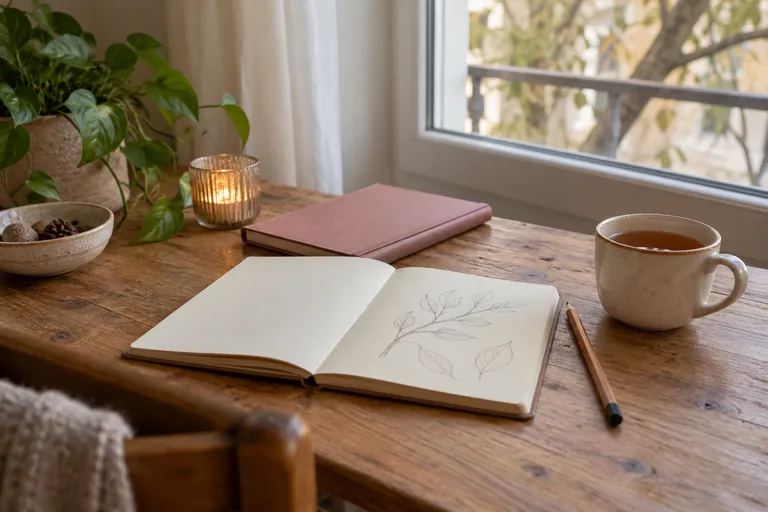
Separate a visible change from its assumed cause
You return to the tree and notice more leaves on the ground. Start by stating what you are comparing: the same branch, side of the trunk, or patch beside the path. If the first drawing showed only part of the tree, the comparison concerns that part. A new viewing angle may reveal a detail that was already there but unrecorded.
Describe the difference before explaining it. “Two yellow areas visible on the branch I watched” keeps the scope clear; “the tree is suffering” already offers an interpretation. Keep an idea in a separate hypothesis section with a question mark. Writing it several times does not turn it into an explanation.
The day’s conditions can accompany the entry without being named as the cause. A weather journal helps separate the observed sky, a measurement, and a copied forecast. A shower during your visit does not explain the condition of every leaf. Seek qualified advice about tree health or identification rather than conclude from the notebook.
On the next visit, return to the same landmark if it is safe. Keep missing days and changes of viewpoint visible. This continuity gives rereading a thread without requiring you to correct old pages or turn every difference into a discovery.
Frequently asked questions
Can you start a journal about a tree in autumn?
Autumn is a good time to start with the leaves, the tree’s outline, or a visible detail. Date your first page and keep this starting point. You don’t have to reconstruct the previous spring.
Do you need to know the tree’s name?
A stable reference point lets you start without knowing the name for sure. Write “identification to be verified.” To contribute to a scientific program, check its species list and criteria before submitting your notes.
How often should you come back?
For a personal notebook, choose a pace that fits your daily life and note the actual dates. A scientific program may require a different frequency: follow its protocol rather than a general journaling rule.
Can I keep the notebook from a window?
A window lets you follow the visible parts of a tree. Note the distance, obstacles, and changes in viewing angle. Don’t present an inaccessible detail as an observation of the entire canopy.
Can the notebook tell me whether a tree is sick?
The journal records observations but doesn’t provide a diagnosis. If you notice a dangerous branch or an unusual situation, keep your distance and notify the site manager. Don’t treat, cut, or collect anything yourself.
Does the form send my notes to researchers?
The worksheet only creates local files, which you’ll need to save yourself. It doesn’t send anything or automatically save the fields. Scientific contributions are made separately, according to the instructions of the program you choose.
Sources
- INRAE/TEMPO: definition of phenology, updated September 25, 2024.
- Observatoire des Saisons: take part and understand the protocol, accessed October 21, 2026.
- CNPF Hauts-de-France Normandie: observing budburst, protocol and form, accessed October 21, 2026.
- INRAE: Climate disruption sends a chill through fruit trees, December 17, 2024.
- What Happens When You Start Nature Journaling? · PBS LearningMedia™.