Contents
- Writing a haiku: what guidelines should you know?
- Start by looking before searching for poetic words
- Writing a haiku with two planes of observation
- Count syllables without losing sight of the scene
- Reread and share with precision
- A brief practice that remains a literary practice
- Four guidelines for your attempts
- Observe the same place at two different times
- Frequently asked questions
- Sources
Writing a haiku means creating a very brief poem attentive to a concrete experience, within a tradition born in Japan. To begin in English, observe a scene, choose a few details, and try three lines without adding a moral to what you saw.
The 5–7–5 formula is familiar, but it doesn’t sum up the work of haiku on its own. This guide presents a few guidelines and an accessible observation workshop. You’ll be able to distinguish a free-form attempt inspired by haiku from a text intended for a setting with specific requirements.
Writing a haiku: what guidelines should you know?
The Association francophone de haïku presents haiku as a short poem in three lines and notes the role of the seasonal word, called kigo, as well as the cut. These guidelines help you see how two elements meet in a small space. They don’t turn just any sentence split into three parts into a finished poem.
For your first attempts, distinguish observation from formal control. You can first note what happens, then look for a more concise version. If a prompt requires five, seven, and five syllables, follow that constraint in that context. In a free personal practice, simply state your choice instead of presenting every deviation as a new universal rule.
| Aspect | Helpful question | Common pitfall |
|---|---|---|
| Observation | What did I actually perceive? | Replace a detail with an idea |
| Season | What clue places this moment? | Add a decorative word |
| Cut | Where does the gaze shift? | Juxtapose without a connection |
| Brevity | What word can I remove? | Cut until it becomes opaque |
The nature observation journal can provide starting notes, but you don't need to live near a forest. Fog on a tram window, a leaf in a bicycle basket, or the sound of a blind can catch your attention. Everyday urban life also offers concrete experiences to work with, without claiming to sum up an entire tradition.
Start by looking before searching for poetic words
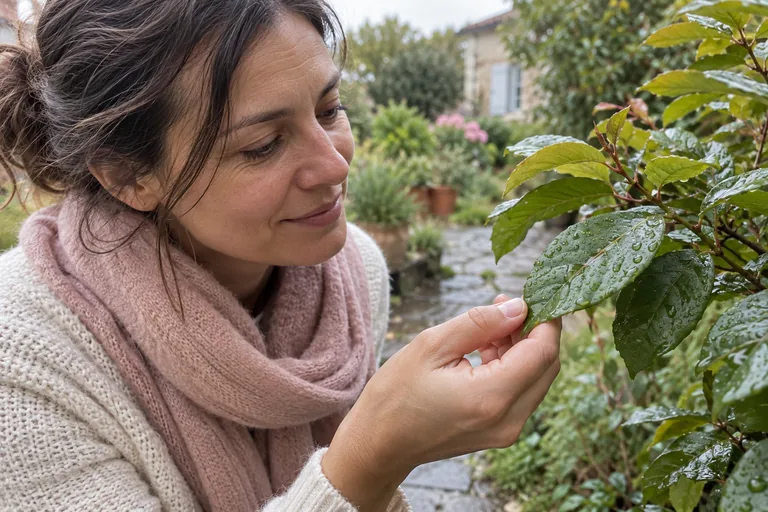
Choose a place where you can stay for a few moments without getting in anyone's way or putting yourself at risk. Note three facts: a texture, a movement, and a sound. For example, a damp bench, a leaf sticking to a sole, and a creaking door. These details don't all have to go into the poem; they make up a reserve for you to choose from.
Avoid jumping straight to a conclusion like “nature teaches us to accept time.” That idea may belong in a journal, but here it would take up all the space meant for the experience. First describe the leaf that stays stuck, then what detaches it. You can develop your notes with five-senses writing, keeping only the perceptions that are truly useful.
During a creative observation walk, gather little. If you look for twenty scenes, you risk no longer seeing the one unfolding in front of you. A minute of detail is better than a collection of abstract themes. Also note the date and place in the margin, even if that information won't appear in the poem.

Writing a haiku with two planes of observation
Here is an original free-form attempt, presented without any claim to meter: “morning rain / beside the empty bench / a leaf holds the water.” The first segment places a scene; the next ones bring the gaze closer to a detail. You can discuss its simplicity, precision, or musicality. It serves to practice a writing move, not to define the ideal haiku.
Then try a second version: “bench still wet / on the fallen leaf / the sky's reflection.” The facts aren't exactly the same: the reflection becomes central. Ask yourself whether you observed it or invented it. Invention isn't forbidden in all poetry, but this session focuses on observation; noting your additions helps you know which exercise you're really doing.
The cut can shift attention between a whole and a detail, between a sound and an image, or between two movements. It doesn't necessarily call for dramatic punctuation. Read the lines with a slight pause and check whether the connection still comes through. If you have to explain at length why the two parts belong together, look for a more concrete connection.
Count syllables without losing sight of the scene
In English, counting syllables sometimes involves choices about pronunciation. Before revising a text to meet a metrical requirement, check the conventions of the workshop concerned. In your own practice, read consistently and note what you count. Avoid adding a vague adjective solely to gain another syllable.
You can compare a free version and a constrained version in your creative project journal. If the second loses the detail that made you pause, return to the first and try another approach. Number isn’t the enemy of poetry, but meeting a count doesn’t prove the image is right. The guide on writing with constraints helps you separate these two evaluations.

Workshop: Which detail should you keep?
Choose a challenge and try the suggestion with your scene.
My text explains an emotion
Remove the name of the emotion. Keep the sound, light, or movement that made you pause.
I have too many details
Choose a wide view and a close-up detail. Put the rest in the margin.
The meter distorts the scene
Keep a free version, then start again with a different word order instead of a filler adjective.
 Read alsoScripting: Write your dream life to clarify what you want
Reread and share with precision
Reread the poem after a break. Circle concrete words and temporarily cross out evaluative ones: beautiful, magnificent, sad, wonderful. See whether the detail is enough to create a sense of presence. This isn’t an absolute ban, but a test that can reveal an unnecessary explanation. Keep the previous version so you can really compare the effects.
In your reading journal, look at published haiku alongside their translations and citations. Don’t turn a translation you found online into text you can reuse freely without attribution. Your quote journal can clearly distinguish the poem you read, the translator’s name, and your personal comment.
If you ask for feedback on your text, ask a specific question: Which image stays with you? Where does the pause fall? Which word feels added? An answer like “it’s pretty” can be encouraging, but it doesn’t help much when choosing a revision. Accept that a reader may not experience exactly what you did; you’re working on a text, not trying to transmit a memory perfectly.
A brief practice that remains a literary practice
You can devote three sessions to the same window: a raw note, two versions, then a selection. You don’t have to write every day or publish every attempt. A solo creative session lets you give this attention a structure without turning your notebook into a performance tracker.
Haiku can be enjoyable to practice, but this guide makes no claim that it has any guaranteed therapeutic effect. You can also choose not to write anything and simply keep an observation. Respecting the scene, the language, and your limits matters more than producing a text at all costs that looks like a poem on the surface.

Four guidelines for your attempts
Generator
Where will you direct your gaze?
Notice a trace of light changing on an object.
See all the phrases
Inside
- Notice a trace of light changing on an object.
- Listen to an everyday sound before looking for its source.
Outside
- Look at what the rain leaves on a surface.
- Choose a detail that places the scene in a season without naming it.
Quiz
Form and observation
Three lines are enough to guarantee a successful haiku.
See the answer
No. Precision and the relationship between elements matter, too.
An observation session means you have to keep everything in the poem.
See the answer
No. Notes are a reserve; the text makes the choices.
Flip cards
One revision idea
I end with a moralFlip
Return to the scene and finish with a detail.
I pile on adjectivesFlip
Try more precise nouns and verbs.
I force the syllable countFlip
Compare it with the free-form version before deciding.
I can’t find anything extraordinaryFlip
Observe an ordinary phenomenon a little longer.
Checklist
My draft is grounded in a specific moment
0 / 5
Your poem can remain a personal draft without having to represent the entire genre.
Observe the same place at two different times
Return to the same window later in the day, without trying to recreate your first poem. Note what has actually changed: the drops have dried, a shadow crosses the table, a sound is no longer there. This second observation helps you distinguish the place from the moment. You can write another draft using almost the same vocabulary and still offer a different experience.
Then compare the two texts without deciding which one is better. Does the first describe mostly a light, and the second a movement? Does a seasonal word come from an observation or from an association added afterward? These questions give your revision a direction. They keep you from treating the three lines as an interchangeable formula to fill with plant and weather words.
You can keep the pair in your journal with the times you took your notes. You don’t need to present both poems together. The second may simply have taught you which detail made the first precise. Paying attention to context is part of the exercise, even if you ultimately keep just one version and a few words in the margin.
For a complementary perspective, watch this video from Natural History Museum of Los Angeles County (NHM).
Frequently asked questions
How do you write a haiku as a beginner?
Observe a concrete scene, note a few details, and try three concise lines. Then reread how the images relate to one another instead of immediately searching for the perfect formula.
Does a haiku have to follow a 5–7–5 syllable count?
This structure is a familiar guideline and may be required in a workshop. For a free practice in English, make your choice clear and check the rules if you want to enter a competition.
What is a kigo?
It’s a word or element associated with a season. It places the poem in a concrete experience rather than serving only as decoration.
Does it have to be only about nature?
This guide also offers observations of everyday urban life. To learn more about the traditions and their distinctions, read collections and specialized resources.
Can you write a haiku without rhyme?
Yes, rhyme isn’t the goal of this workshop. Work on precision, brevity, and the relationship between the elements.
How can you tell if a word is unnecessary?
Read one version with it and one without it. If it changes neither the meaning, the rhythm, nor the image, you can try removing it.