Contents
- Journal of personal objects: which ones should you choose?
- How do you write a scene in your journal of personal objects?
- A fictional example: the little key that no longer opens anything
- How do you tell the story of an object when its history is uncertain?
- Should you photograph, draw, or keep the object?
- How do you finish the five portraits?
- Two objects that tell the story of the same period
- Frequently asked questions
- Sources
A journal of personal objects tells memories through ordinary things: a cup, a ticket, a tool, or a piece of clothing. Choose five objects connected to different scenes, then write about what they remind you of; their price and age don't need to be exceptional.
This process is neither an inventory of possessions nor a decluttering challenge. You can tell the story of an object without deciding to keep it, and keep an object without finding great meaning in it. The journal helps you distinguish the physical thing, the memory it brings up, and the place you want to give it now.
Journal of personal objects: which ones should you choose?
Start with what's already within reach. The spoon you used in your first apartment may offer a more vivid scene than a family heirloom whose history you barely know. The right starting point isn't the supposed value of the memory, but a detail that makes you want to write.
| Starting object | Possible question | Caution |
|---|---|---|
| Object you used | What action is associated with it? | Don't force it to be a symbol |
| Object you received | What moment of receiving it comes back to me? | Don't invent the giver's intention |
| Lost object | What do I remember about it? | Flag uncertain details |
| Handed-down object | What do I know about its history? | Separate family stories from established facts |
For your five choices, vary the uses: an everyday object, one connected to a place, one you received, one you let go of, and one that's still with you. This framework is an editorial suggestion, not a personality test. If you'd rather start without making a selection, the prompts for keep a personal journal work just as well.
How do you write a scene in your journal of personal objects?
First, describe a visible feature: a worn edge, a seam, a weight, or a color. Then ask yourself where you used it. “A blue cup” becomes “the cup I set on the windowsill before my first departure of the morning.” The detail opens up a place and an action.
Add what surrounded that moment. Who was there? What season was it? What were you doing before or after? Don't try to fill in every sense if you don't remember. Our guide to writing about a specific memory helps you focus on a few reliable traces instead of a scene that's too complete to be honest.
You can also tell how its use changed. A box that once held cookies can become a button box, then a box for letters. This object's journey can support a personal timeline without having to tell the story of an entire period of your life.
A fictional example: the little key that no longer opens anything
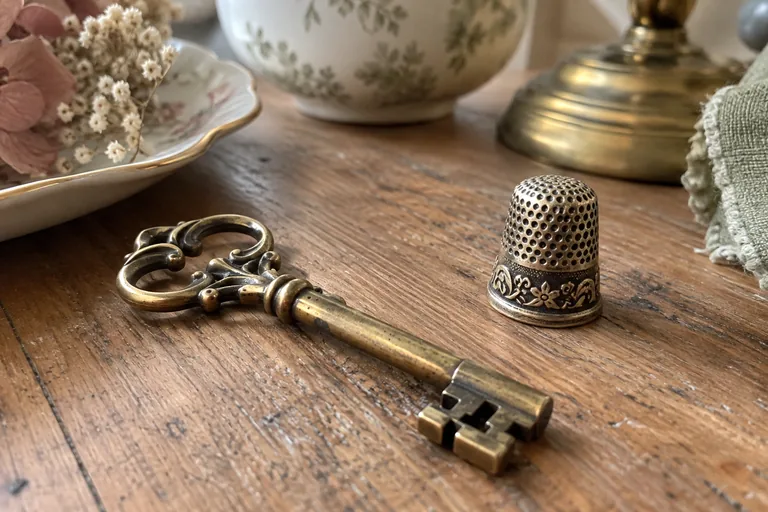
Imagine a key kept after a move. The page begins with its shape and worn ring. Then comes the scene of returning: setting down the bag, searching for the lock in the dark, and hearing the entryway floorboards creak. The text doesn’t need to conclude that this key represents an entire youth.
A second part explains what has changed since then. You no longer live there; some relationships have evolved; a familiar route is no longer part of your weeks. You can acknowledge nostalgia without deciding to return to that period. The moving journal explores this transition between places more broadly.
Finally, the page distinguishes between remembering and putting things away. You can keep the key, take a photo of it, or make no decision. Writing its story doesn’t obligate you to throw it away. Likewise, keeping it doesn’t mean you’re rejecting the present. These are two different decisions, and you can make them at different times.
How do you tell the story of an object when its history is uncertain?
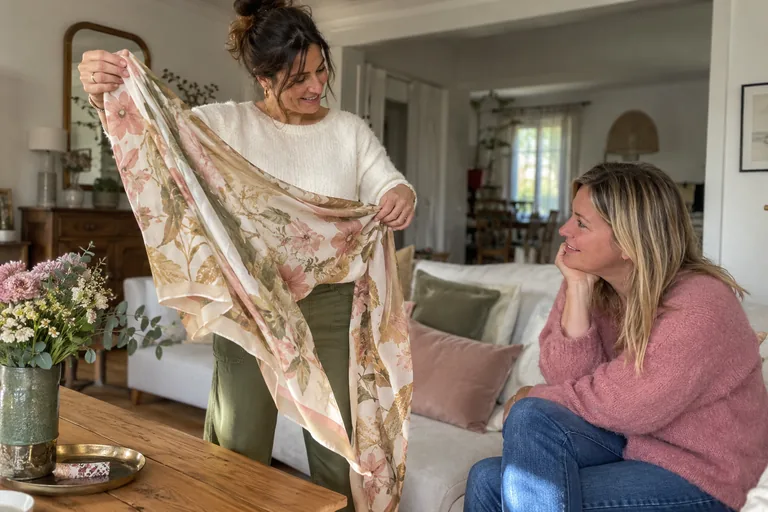
Indicate where the information came from. “My aunt said this tablecloth came from her mother” keeps the family account visible. “This tablecloth belonged to my great-grandmother” states more. If you only have the first version, keep it as it is instead of making it sound artificially certain.
You can prepare a question for someone close to you, but let them choose whether to answer and make corrections. A shared object can bring different scenes to mind for each person. The journal of memorable conversations helps you record your part of the exchange without turning hesitant words into a definitive account.
In its coverage of Zola’s correspondence, the BnF highlights the place of daily routines, meals, trips, and exchanges in personal archives. It offers a cultural reference point for paying attention to concrete details. It doesn’t prove that writing about objects eases grief or resolves a difficulty; this is a creative, personal exercise.
Flip cards
A few things to keep in mind
The techniqueFlip
What did you do with this object?
The placeFlip
Where was it at that exact moment?
What comes nextFlip
What place would you like to give it today?
 Read alsoScripting: Write your dream life to clarify what you want
Checklist
Prepare your page
0 / 4
You can now try something, adapt your approach, or close your journal.
Your workshop
Choose your starting point
Open a suggestion and try it in your journal. You don’t have to share anything personal on this page.
An everyday object
Describe its most recent use and an earlier use. Compare the actions without forcing a conclusion.
An object you received
Describe the scene of the gift as you remember it. Don’t assume you know the person’s intentions for certain.
A lost object
Write down its approximate shape and a scene connected to it. You can tell the story even without a photo.
Generator
A writing prompt
Start with an ordinary object and a concrete detail. What I notice specifically is…
See all the phrases
Observe
- Start with an ordinary object and a concrete detail. What I notice specifically is…
- Tell a story about a scene rather than its monetary value. My example today would be…
Choose
- Choose what you want to keep on the page. The version that works for me is…
- I can leave this page as it is, because what I wanted to put down here was…
Should you photograph, draw, or keep the object?
A photograph can complement the text, especially for a bulky or fragile object. Choose a frame that won’t accidentally reveal a name, address, or private letter. The A personal photo journal suggests giving the image a purpose instead of accumulating copies.
A rough drawing can also preserve an outline without aiming for accuracy. You can write around it, glue on plain paper, or describe the texture. If you like putting several elements together, creative journaling and collage offer a way to take it further, without having to embellish every page.
When an object belongs to someone else or is shared, telling your memory doesn’t give you the right to dispose of it. Don’t decide on your own to donate, sell, or destroy it. The page can help you distinguish what you want from what requires an agreement with others.
How do you finish the five portraits?
Reread the scenes and look for their differences. Maybe they tell stories about work, friendship, travel, cooking, and learning. You don’t need to find a common theme. Five fragments can make a collection simply because they belong to your life.
Add a final sentence about what you’d like to find again when you reread: a gesture, an atmosphere, a question to pass on. A kitchen object can lead to a recipe and memory journal. An object associated with someone can remain a private page, without needing to be given away or shown.
If an object brings up pain that feels too intense, you can change the subject or stop. Don’t force yourself to handle, describe, or sort through belongings before you’re ready. If a subject continues to deeply upset you, talking with someone you trust or a professional may be more appropriate than doing an exercise on your own.
Two objects that tell the story of the same period
You can choose two objects associated with a single period so you don’t have to artificially search for five different stages of your life. A transit card and a small saucepan, for example, might both belong to your first apartment. The card tells the story of getting around; the saucepan, of improvised meals. Their closeness in time doesn’t make the two pages redundant.
Write each scene separately, then see what putting them side by side adds. You may notice the contrast between a very busy day and the pleasure of coming home to a place of your own. If no particular connection emerges, simply keep the two scenes. You don’t need to find a shared symbol to justify including them.
This method also works when an object brings up a story that’s too broad. A second, more ordinary object can help you return to a specific gesture. That way, you can keep the page to a comfortable length and stay free to tell other fragments later, instead of trying to sum up an entire era through a single thing.
For a complementary perspective, watch this video from TEDx Talks.
Frequently asked questions
Do I have to choose exactly five objects?
No. Five gives you a limited, varied path, but a single portrait can be enough to explore the practice.
Can I write about a lost object?
Yes. Describe what you remember and point out uncertain details instead of filling them in automatically.
Can an everyday object be interesting enough?
Yes, if it’s associated with a scene. The details of an everyday gesture can bring a story to life without anything extraordinary happening.
Do I have to keep the object after writing about it?
Writing doesn’t determine that choice. You can keep it, pass it on, or put off the decision depending on your situation and whether there are other owners.
Can I tell the story of a family object?
Yes, while distinguishing what you know from what you’ve been told. Respect confidences and the wishes of the people involved.
How can I avoid simply making a list?
Choose a use and a scene for each object. A few details about the setting can turn a list of features into a story.
Sources
- Bibliothèque nationale de France. “Zola au jour le jour.” Heritage resource on the place of daily life, travel, and everyday details in correspondence. View the resource.
- Bibliothèque nationale de France. “Writers’ rituals.” Cultural insight into the diversity of writing practices, with no evidence of a therapeutic benefit. View the resource.