Contents
A personal timeline brings together stages of your journey on a simple line. It can include dates, but also approximate periods, places, activities, or people you’ve met. To get started, choose a limited focus and five to eight milestones. You don’t have to tell your whole life story or turn every event into an explanation of who you are today.
This format is mainly for looking at the sequence of changes. You might notice that you started learning something before a move, that an activity came back at different times, or that a project evolved slowly. The timeline gives you an overview; on its own, it doesn’t prove what caused these developments.
Set the scope before adding dates
Choose what you want to explore. A timeline of the places you’ve lived, creative activities, or things you’ve learned won’t call for the same information. A specific focus keeps you from filling the page only with events usually considered important: degrees, jobs, relationships, or major decisions. Everyday milestones can matter too.
You can focus on one year, a decade, or a single project. Write that period at the top of the page. If the overview feels too crowded, split it into several lines. A professional timeline and a personal one can overlap without being completely merged.
Finally, make a note of what you don’t want to explore. You can keep this boundary private, and you don’t need to justify it. You can create an interesting page about homes, books, or skills you’ve learned without exploring painful events. Your journal is a resource you choose to use, not an obligation to revisit everything.
Gather milestones without trying to be exhaustive
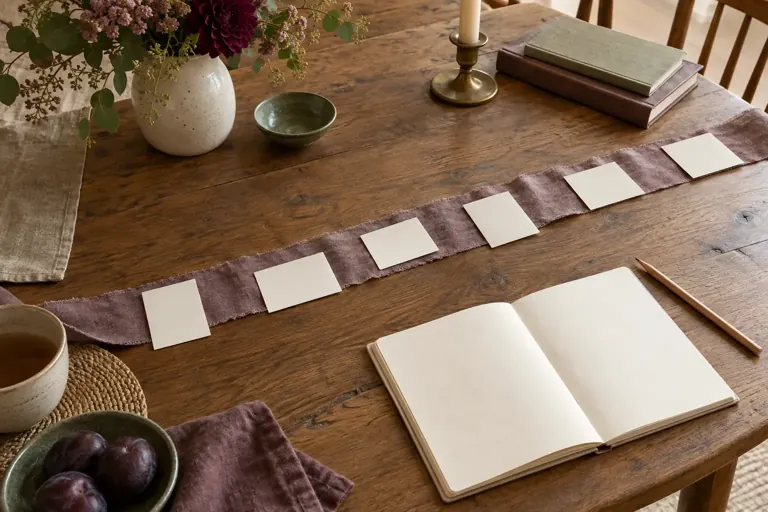
Write down your first memories on small slips of paper or in a list. Start with the ones that come easily: the beginning of an activity, a change of place, the end of a course, the discovery of an interest. Don’t put them in order right away. Collecting them and organizing them can remain separate steps.
Then add the dates you know and approximate time periods. A phrase like “toward the end of my studies” may be enough. If you want to check, consult a relevant document, but try not to turn the session into an endless search. You can add a question mark and come back to an important reference point later.
For each stage, write a descriptive sentence. “I started drawing on the train” says more than “creativity.” “I stopped going to that workshop after the schedule changed” distinguishes a practical constraint from a lack of interest. These phrases make possible connections more specific without imposing an interpretation yet.
Draw a line that leaves room for gaps
Draw a horizontal or vertical line and place the reference points in order. The distances don’t need to be proportional, but make that clear if you choose to use that flexibility. Otherwise, a long interval may look very short simply because you ran out of room. A regular scale is useful if you want to compare durations.
Leave some blank spaces. They don’t mean nothing happened. They only show what you chose to represent or what you remember at this point. You can write “period with few records” instead of filling the gap with a broad conclusion.
Use one color to distinguish places, another for activities, and a third for decisions. Limit the number of codes so the page stays readable. If you spend more time checking the key than looking at your journey, simplify it. The drawing should help you see the stages, not become a system you have to learn.
Flip cards
Four questions to ask as you look at the timeline
What beginsFlip
What interest appears here, even in a small way?
What continuesFlip
What activity runs through several periods in different forms?
What changesFlip
What conditions changed at this stage?
What remains openFlip
What connection calls for a question rather than a conclusion?
 Read alsoMoving journal: navigating change without losing your bearings
Notice connections without inventing a perfect story
A timeline can make you want to tell the story as if everything had inevitably led to the present. Resist that simplification. At every stage, several paths forward were possible. You can note what you knew then and what you only understood later. Looking back gives you more information, but it can also make certain decisions seem more obvious than they were.
Look for concrete continuities: a way of working, an interest, a supportive person, a place you kept returning to. Then ask yourself whether the connection is documented or simply plausible. “I picked up photography again after that trip” describes an order of events. “That trip explains everything about my work today” requires much more evidence.
You may also notice breaks that don’t need to be repaired. An activity may have been enjoyable for a while and then taken a less central place in your life. Your journey doesn’t have to prove that you’ve always been faithful to the same tastes. The guide to telling the difference your desires from other people’s goals can help if you mostly notice milestones expected by the people around you. The different stages of your life can help you introduce yourself as more than your job. Looking at transitions, you can ask what project has a place in this season of life.
Add a scene to a milestone
Choose a point on the timeline that intrigues you and develop a short scene on another page. The timeline provides context; the scene adds actions and details. You could describe your first trip to a workshop, the moment you put away some equipment, or a conversation that led you to ask a new question. If you find old journals, you can reread them without judging the person you were by placing each page in its context. To revisit a period without rating it, you can tell the story of your year without a score or New Year’s resolutions.
The guide to writing about a specific memory suggests distinguishing what is certain, likely, or unknown. This distinction is especially useful when the timeline spans several years. You can keep an approximate version without artificially assigning it a date or exact words.
Link the scene to the timeline with a page number. This creates a collection at different scales: an overview and a few detailed moments. Not everything needs to be developed. Some markers can remain as words, while others become longer pieces of writing.
Use the page to explore a current question
The timeline can help you prepare for a decision without making it for you. If you’re unsure about returning to an activity, look at the conditions that made it possible before: available time, proximity, equipment, support. Compare them with your circumstances today. You may find a condition to recreate instead of waiting for motivation.
You can also note what you’d like to continue in the coming months. Keep this part visually distinct from the past: use a dotted line or a new page. A future intention isn’t an event that has already happened. It can evolve as you try things and your circumstances change.
To finish, write a single sentence about what the page helped you notice. It can be modest: “this interest comes back when I have a place to leave my equipment.” If you’d like to save this question for later, a letter to your future self can extend the exercise without predicting what comes next in your journey. Once you’ve made the decision to leave a job, a journal after resigning separates the experience you want to keep from the conditions you’d like for what comes next. If you want to share part of this story, prepare a memory journal to pass on separate from your private pages.
Frequently asked questions
Should I include difficult moments?
Only if you want to and the exercise feels right for you. You can leave them off the page, name them briefly, or choose another angle. The timeline doesn’t require a complete story.
Can I change it later?
Yes. Date your additions if you want to keep track of your current perspective. New information can clarify a milestone; a new question can change the angle you’ve chosen.
Can I do this exercise with someone close to me?
Yes, as long as everyone decides what they want to share. Your milestones may differ. A shared timeline works best when it distinguishes personal memories from dates you’ve verified together.