
Contents
- Why reread a text aloud?
- Prepare a rereading session that won’t tire you out
- How do you reread a text aloud in three passes?
- Hear repetitions without removing every bit of repetition
- Ask for useful outside feedback
- Know when to stop rereading
- Listen to your next passage
- Rereading a text aloud: expressive or neutral?
- How can you hear whose sentence it is?
- Which errors cannot be settled by reading aloud?
- Frequently asked questions
- Sources
Rereading a text aloud lets you listen to its rhythm, repetitions, and passages where the meaning becomes hard to follow. Read exactly what’s written, mark the spots that catch, then revise one issue at a time: the goal isn’t to give a successful oral performance.
This method can work for a story, a dialogue, or a journal page you plan to share. It doesn’t replace visual proofreading or fact-checking. Here’s a simple process for hearing what your eyes sometimes correct automatically.
Why reread a text aloud?
You know what you intend in every sentence you’ve written. When you reread silently, that familiarity can fill in a missing word or make a pronoun clearer than it would be to someone else. Reading aloud adds another experience: you hear the actual sequence of words and notice where you need to slow down, start over, or anticipate the meaning.
François Bon describes reading aloud as one part of his workshop practice, presented by the BnF. This reference shows a writer’s practice and a way of sharing knowledge, not a scientific guarantee that every text will improve. Here, you use listening as one revision tool among others. You can keep your observations in your learning journal.
| Reading | What it helps you examine | What it doesn’t guarantee |
|---|---|---|
| Silent | Structure, vocabulary, visual details | Distance from your intention |
| Aloud | Rhythm and audible flow | Accuracy of information |
| By another person | Understanding without your own assumptions | Fit with your project |
| With text-to-speech | A different listening experience, if available | Natural interpretation of every punctuation mark |
Having another person read your text requires their consent, and you shouldn’t send a private text to an external service without understanding how it works. You can read it yourself without recording. Sometimes the most useful tools are still a sheet of paper and a pencil, not a new app.
Prepare a rereading session that won’t tire you out
Choose a page or scene, then define your goal. Today, you might look for confusing pronouns; tomorrow, repetitions; another time, dialogue. If you ask yourself to check everything at once, you may interrupt each sentence before you hear it as a whole. A solo creative session short one helps you keep the scope manageable.
Settle into a place where you can speak comfortably. An ordinary speaking voice is enough; there’s no need to project, whisper for a long time, or strain. If reading aloud tires you or isn’t accessible to you, adapt the session: read in sections, listen to someone who has agreed to help, or use another suitable approach. The protocol is there to serve your text; it doesn’t need to become a physical test.
Prepare three simple marks: a dash for a hesitation, a circle for a repetition, and a question mark for an uncertain meaning. Don’t add ten categories. The creative project journal can keep the key so you can find your notes again after a break.
How do you reread a text aloud in three passes?
1. Listen without fixing things right away
Read from the beginning of the passage to the end. If you spontaneously replace a word, underline it and keep going. If you catch your breath in the middle of a group of words, mark the spot without immediately deciding that the sentence is too long. Your breathing that day, posture, and reading habits also affect what you notice.
You’re looking for clues, not verdicts. A choppy sentence may be intentional in a hurried scene; a repetition may create a useful emphasis. The purpose of a revision depends on your intention. Before removing an effect, ask yourself whether it gets in the way of understanding or creates exactly the movement you want.
2. Understand why a passage catches
Go back to the marks one by one. Is it an uncommon word, a sequence of sounds, an overloaded construction, or information given too late? “She asked him to put it back in its place before she arrived” contains few words but has several possible referents. Expanding it by naming a person or object can make the sentence clearer.
For a dialogue between characters, listen for intentions rather than acting out every voice. Does one line really respond to the previous one? Are two characters explaining what they already know? You can remove the tone directions for one try to see whether the words carry the exchange without constant commentary.
3. Revise, then compare two readings
Make a copy of the paragraph before changing it. Change just one thing: a pronoun, a break, or the order of clauses. Read the two versions one after the other. That way, you can choose based on a difference you hear, instead of assuming every change is an improvement. An earlier version may still be better in terms of rhythm, even if it needs a small clarification.
In your idea notebook, keep only the alternatives that involve a real choice. Saving every comma you move would make the comparison tedious. A note like “clearer version, but slower” may be enough to remind you of the tradeoff you made.
Hear repetitions without removing every bit of repetition
Distinguish an unintended repetition from a deliberate effect. Three sentences that start with “she” may create an interesting, clipped rhythm or an unnecessary monotony. A word repeated later may recall a motif. Replacing every repetition with a synonym can blur the objects: a cup turned into a container and then a utensil isn’t necessarily better described.
Read the paragraph while listening only to its beginnings and endings. This test brings out recurring patterns without requiring you to count every word. You can compare what you hear with observations in your reading journalStudying a technique doesn’t mean adopting an author’s rhythm for all your writing.

Workshop: What does your hesitation signal?
I’ve lost track of who’s acting
Name a person or object instead of using a pronoun, then reread the whole sentence.
I stumble over the sounds
Try a different word order before changing the meaning. Keep the effect if it serves the scene intentionally.
I lose the thread of the sentence
Identify its main action. Move a secondary detail or cut at a logical point.
 Read alsoScripting: Write your dream life to clarify what you want
Ask for useful outside feedback
If someone agrees to read, give them the passage without reciting it first. They can show you where the punctuation or order of information makes it harder to follow. Ask them to mark the places where they need to reread, not to perform a perfect scene. The guide for asking for feedback on a creation helps you define this request without requiring a long session.
Avoid immediately defending every sentence. First, note what they understood and where they hesitated. You can explain your intention afterward if it helps the discussion. Outside feedback is one reading experience, not an order to make changes. You can keep a difficult passage if you know what effect you’re aiming for and accept the cost to the reader.
Know when to stop rereading
Once you’ve chosen your edits, read straight through without a pen. Then visually check the spelling, names, and factual information. The BnF shows in its resources on drafts that revision can still transform a text late in the writing process. That possibility doesn’t mean you have to keep going indefinitely: your personal project also needs a stopping point.
Note a specific improvement, such as “it’s now clear who the letter belongs to.” You can recognize this progress without waiting for perfection then close out the day in your journal. If another question remains, write it down for your next session instead of reopening the whole text tonight.

Listen to your next passage
Generator
A focus for rereading
Listen only for pronouns and check what each one refers to.
See all the phrases
Clarity
- Listen only for pronouns and check what each one refers to.
- Find the information you understand too late.
Pace
- Listen to the first three words of each sentence.
- Compare a repeated phrase before and after a cut.
Quiz
Should you shorten everything?
Any sentence that makes me pause for breath is bad.
See the answer
No. A hesitation is a clue to examine, not an automatic verdict.
Reading aloud replaces fact-checking.
See the answer
No. Rhythm and accuracy require different checks.
Flip cards
One edit to try
The pronoun is ambiguousFlip
Bring back the relevant name.
The sentence piles up detailsFlip
Keep the main action and move one modifier.
The repetition bothers meFlip
Compare removing it with keeping it in context.
I edit as I readFlip
Mark the spot and finish the passage first.
Checklist
A focused reread
0 / 5
You can make one specific revision without reworking your whole project.
Rereading a text aloud: expressive or neutral?
After making revisions, read it once with the intonation you imagine, then once in a more neutral way. If the meaning depends entirely on a pause or emphasis that the punctuation doesn’t suggest, a reader silently may take it differently. You can adjust the word order or accept that ambiguity if it’s intentional.
Expressive reading can enrich a public performance, but it sometimes masks a fragile sentence by giving it more intention than it carries on its own. This test doesn’t ask you to remove the musicality. It simply helps you distinguish the work of the text from that of the interpretation, so you can choose what should be visible on the page.
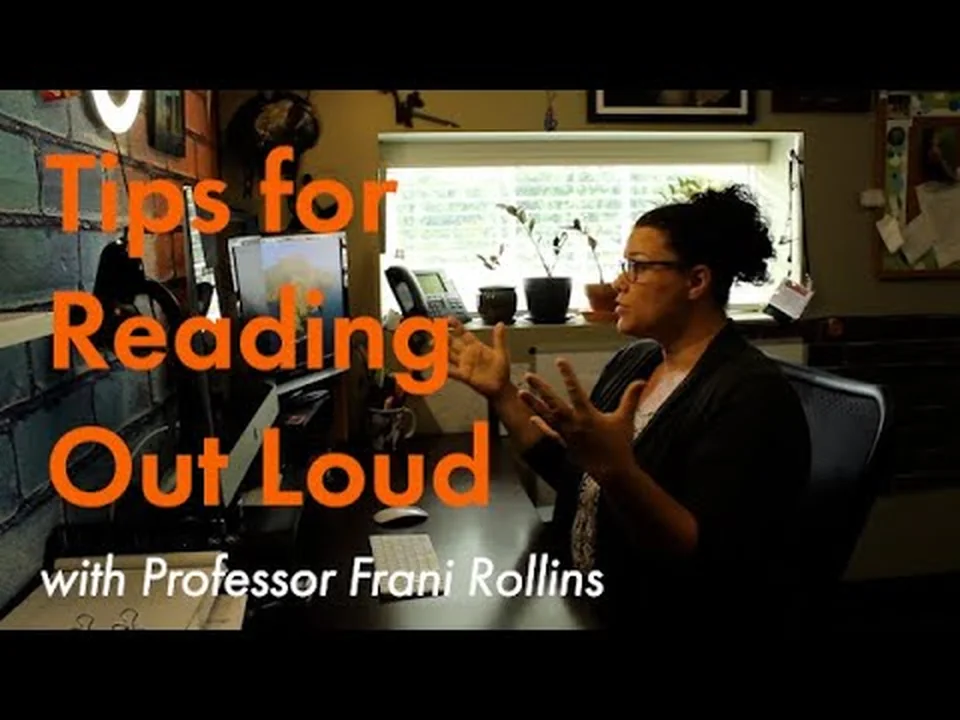
A librarian shares five read-aloud tips you can use to make your text easier to hear.
For a complementary perspective, watch this video from Center for Engaged Learning, Mercer University. Public read-aloud tips can help you hear a sentence; you do not have to perform your draft for an audience.
How can you hear whose sentence it is?
Read a sentence in context before deciding who speaks or thinks. An expressive performance can conceal a missing cue on the page. Compare a neutral reading without inventing accents or acting every character.
Original example: “Mina scanned the platform. Gone already! She should have checked the sign.” The first sentence establishes Mina; the next ones can carry her reproach. Starting directly with “She should have checked the sign” makes attribution less clear. Rhythm may not be the problem; the passage may need a situation.
| What you hear | What you can check |
|---|---|
| A voice clear only when acted | Is there a cue on the page too? |
| A judgment without an identifiable owner | Does context establish the character? |
| A deliberate repetition | Does it create a return rather than an accident? |
The free indirect discourse workshop explores the shift between narration and thought. For a short form, compare the order of a list poem. Avoid repairing everything in one session: focus here on voice clarity and leave sentence length for another reading.
Which errors cannot be settled by reading aloud?
Words can sound alike while differing in meaning or spelling. Reading aloud therefore cannot settle their spelling on its own. The OQLF defines homophones ; Merriam-Webster and the RAE explain the same distinction in their languages. Examples need to change with the language of the text rather than being translated word for word.
An original example: “The drawer holds two keys” and “The drawer holds too keys” sound alike at the uncertain word, but only the first expresses a number correctly. Hearing the sound alone does not select the intended spelling. Return to the written context: does the sentence need a number or a word meaning also or excessively? A dictionary can clarify the meaning if uncertainty remains.
| What you notice | Complementary pass |
|---|---|
| An ambiguous sound | Check the word and its meaning in context |
| An audible repetition | Look at its position and function |
| A doubtful fact | Return to the document supporting it |
Record points in two columns, “heard” and “check in writing,” without stopping at every sentence. Repetition need not always be removed: the anaphora workshop demonstrates a deliberate return. Oral reading, visual reading, and checking sources have complementary roles.
Frequently asked questions
Why read aloud?
Reading aloud gives you access to the rhythm and flow you can hear. It can reveal repetitions or ambiguities you no longer notice.
Should I record my voice?
No. A sheet of paper and a few marks are enough. If you record, consciously choose where the file will be stored and who can access it.
Should I read the whole text?
You can work on a page or a scene. A short passage makes it easier to stay focused while listening and compare versions.
Does a long sentence always need to be cut?
No. First, look for what’s getting in the way: syntax, information that comes too late, or simply the difficulty of reading in that moment.
What can I do if reading aloud wears me out?
Shorten the session and change the format without straining your voice. Another willing reader or an accessibility tool may offer a different listening experience.
How many times should I reread?
There’s no required number. Stop when you’ve addressed your chosen goal, then save the other questions for a separate session.