Contents
- What is a wheel of life for?
- What areas should you include in your wheel of life?
- How can you fill out the wheel of life without judging yourself?
- How can you interpret your wheel without looking for a perfect circle?
- An example of a wheel of life and a small step
- How can you move from reflection to a realistic action?
- When should you check in again, and what can you expect from it?
- Frequently asked questions
- Sources
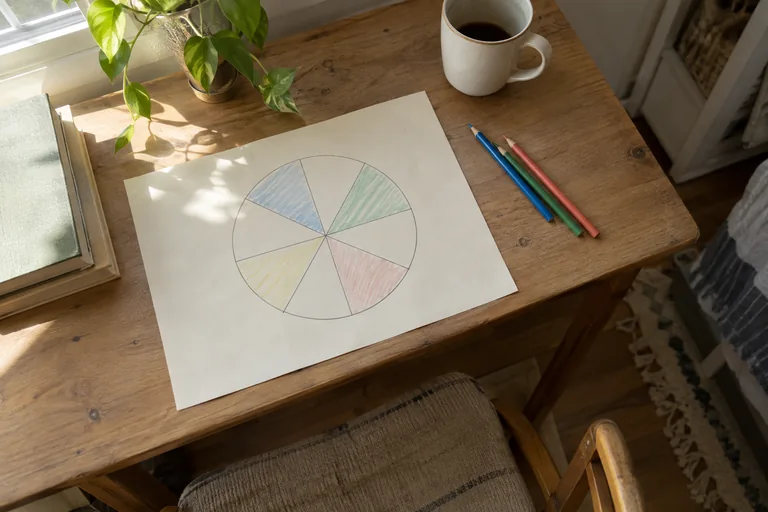
The wheel of life is a reflection exercise that represents your satisfaction across several areas of your daily life. You rate each area according to your own standards, then choose what deserves your attention: the goal is to plan one small action, not to create a perfect circle.
This guide offers an interactive wheel, an example, and a method you can use on paper. It can help you put words to a vague feeling, such as “everything takes up too much space.” It doesn’t measure your worth, your mental health, or the objective quality of your life. Your circumstances and what matters to you remain central to how you interpret it.
What is a wheel of life for?
The wheel brings together topics we often examine separately: relationships, rest, work, living environment, and leisure. Looking at it may reveal a contrast. You spend a lot of time working and little time with your friends—but is that a temporary choice that works for you, or a situation you’d like to change? The drawing opens up this question; it doesn’t answer it for you.
The versions used in coaching aren’t all the same. Some represent satisfaction, while others show the time or attention given to each area. So define what you’re rating before you begin. Here, the question is: “How well does this part of my daily life work for me over the period I’ve chosen?” A small amount of time can still feel completely satisfying.
Don’t try to divide your energy into eight equal parts. A move, caring for someone close to you, or a training program can shift your priorities. The wheel helps you look at this balance in context, then choose a possible adjustment. To tell your own wishes apart from the expectations around you, you can start by sorting out goals inherited from others.
What areas should you include in your wheel of life?
We suggest eight areas to get started. They aren’t a required list. On paper, you can combine two categories, split one up, or replace a label. Someone without a partner has no reason to give themselves a low score in a “relationship” category. They can choose the connections that truly matter in their life.
| Suggested area | Starting question | What the rating doesn’t tell you |
|---|---|---|
| Energy and rest | Does my pace leave room for me to recharge? | It doesn’t make any health diagnosis. |
| Close relationships | Do my important interactions work for me? | It doesn’t judge the people in my life. |
| Friendships and social connections | Do I have the kind of connection I want? | It doesn’t count the number of friends I have. |
| Work or activity | Does my current activity have room in my life? | It doesn’t measure my professional success. |
| Practical matters | Do practical matters feel manageable? | It doesn’t rate my income or assets. |
| Living environment | Does my environment meet my current needs? | It doesn’t compare my home with other people’s. |
| Leisure and creativity | Do I have room for what interests me? | It doesn’t evaluate my talent. |
| Learning and meaning | Does what I’m exploring feel nourishing? | It doesn’t impose any beliefs on me. |
Before rating each area, write down a concrete sign of satisfaction. “Having a calm conversation with a friend” is more specific than “succeeding at my social life.” Our values-in-action journal can help you find these signs in your actions. The words are personal: your definition doesn’t have to resemble another reader’s.
How can you fill out the wheel of life without judging yourself?
Choose a time when you can reflect for a few minutes, without feeling you have to finish everything. Write down the date and the period you’re looking at. If you’ve just had an especially difficult or happy day, remember that it may color how you see things. You can wait, or simply make a note of it alongside your answers.
For each area, think of two recent examples. What already works for you? What feels missing or weighs on you? Then rate your satisfaction from zero to ten, with zero meaning “this doesn’t work for me at all” and ten meaning “this works fully for me today.” There’s no average to reach here, and no universal threshold that would make you a balanced person.
If numbers make you feel boxed in, replace them on paper with three words: “preserve,” “adjust,” “explore.” Hesitation can also be useful information: you may not yet know what you want from this area. To keep your observations precise, distinguish facts from interpretations in your journal.

Your workshop
Your wheel, then a priority you choose
Start with the period you want to observe. The sliders are set to five as starting points for you to adjust; they are not answers calculated about you.
Choose based on how important the area is and what you can do, not just its rating.
No overall average. Nothing is saved or sent; your settings disappear when you leave or reload this page.
Do the same exercise on paper
Rate the eight areas in the table, or use your own labels. For each one, write a recent example and then a satisfaction rating from zero to ten. Draw the circle and mark your ratings. Then choose an area that matters to you now, one possible action, and any support you might need. You can also replace the ratings with “preserve,” “adjust,” or “explore.”
 Read alsoScripting: Write your dream life to clarify what you want
How can you interpret your wheel without looking for a perfect circle?
First, look at what’s working. A supportive relationship, an activity you enjoy, or a quiet corner can become sources of support. Satisfying areas aren’t boxes checked forever; some simply call for preserving what’s already there. You can protect a shared lunch before trying to add a new habit.
Next, notice which areas draw your attention. For each one, ask yourself whether it matters now, whether an action is within your control, and whether you have the resources you need. A material hardship doesn’t disappear just because you choose a positive thought. It may call for information, help, or a concrete step, sometimes with someone else.
Don’t calculate an average to sum up your life. The same result can hide very different situations, and adding the ratings doesn’t turn this exercise into an objective measure. Don’t compare your drawing with a friend’s, either. Your expectations and circumstances aren’t the same. If several paths still seem worthwhile, the guide for choosing a priority among several projects goes deeper into this decision.
Flip cards
Three questions to help you choose a priority
Does this matter to me now?Flip
A low score may concern an area you don’t want to develop this season. Start with your real need, not the shape of the drawing.
What action depends at least partly on me?Flip
Asking for information, suggesting a time, or preparing an item are possible actions. Getting another person’s response isn’t entirely up to you.
What support do I need?Flip
You can choose to seek help before taking action. A lack of time, money, or support isn’t a lack of willpower.
An example of a wheel of life and a small step
Let’s imagine a fictional example. Lina looks at the two weeks since her move. She rates her living situation a four, her friendships a five, and her leisure time a three. Still, she doesn’t choose to start with leisure time. The boxes limit her space for cooking, and that frustration comes back every evening, so her living situation feels like the priority this week.
She doesn’t set herself the goal of “tidying the whole apartment.” She chooses to clear part of the counter on Tuesday, after putting down her bag. If she’s too tired, she’ll just gather the items taking up that space in a labeled box. This first action doesn’t guarantee a higher score; it lets her check whether the kitchen becomes easier to use.
Lina also wants to reconnect with a friend. She suggests two time slots without treating a lack of response as a personal failure. This helps her distinguish an intention from a goal and an action from an outcome. You can make the same distinction in your own words: “I’d like more connection” and then “I’ll send a specific invitation today.”

How can you move from reflection to a realistic action?
Write a sentence with an observable verb: call, prepare, ask, try, or set aside a time. “Be more fulfilled” points in a direction, but doesn’t say what to do tomorrow. “Read two pages of the book already resting by the armchair” describes an identifiable action. Choose a version small enough to fit into your current daily life.
Add a concrete cue, then a likely obstacle. You can use an if-then plan : “If my meeting ends too late, then I’ll move my attempt to Thursday at noon.” Preparing this alternative lets you adapt your plan instead of treating the first unexpected event as a verdict. The five-minute small step offers other ways to make getting started easier.
Finally, choose what you’ll observe. Did you take the action? Was it useful, too demanding, or poorly timed? This observation is first about the action, not an obligation to feel better. The distinction between process goals and outcome goals helps you track what depends on you without promising a specific effect.
Checklist
Is my next action clear enough?
0 / 5
Your next attempt is defined. You can adapt it if your circumstances change.
When should you check in again, and what can you expect from it?
Choose a time to check in that gives you a chance to try your action: for example, at your next weekly check-in or after a concrete change. There’s no required frequency for the wheel. Repeating the notes every evening can take up a lot of space without adding useful information. A simple weekly check-in is often enough to observe the chosen action.
The research cited at the end of this guide concerns tracking progress toward a goal, not the wheel of life itself. Harkin and colleagues’ meta-analysis brings together 138 studies and finds that, on average, tracking your progress can help you reach a goal. It does not validate our eight categories or a psychological interpretation of the notes. Here, it supports only the idea of revisiting an action rather than forgetting the check-in.
Read your examples again before comparing two drawings. A rating may go down because you notice a need more clearly or because the circumstances are different. On its own, it doesn’t prove that you’re regressing. You can adapt a goal when your situation changes and keep a record of what you learned, even if the action hasn’t become a habit.

For a complementary perspective, watch this video from Springboard Consultancy.
Quiz
How to read the exercise results
Should my lowest-rated domain be my priority?
See the answer
Not necessarily: I also consider how important it is and what I can do. The rating draws your attention. It doesn’t choose for you what matters now.
Does an uneven wheel mean my life is a failure?
See the answer
No, the drawing reflects my answers at a given moment. The domains don’t all have the same place in your life, and the exercise isn’t an overall judgment.
How can I tell whether my small step is worth keeping?
See the answer
I look at what I did, how useful it was, and what needs adapting. Looking back at an action gives you concrete information. No score guarantees its effect.
Frequently asked questions
Is the wheel of life a psychological test?
No. The version offered here is a tool for self-reflection, with no clinical score or validated threshold. It cannot diagnose a difficulty. If ongoing distress is weighing on your daily life, talk to a health professional rather than looking for an explanation in the drawing.
How many domains should I choose?
Eight is a practical starting point, not a rule. On paper, you can adapt the labels to your situation and keep fewer. The key is to understand what each area represents and avoid rating exactly the same thing twice.
Can you fill out a wheel of life online?
Yes, the tool in this guide lets you move the eight sliders and choose an area to explore. The values stay on the open page and disappear when you reload it. To keep your reflection, copy only the information you want to save in your journal.
How do you make a life wheel on paper?
Draw a circle, divide it into sections, and write your chosen areas around the outside. The center represents zero and the edge represents ten. Add a score in each section, then connect the points. Add the date, the period you’re reflecting on, and a sentence explaining each answer; the drawing alone isn’t enough.
What should I do if I give everything a low score?
Return to the context and recent facts, then look for accessible support. You can set the ratings aside and start with a concrete need, without asking yourself to change everything. If you’ve been feeling this way for a while, someone you trust or a professional can help you avoid carrying it alone.
Is the coaching Wheel of Life the Buddhist Wheel of Life?
No, the same name can refer to different things. This guide is about a contemporary personal-reflection exercise organized by areas. It doesn’t cover the Buddhist wheel or offer a spiritual interpretation of it.
Sources
- Mind Tools: The Wheel of Life, an overview of the coaching exercise and its areas.
- Go Master Coach: Wheel of Life, a reflection method based on satisfaction and desired changes.
- Harkin et al., 2016: Does monitoring goal progress promote goal attainment?, a meta-analysis published in Psychological Bulletin, DOI 10.1037/bul0000025. This study concerns goal monitoring, not validation of the Wheel of Life.
Sources consulted on October 8, 2026. Lina’s example is fictional.