Contents
- What does ikigai mean beyond the four circles?
- How do you start an ikigai exercise with real-life moments?
- How do you separate enjoyment, skills, and the desire to learn?
- How can you consider usefulness without having to save the world?
- Why do constraints belong on the worksheet?
- What does a filled-in ikigai example look like?
- Your workshop: four notes, then one hypothesis to choose
- How do you turn a path into a small experiment?
- How do you review your ikigai exercise without grading yourself?
- What does research actually say about ikigai?
- Frequently asked questions
- Sources
An ikigai exercise can help you explore what matters in your everyday life, then choose a concrete path. It doesn’t uncover a hidden calling or require you to combine enjoyment, talent, usefulness, and income in one activity.
Take a sheet of paper, a few recent moments, and the freedom to leave some boxes open. We’ll distinguish a Japanese idea about lived meaning from a modern adaptation with four questions. The workshop here leads to a modest experiment: something to observe, not a definitive answer about who you are.
What does ikigai mean beyond the four circles?
A presentation by the Japanese government describes ikigai as what gives life value and joy: it can involve work, relationships, or leisure. So the word, by itself, doesn’t require you to turn everything that matters to you into a profession. A presence, a practice, or a curiosity can be meaningful without becoming a career project.
The four-circle version has a different history. In a 2014 post, Marc Winn connected the word ikigai to a “purpose” diagram that he later attributed to Andrés Zuzunaga. This now-popular diagram can open a conversation, especially about work. It isn’t an exhaustive definition of the Japanese term or a validated test that could establish the right path for you.
Keep this distinction in mind as you fill out a worksheet. You can use the four questions without demanding a perfect intersection. If the word “vocation” puts pressure on you, replace it with “a direction I’m interested in right now.” The values-in-action journal explores the qualities you want to bring to your actions; the two approaches can complement each other.
| Aspect | Helpful question | What it doesn’t prove |
|---|---|---|
| Lived meaning | What matters in my life today? | A single mission |
| Modern diagram | Which directions bring several interests together? | A complete definition of ikigai |
| Practical experiment | What do I want to observe as I practice? | A definitive aptitude |
| Paid project | What real-world conditions should I examine? | A guaranteed demand or income |
How do you start an ikigai exercise with real-life moments?
Choose three recent moments when you wanted to take part, understand something, or keep going. It could be preparing a meal, explaining a detail to a friend, or repairing an object. Describe what you were doing, who you were with, and the conditions. “I like helping” is broad; “I liked explaining that route to someone” offers a more specific starting point.
Add a moment you don’t want to repeat. Maybe you liked the activity, but not its pace, setting, or the expectation to show it to others. This nuance can help you avoid dismissing an entire field because of one difficult experience. You can like drawing without liking urgent commissions, or enjoy organizing without wanting to make every decision for a group.
If nothing comes to mind, choose a neutral scene. The one-sentence-a-day journal lets you collect a few facts without launching into deep introspection. You don’t need to feel an intense passion. A little curiosity, a moment of focus, or the desire to return to an activity is enough to suggest a first hypothesis.

How do you separate enjoyment, skills, and the desire to learn?
On your worksheet, distinguish what you enjoy from what you already know how to do. These lists may overlap, but they aren’t the same. You can enjoy listening to music without knowing how to play an instrument. You can also be skilled at a task that wears you out. Neither of these gaps invalidates what you write down.
For a skill, look for evidence: a finished piece, a clearly explained request, specific feedback, or a problem solved. Avoid broad statements like “I’m good with people.” Instead, ask what action you take and in what context. The skill learning journal helps you distinguish an existing skill, a challenge, and a next opportunity to practice.
Make room for learning interests. An activity you’re still clumsy at can count, and an old skill may no longer fit your priorities. You can write “I’d like to try” without claiming “I’m made for this.” To get an outside perspective, ask for specific feedback on something you’ve created rather than a verdict on your talent or future.
Flip cards
Four distinctions to keep in mind
I enjoyFlip
An activity or condition that interests me.
I canFlip
An action I can describe with an example.
I’m learningFlip
A possibility that’s still open, without a verdict on my skill level.
I chooseFlip
A path to try in my current situation.
 Read alsoScripting: Write your dream life to clarify what you want
How can you consider usefulness without having to save the world?
The question of usefulness can stay close to home. Who might appreciate this gesture, explanation, or presence? Don’t decide on behalf of the person concerned. An offer of help becomes more concrete when you check that it meets a real need and respects the other person’s choice.
You can also choose an activity for your own enjoyment, without assigning it a collective impact. Rest, relationships, and leisure don’t have to earn their place by becoming services. If you feel compelled to make every desire useful, consider the difference between your desires and other people’s goals. You can keep an activity private, ordinary, or simply enjoyable.
For a work project, the question shifts in scale: who is it for, under what conditions, and with what resources? A personal worksheet can’t verify professional demand. It can help you prepare questions, then have a conversation or do relevant research. It isn’t enough to quit a job, take on a major expense, or conclude that an idea will be profitable.
Why do constraints belong on the worksheet?
Time, resources, health, responsibilities, and access to places all influence the options available to you. Writing them down doesn’t mean you lack ambition. It helps you distinguish between a path you could pursue now and a project that would require preparation, support, or a different time.
Also write down what you want to preserve. You can refuse to turn a hobby into a source of income, or prefer an occasional activity to a regular commitment. The guide for setting a boundary without justifying yourself can help you define that place. Your exercise should make room for these limits, rather than presenting them as resistance to overcome.
If several areas are calling for your attention, the wheel of life offers another perspective: it organizes a satisfaction review. Here, we’re looking for an activity to explore. A low score in one area doesn’t require you to make it your new calling, and wanting to try something doesn’t mean you have to reorganize your whole daily life right away.
What does a filled-in ikigai example look like?
Here’s a entirely fictional example, designed to show concrete responses. Camille isn’t a client or someone whose results we’re recounting. She wants to take up a hands-on activity again, without changing jobs or monetizing her hobby. The four boxes bring one possible path to light; they don’t prove she’s found her calling.
| Worksheet question | Camille’s fictional response |
|---|---|
| What scene interests me? | I enjoyed calmly mending a small tear in my bag. |
| What skill or learning? | I know how to sew on a button; I’d like to learn a simple darning stitch. |
| What connection, usefulness, or private enjoyment? | Extend the life of an object I love, without taking on orders. |
| What conditions and limits? | A short session on Sunday, using supplies you already have; no purchase and no obligation to turn it into income. |
Her chosen path becomes: “explore textile mending for my own enjoyment.” Her next try is to practice on a scrap of fabric before working on the bag. What she wants to observe: does she feel like continuing, and do the conditions work for her? An imperfect stitch doesn’t decide her future. She can adjust the try, ask for an explanation, or choose something else.
So the “income” box can stay open. The broad meaning presented by the Japanese government includes relationships and leisure; our educational example demonstrates no health effects. If your project concerns a profession, real demand and working conditions will need to be considered separately.
Download the blank text worksheet
The file contains the four questions, the chosen path, the next try, and a line for reflection. Open it in your editor or print it. No personal answers are sent.
Your workshop: four notes, then one hypothesis to choose
Use one example for each question. The workshop brings your notes together without interpreting them: you choose a path and what you want to try. You can use the same format in a journal and leave an answer blank if it doesn’t help you today.
Your workshop
A path you choose, then a try
These notes aren’t a test. No results are inferred from your answers.
Your entries stay only on this page and disappear when it reloads. Nothing is sent or saved.
Do the same exercise on paper
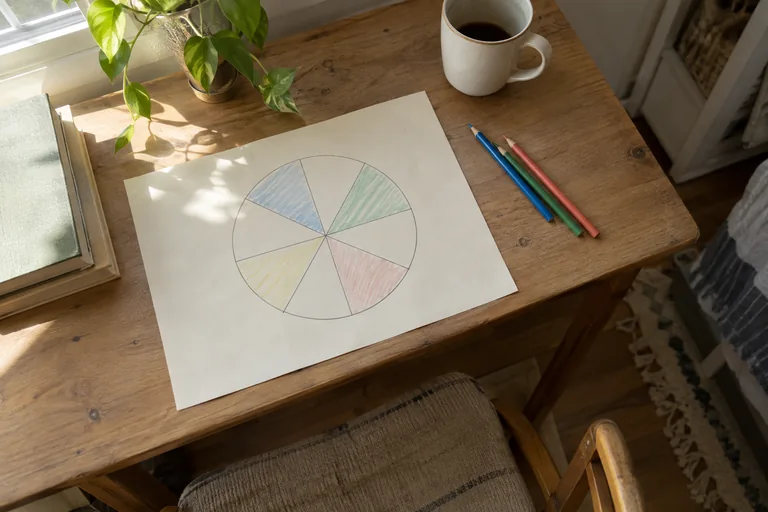
Mark out four spaces: a scene that interests you; a skill or something you want to learn; a connection or private enjoyment; your conditions and limits. Then add the path you choose, a small try, and what you want to observe. You can leave spaces blank. There’s no score or required overlap.

How do you turn a path into a small experiment?
Describe an observable, limited, and reversible action. “Explore photography” could become “take a few pictures of an object with the camera I already have.” “Share what I know” could become “offer a short explanation to someone who wants to hear it.” The action doesn’t need to prove that this path will be right forever.
Then choose what you want to observe: your interest while practicing, the conditions that make the activity easier, a challenge, or whether you feel like trying again. Distinguish the process goal from the expected outcome. Preparing for a conversation is something you can do; receiving an invitation or persuading someone also depends on other people and the context.
You can use the five-minute small step to make an overly broad starting point more manageable, without making that time frame an obligation. Plan for a realistic opportunity instead of a heroic schedule. A single experiment can raise a useful question; it can’t tell you whether or not you have a calling.
Checklist
Plan a try that fits you
0 / 5
A completed checklist prepares you for an action; it doesn’t obligate you to take it.
How do you review your ikigai exercise without grading yourself?
After the trial, write down what actually happened. Separate the experience from your judgment of yourself. “I enjoyed preparing, but the duration didn’t work for me” offers useful information. “I have no passion” turns one limited experience into a general conclusion. You can change the format, look for support, or set this path aside.
Harkin and colleagues’ meta-analysis examines progress monitoring toward goals and found an average benefit across the interventions studied. It does not validate an ikigai exercise. Here, keeping a brief record is mainly a way to decide what to do next; it guarantees neither success nor well-being.
A weekly review in your journal can hold this record. You don’t have to track every activity or share your results. Notice whether the notes help you make a choice; if they mostly make you check whether you’re making enough progress, simplify the format or take a break.
What does research actually say about ikigai?
A 2022 longitudinal study examined links between self-reported ikigai and various health and well-being indicators in Japanese adults aged 65 and older. The associations observed don’t prove that an exercise based on four circles produces these effects. Ikigai was assessed with a question, without using our workshop.
The authors discuss, among other things, the limits of self-reported answers, factors that may still confound the associations, and the possibility of relationships in both directions. The population and context matter too. We can’t turn these findings into a promise of longevity, health, or happiness for someone filling out a worksheet today.
This article offers a more modest proposal: describe specific experiences, formulate a possibility, and choose an experiment that fits your resources. If this reflection starts to feel burdensome, you can set it aside. Ongoing loss of interest, distress, or difficulties that go beyond this scope call for appropriate support from another person; a journaling workshop is no substitute for that support.

Quiz
Three ideas to examine
An activity must be paid to be meaningful.
See the answer
False. A sense of meaning can also come from relationships, hobbies, or private activities.
The four circles are a validated career aptitude test.
See the answer
False. This modern diagram opens up reflection; it doesn’t provide a diagnosis.
A first trial may lead you to change course.
See the answer
True. Observation helps you choose what comes next, not defend your first idea at all costs.
For a complementary perspective, watch this video from Andre.
Frequently asked questions
Do you need to fill in all four circles to find your ikigai?
No. The diagram is a modern adaptation, and no perfect intersection is required here. You can leave a question open.
Can you do this exercise without a work project?
Yes. Relationships, hobbies, and personal activities can count. You can replace income with the conditions that make an activity possible.
What should I do if I don’t know what I love?
Start with a recent moment or a small curiosity. You can simply collect examples without searching for a passion or drawing a conclusion right away.
Can you have more than one possibility?
Yes. Different activities can feel meaningful at different times. Choosing one experiment now doesn’t mean you have to give up all the others.
How long does it take to get an answer?
No timeline guarantees an answer. You can move forward through moments and experiments, then stop when reflection is no longer useful.
Does this exercise improve health or longevity?
This workshop can’t promise that. Associations observed in studies on ikigai don’t validate our exercise or establish a medical effect.
Sources
- Government of Japan (2022). Ikigai: The Japanese Secret to a Joyful Life. Cultural overview; no health claims are repeated here.
- Marc Winn (2014, attribution note added later). What is your Ikigai?. Source for the modern association between the word and the diagram, attributed to Andrés Zuzunaga.
- Okuzono, S. S. et al. (2022). Ikigai and subsequent health and wellbeing among Japanese older adults: Longitudinal outcome-wide analysis. The Lancet Regional Health – Western Pacific. DOI. Observational study, not validation of a workshop.
- Harkin, B. et al. (2016). Does monitoring goal progress promote goal attainment? A meta-analysis of the experimental evidence. Psychological Bulletin. DOI. A reference point for goal tracking, separate from ikigai.