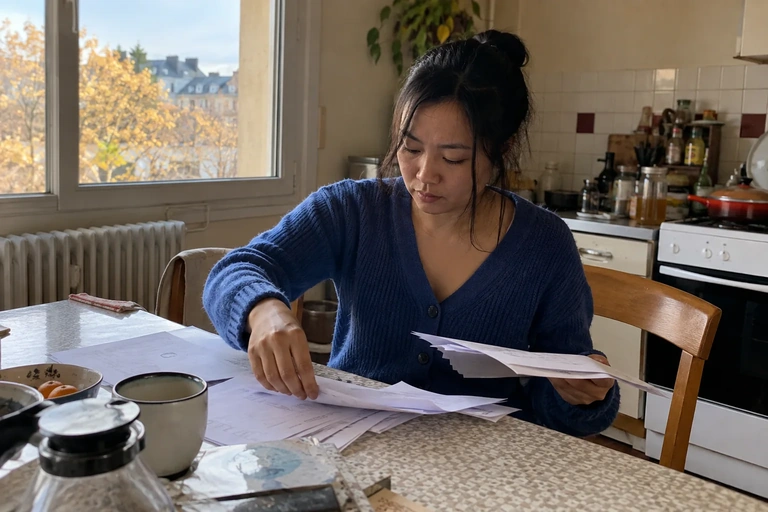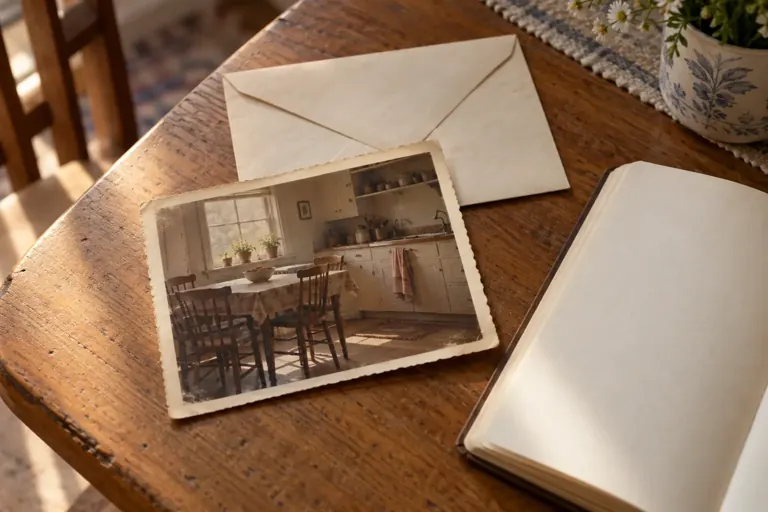
Contents
- Why do a birthday reflection that’s different from a review of your goals?
- Birthday reflection: How can you revisit the year you lived?
- What questions can you ask about relationships?
- How can you look at what has changed in you?
- How can you choose an intention for the year ahead?
- What can you do if your birthday makes you sad or puts you under pressure?
- A birthday page inspired by places
- Frequently asked questions
- Sources
A birthday reflection can tell the story of what mattered in your year without ranking your achievements or delays. Choose a few moments, important relationships, and a current need; this date is a personal marker, not a deadline to have become a certain version of yourself.
You can write on the day itself, before or after, on your own or in several sessions. No ceremony is necessary. If birthdays are complicated for you, you can choose another date or skip the reflection: the calendar doesn’t require you to set aside time for introspection.
Why do a birthday reflection that’s different from a review of your goals?
A goal lets you track a defined outcome. A year of living also includes acts of care, detours, waiting periods, and things you hadn’t planned. Looking at them only as successes or failures leaves out much of the experience.
| Starting your reflection | Question | What it avoids |
|---|---|---|
| A moment | What moment comes to mind? | The overly broad summary |
| A relationship | Who did I share something with? | The performance list |
| A curiosity | What did I feel curious to discover? | The pressure to excel |
| A need | What would I like to make room for now? | The overambitious plan |
If you’d also like to evaluate a project, set aside a separate page for the judgment-free goal review. Separating the two keeps a disappointing result from becoming the conclusion of your whole year. You may have gone through an important period without having an accomplishment that’s easy to show.
Birthday reflection: How can you revisit the year you lived?
Choose three markers: a season, a place, and a conversation. You can check your calendar or a few photos if you like, but you don’t need to go through all your archives. A personal reflection is a selection; it isn’t an exhaustive account.
Write a moment for each marker. “The lunch where we talked for a long time” gives you more to work with than “I saw my loved ones more often.” The guide to writing about a specific memory helps you hold on to a gesture or a phrase without claiming to recall every detail.
You can add an ordinary moment, such as a regular walk or a coffee shared with someone. It doesn’t have to be happy to deserve a place. The BnF shows, through Zola’s correspondence, that everyday routines, meals, and exchanges are also part of the historical record. This cultural reference invites you to look at concrete details without assigning them a therapeutic effect.

What questions can you ask about relationships?
Ask yourself who you shared a moment of connection with, learned something from, or found support in. You can also notice a relationship that has become more distant without deciding right away to repair it. This reflection isn’t a ranking of the people who mattered enough to you.
Write about what you received and what you gave, using examples. If a sense of gratitude emerges, a unsent gratitude letter lets you explore it freely. Afterward, you’re still in control of whether or not to share this page.
For a difficult relationship, use wording that describes your experience rather than diagnosing the other person. “Our conversations often left me feeling drained” may point to a need for a boundary. The guide to setting a boundary without justifying yourself can help you reflect further if taking action becomes necessary.
How can you look at what has changed in you?
Start with an observable change: you ask for clarification more easily, cook a new recipe, or accept being a beginner without knowing everything. These changes don’t need to be dramatic. You can connect them to the guide for celebrating yourself before you reach perfection.
Also write about what’s still difficult. Acknowledging fatigue or a constraint doesn’t ruin the page. A year can hold several truths: a joyful discovery and a disappointment, a supportive relationship and a sense of absence. You don’t have to calculate an emotional average that erases the contrasts.
Finally, distinguish your desire from the social timeline. An important milestone for others isn’t automatically an obligation tied to your age. The article on personal desires and other people’s goals helps you examine this difference without judging the choices of those around you.
Flip cards
A few things to keep in mind
A momentFlip
What detail captures the spirit of this year?
A relationshipFlip
What conversation mattered without being dramatic?
A needFlip
What would you like to make room for in the next chapter?
 Read alsoScripting: Write your dream life to clarify what you want
Checklist
Prepare your page
0 / 4
You can now try something, adapt your approach, or close your journal.
Your workshop
Choose your starting point
Open a suggestion and try it in your journal. You don’t have to share anything personal on this page.
A full year
Choose just a few contrasting moments. You don’t have to sum up everything that happened.
A challenging year
Narrow the page down to what helped you and what you need now. You can stop at any time.
An ordinary year
Write about a commute, a meal, or a familiar encounter. Look for a specific detail, not an exceptional event.
Generator
A writing prompt
Choose moments instead of ranking them. What I notice specifically is…
See all the phrases
Observe
- Choose moments instead of ranking them. What I notice specifically is…
- Make room for relationships and curiosities. My example today would be…
Choose
- Choose an intention or simply bring things to a close. The version that works for me is…
- I can leave this page as it is, because what I wanted to put down here was…
How can you choose an intention for the year ahead?
You can finish without a goal. If an intention feels useful, phrase it as a direction to explore: more time outdoors, a relationship to nurture, or a curiosity to follow. Avoid turning the last page into a contract with twelve areas to improve all at once.
Then choose a step small enough to try soon. An intention to connect with others can start with suggesting a walk, not by remaking your entire social circle. The five-minute small step helps make a direction actionable without promising a result.
You can also write a permission: to let a project rest, protect a block of free time, or hold off on deciding. To keep your wish provisional, the weekly intention offers a horizon that’s easier to revise than a solemn yearlong commitment.

What can you do if your birthday makes you sad or puts you under pressure?
Narrow the scope. You can choose a single moment instead of an entire year, or write about what you need today. You don’t have to make this day happy through writing. A page can simply acknowledge that this date is difficult and that you’d rather get through it another way.
Avoid comparing your behind-the-scenes with other people’s announcements. A party photo, a promotion, or a trip shows only part of a life. The guide for comparing yourself without putting yourself down can help you return to a question that truly concerns you.
If sadness, isolation, or distress persist and weigh on your daily life, seek support from someone you trust or a professional. This reflection is optional; it doesn’t replace support, and it shouldn’t leave you alone with suffering that has become too much to bear.
You can give the page a title without any judgment, such as “What took up space this year.” Then add the actual date you wrote it. If you return to the text later, you’ll know it reflected a particular moment, not a final verdict on twelve months. You can leave blanks for memories that don’t come to mind, without promising yourself you’ll fill them in. A partial page may be truer to your experience than a review carefully balanced across every area of life.
A birthday page inspired by places
If questions about yourself feel too abstract, choose three places where you spent time this year. They can be nearby and ordinary: a kitchen, a park, a waiting room. For each one, describe a scene and what you were doing there. You’ll have a review grounded in specific places without starting with a personal evaluation.
Then look at who appears in these scenes and which activities come up again. One place may have been where you connected with others, another where you rested or went through a period of uncertainty. None needs to be labeled positive or negative. Together, they show different parts of the year, some of which might have stayed invisible in a list of accomplishments.
You can finish by naming a place you’d like to keep visiting, or a space you need now. This last sentence is a signpost, not a promise to follow a plan. That way, your review can open the door to a concrete desire without imposing a transformation tied to your new age.
For a complementary perspective, watch this video from with Jocelyn.
Frequently asked questions
When should I write a birthday review?
Whenever works for you, even several days later. The date is a reference point, not a mandatory deadline.
What if I didn’t accomplish anything this year?
You can look at the moments, connections, and needs rather than the results. Your reflection doesn’t have to prove that you earned your year.
Should I reread my previous review?
It’s optional. If you do, put it back in context rather than treating every intention as a promise to keep track of.
Can I do this review without talking about my age?
Yes. You can simply name the period and what it held for you.
Should I share my review with people close to me?
No. A private version can remain more open; if you share it, choose which passages to include and respect the people mentioned.
How many pages should I write?
One page may be enough. Stop when you’ve kept what seems useful to you, without filling pages just to reach a certain number.
Sources
- Bibliothèque nationale de France. “Zola au jour le jour.” Heritage resource on the place of daily life, travel, and everyday details in correspondence. View the resource.