
Contents
- What is a coming-home ritual for?
- Choose a threshold that exists in your life
- A three-part ritual for coming home
- Adapting the ritual when the house is already occupied
- Two examples without an ideal setting
- Keep only what makes the transition easier
- When the commute itself is a transition zone
- A seven-day adaptation, with no performance chart
- Coming home after an enjoyable activity can also call for a transition
- What the ritual can’t resolve on its own
- Frequently asked questions
- Sources
A coming-home ritual is a brief transition between an activity outside the home and whatever is waiting for you at home. It can consist of three ordinary gestures: putting your things down, identifying what’s still open, and choosing how to move into the rest of your day.
The goal isn’t to feel available and relaxed the second you walk through the door. It’s to make the transition less automatic with a version that works for your home, schedule, and the people who are there. No special equipment is needed.
What is a coming-home ritual for?
The commute doesn’t always feel like a clear ending. You might come home still carrying a work conversation in your mind, or check a message while you’re already looking for your keys. A small sequence you choose creates a visible cue: this activity stops for now; another one begins. It won’t magically put your worries to rest or resolve an excessive workload.
The evening ritual is more about the end of the day. Coming home can happen at noon, early in the morning, or after an outing unrelated to work. Think about the transition that actually gives you trouble, rather than an ideal end-of-workday scene. Someone who works shifts and someone who works remotely will need different cues.
| Context | Possible threshold | Minimum version |
|---|---|---|
| Working outside the home | Keys put down | Set down your bag and have a drink |
| Remote work | Equipment put away | Close the file and note where to pick up |
| Shift work | Change clothes | Choose what you need right now |
Choose a threshold that exists in your life
Your threshold can be the front door, the moment you take off your shoes, or closing your laptop in a home that also serves as your office. Avoid creating a condition that’s hard to meet, such as having a quiet room available for fifteen minutes. The more your ritual depends on a perfect setting, the more likely you are to put it off precisely on the days when the transition would help.
Observe two or three returns without changing anything. What do you already do? Where does your bag end up? When do requests overlap? The time estimation journal can help you see how much room is actually available, without timing every gesture. You’re looking for a foothold in your existing routine, not a new program to add to an already cluttered entryway.
Research by Lally and colleagues on habit formation highlights the role of repetition in a stable context, with important differences between people and behaviors. It doesn’t validate this particular ritual or let us promise that it will become automatic after a fixed amount of time. You can try a consistent cue without setting yourself a perfect streak or a magic number of days.
Quiz
Check your understanding
Does coming home always have to happen in the evening?
See the answer
No, it depends on your activities and schedule. Choose the actual transition in your day.
Should the ritual make every concern disappear?
See the answer
No, it marks a transition without guaranteeing an emotion. An important question can remain open.
A three-part ritual for coming home
Set down what you can
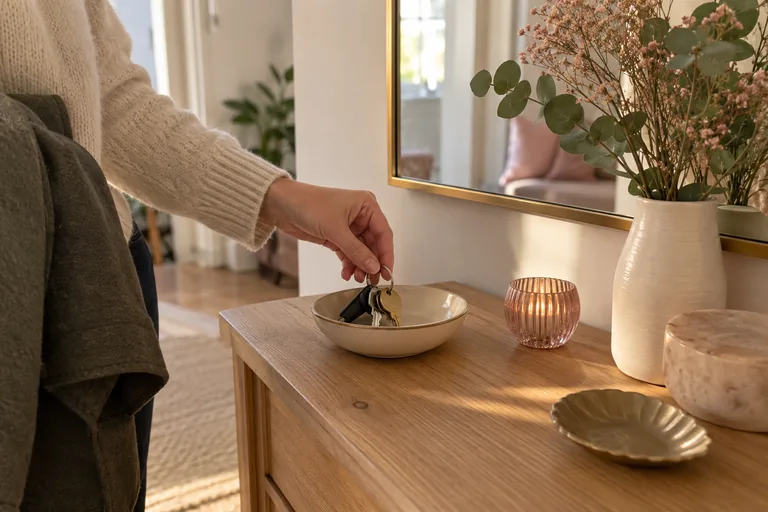
Choose a physical action you already need to take: set down your bag, put away your keys, take off a jacket, or put away your work equipment. Give it a simple place. If you have to move four things before setting down your work phone, your storage setup may need simplifying. The gesture doesn’t need deep meaning; first and foremost, it needs to be practical.
Don’t confuse setting things down with an obligation to cut off all communication. Some responsibilities require you to be available at specific times. In that case, define what you can realistically commit to: which channel will remain accessible, for what kinds of requests, and until when? The boundaries guide can help you prepare for a conversation, but a personal ritual doesn’t replace a work or family agreement.
Leave a note about what’s still open
If a task keeps going around in your head, write down only the next point to pick it up again. “Tomorrow, check the document I received” is more useful here than reconstructing the whole day. You can use the journal to close out the day when you’d like a little more detail. For a short transition, one line is often enough so you don’t have to keep the information in your head.
The note doesn’t promise that you’ll stop thinking about it right away. It simply gives what’s still open a place. If a real emergency requires action, handle it according to its importance instead of trying to make it disappear through the ritual. On the other hand, if you add a new list of twenty tasks, you’ve probably started working again. Go back to just one next step.
Choose when you’ll first be available
Ask yourself what you need before moving on: a glass of water, a change of clothes, greeting someone, or a few quiet moments. If you live with other people, express that need concretely: “I’ll put my things down, then come find you.” A realistic time frame and following through are clearer than withdrawing indefinitely and leaving the other person to guess.
It’s also possible that the best transition is an immediate conversation. Some people like to briefly share how their day went; others prefer to wait. You don’t have to adopt the model that looks calmest. The memorable conversations can help you identify the kind of contact that works for you, as long as you don’t turn every homecoming into a mandatory debrief.
Flip cards
Choose a starting point
Set downFlip
What object marks the end of the activity?
Write it downFlip
What’s the next point to pick it up again?
Step inFlip
What do you need before moving on?
 Read alsoNew moon ritual: set your intentions for the month
Adapting the ritual when the house is already occupied
In a small home, the threshold is sometimes mostly about time. You can close a box of supplies, turn a notebook over, or move your chair after work. These are modest signals, but they keep you from depending on a separate room. Don’t turn the shared table into permanent territory if it serves other purposes. Reversible storage respects both your need for a transition and the shared life around you.
If someone is waiting for you with a specific request, distinguish urgency from preference. You won’t always be able to follow your usual order. Plan a shorter version: set down your bag, name the transition to yourself, and respond to what matters. The five-minute small step illustrates this approach of scaling down, but your threshold can be even shorter. There is no minimum duration that would make the transition valid.
Finally, avoid asking others to create the whole atmosphere for your ritual. You can suggest a mutually discussed rule, but don’t assume everyone will guess that you need quiet. A helpful transition remains negotiable. If tensions stem from a long-standing imbalance in how tasks are shared, a conversation about how things are organized will matter more than choosing a herbal tea or music.

Two examples without an ideal setting
In a fictional scenario, Élodie comes home after a late shift. She doesn’t want to talk at length or start a review. Her transition consists of taking off her shoes, preparing some water, and leaving a note if there’s something to revisit the next day. After that, she remains free to eat or go to bed according to what she needs. The ritual doesn’t decide the rest of the night for her.
Another example: Maëlle works at her kitchen table. She puts her computer in a sleeve, notes the first file to reopen, and clears the table for its shared use. Then she chooses a short observation walk or stays home. Going outside is optional. What matters is distinguishing the end of a session from simply waiting for the next message.
Generator
A wording to adapt
I set down what can be set down and choose what comes next.
See all the phrases
Threshold
- I set down what can be set down and choose what comes next.
- This session ends here, even if everything isn’t finished.
Revisit
- I keep just one note to pick up where I left off tomorrow.
- I don’t have to resolve the whole day in the entryway.
Keep only what makes the transition easier
After a few times, notice which action really helps you start something else. Maybe putting your things away is enough, and the note feels like extra weight. Maybe what you need most is to let your loved ones know before you arrive. You can keep one element and drop the rest. The nonjudgmental review helps you examine an experience without deciding that you succeeded or failed at your routine.
A ritual isn’t meant to make you feel calm all the time. A difficult day can still weigh on you after you’ve hung up your coat. If your worries persist or seriously disrupt your daily life, seek appropriate support rather than a more demanding protocol. For today, a clear enough transition can be as simple as this sentence: “I know what’s still open, and I choose my next action.”

Checklist
Keep only what works for you
0 / 4
You’ve set your reference points. You can adapt or stop this practice.
When the commute itself is a transition zone
Some days, you can mark the transition before you arrive. When you’re safely settled on public transportation, you can note your next point to pick up from or choose what you’ll need when you get home. This is different from being obligated to meditate on the bus. If you need to watch for your stop, your luggage, or conditions during the trip, keep your attention available. The ritual should never take priority over safety.
When driving, wait until you’re parked before writing, changing an app, or looking for audio content. You can simply decide before leaving that your first action when you arrive will be to put your things in a specific place. No exercise with your eyes closed or absorbing instructions are needed during the trip. You can prepare for a transition with a very simple decision without adding another task to driving.
You don’t always need to use the commute. You may want to listen to the radio, talk to someone, or do nothing in particular. If every break becomes a self-improvement exercise, your ritual adds another layer of work. Keep a version that starts only once you’re home. Choosing where to begin should lighten your load, not take over every minute between responsibilities.
A seven-day adaptation, with no performance chart
For the first two days, observe what your return home is actually like. Don’t try to make it ideal yet. Just note when you start to feel pulled between different activities: a notification by the door, work materials left out, or a request you answer before putting down your bag. This observation helps you choose a useful action; it isn’t a checklist of everything that’s poorly organized.
For your next two returns, try just one change. You can set up a place for your keys, write your note before leaving work, or let someone know what time you’ll arrive. If you introduce several changes at once, it will be harder to tell which one actually makes the transition easier. One tiny change is enough for this first try, even if it doesn’t immediately help you feel more relaxed.
In the following days, prepare a version for unexpected situations. Imagine getting home later, with your hands full, or in the middle of an urgent request. Which part can stay? Maybe all you do is put one item away and leave the rest for later. This short version is part of the ritual; it isn’t a failed version. At the end of the week, keep what was useful and remove what you forgot without any consequences.
Coming home after an enjoyable activity can also call for a transition
We often associate a coming-home ritual with a difficult day, but a pleasant moment can also leave you feeling out of sync. After an outing with friends or a workshop, you may arrive with lots of ideas while the house is already quiet. You can keep a phrase or detail in a notebook, then choose how to join the atmosphere around you. The point isn’t to dampen your enthusiasm, just to give it a place.
Conversely, you may feel a little empty after an event you’d been looking forward to. Returning to everyday life doesn’t prove the outing was disappointing or that you should keep the evening going indefinitely. Prepare one ordinary, welcoming action: put away your ticket, set aside the things you used, or get ready what you’ll need when you wake up. Keeping it simple can help you avoid expecting the return to match the moment that just ended.
If you’d like to tell someone about the event, ask if it’s a good time. A conversation later may feel better than launching into the story while the other person is trying to finish a task. You can jot down two details so you don’t forget them and pick up the conversation later. Your experience remains valuable even when you don’t share it right away.
What the ritual can’t resolve on its own
Putting your computer away won’t change a schedule that’s constantly overloaded. A note about where to pick up won’t replace clear priorities when you’re given conflicting requests. If you find that the transition keeps failing for the same external reason, address that reason directly. A conversation about your workload, clarification on deadlines, or professional support may be more relevant than another relaxation exercise.
Likewise, home isn’t a restful place for everyone. Don’t blame yourself if you don’t feel the calm you expect there. Choose only a step that seems possible and safe in your situation. If your environment is making things difficult, the important issue is access to suitable support and solutions. The ritual can remain a small organizational aid without carrying sole responsibility for your well-being.
Personal workshop
Prepare your version: coming-home ritual
Answer the three prompts below, or use them aloud. This workshop works without JavaScript. This workshop does not offer a save feature. Copy anything you want to keep into your journal, and avoid entering sensitive information on a shared device.
How do you finish this workshop?
Review your answers and keep only a next step that seems doable to you. You can also decide not to pursue anything today. This decision creates neither a score nor a commitment.
For a complementary perspective, watch this video from Body Brain Alliance.
Frequently asked questions
What should you do when you get home from work?
Start with what you actually need in the moment. One tidying task, a note for when you pick things back up, and a transition into home life may be enough.
How long does this ritual take?
There’s no set duration. A version with just a few steps still counts.
How can you do this while working remotely?
Choose a physical or time-based boundary, such as putting away your computer. You don’t need a separate room.
What if someone is waiting for me right away?
Adapt the transition and, if possible, express a specific need. The ritual should fit around your real responsibilities.
Should you turn off your phone?
Not necessarily. Set a realistic level of availability based on your obligations and existing agreements.
What should I do if I still feel preoccupied?
The ritual doesn’t require you to feel calm right away. A persistent difficulty may call for a separate action or support.
Sources
- Lally, P., van Jaarsveld, C. H. M., Potts, H. W. W., and Wardle, J. (2010). How are habits formed: Modelling habit formation in the real world. European Journal of Social Psychology. DOI verified.