Contents
A knitting journal preserves a project’s history: pattern reference, yarn used, observed gauge, and changes actually made. Start with a notebook you already own and one record per project. Separate the instructions from your own trials, then leave a restart note instead of aiming for a perfect account of every session.
Identify the pattern and version you used
Give the project a short name and record the pattern reference, designer, version, and chosen size. If an official correction appears, keep its date and note when you applied it. A cover photograph may help identify the document, but it does not replace its reference. Do not copy a paid pattern into a public space to make your record look complete.
The notebook helps you find decisions; it does not create new technical instructions. Keep the pattern in its authorized location and refer to the relevant page or section. A paper index can connect the project name to its pages. Add an entry even for a trial, keeping “to test” distinct from “started.”
You can return to an incomplete older record as it is. Write what you know today and mark forgotten details. Presenting a likely reference as something recorded at the start would weaken later comparisons. A creative project notebook offers a broader framework when you combine several crafts.
Keep yarn references without copying everything
Save the label details that identify the yarn: name, fiber content, color, and dye lot when one exists. Record needle size with its unit, since a bare number can mean different things in different systems. The Craft Yarn Council describes these as material references. They do not prove that your result will match the sample in a pattern.
A saved label and a reference to a photograph may be enough. If you change yarn or tools during the project, date the change rather than silently replacing the first entry. You can then understand why two sections were made under different conditions. A personal color palette can support color choices without promising an accurate screen representation.
Separate the requested gauge from what you observe
Leave two spaces: the pattern’s stated reference and the result you actually measured. Include units, the stitch pattern, and the swatch’s condition when measured. If you measure at several stages, keep separate results instead of overwriting the first. Follow the pattern and appropriate technical guidance to make and interpret a swatch; this journal does not calculate a new garment size.
The Knitting & Crochet Guild suggests preserving a project record for future reference or a return after a break. Our distinction between instructions, observations, and trials is an organizational proposal. It does not validate size adjustments or yarn substitutions. If you are unsure, write down the question to check before continuing.
| Note type | Fictional example | Status to keep |
|---|---|---|
| Instruction | Pattern reference and section | Instruction to consult |
| Observation | Dated measurement with unit | Observation under those conditions |
| Trial | Change tried on one section | Result still to check |
Flip cards
One detail, three places
The pattern asksFlip
Keep a reference to the original instruction.
I observedFlip
Record conditions and date.
I want to tryFlip
Do not mark the trial as already completed.
 Read alsoScripting: Write your dream life to clarify what you want
Describe a change without rewriting the pattern
Record what changed, where, and which question it addressed. “Try a different finish on the second piece” remains a proposal. Once you try it, add the date and what you can observe without turning a personal preference into a rule for every knitter. Do not present a personal adjustment as an official correction.
You can add a small location sketch or dated photograph with a reference you can find. There is no need to document every session. An approach to spaced practice can support something you want to learn; keep the project record short enough to find key decisions. Future ideas can stay in an idea notebook, separate from the current piece.
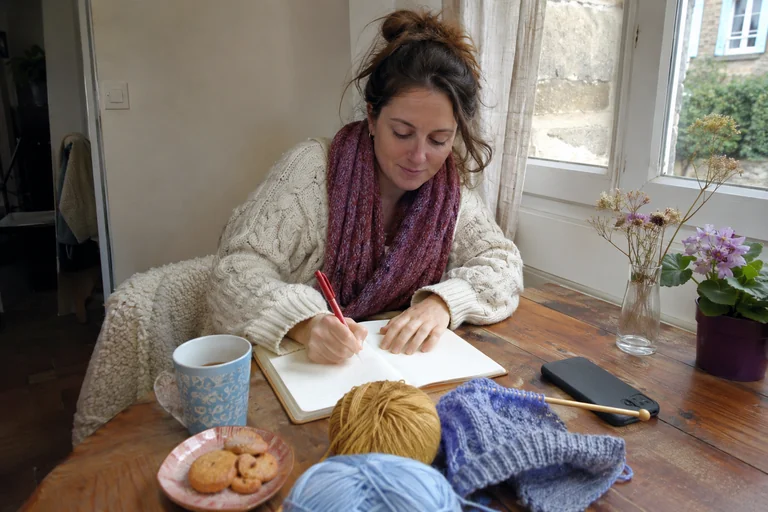
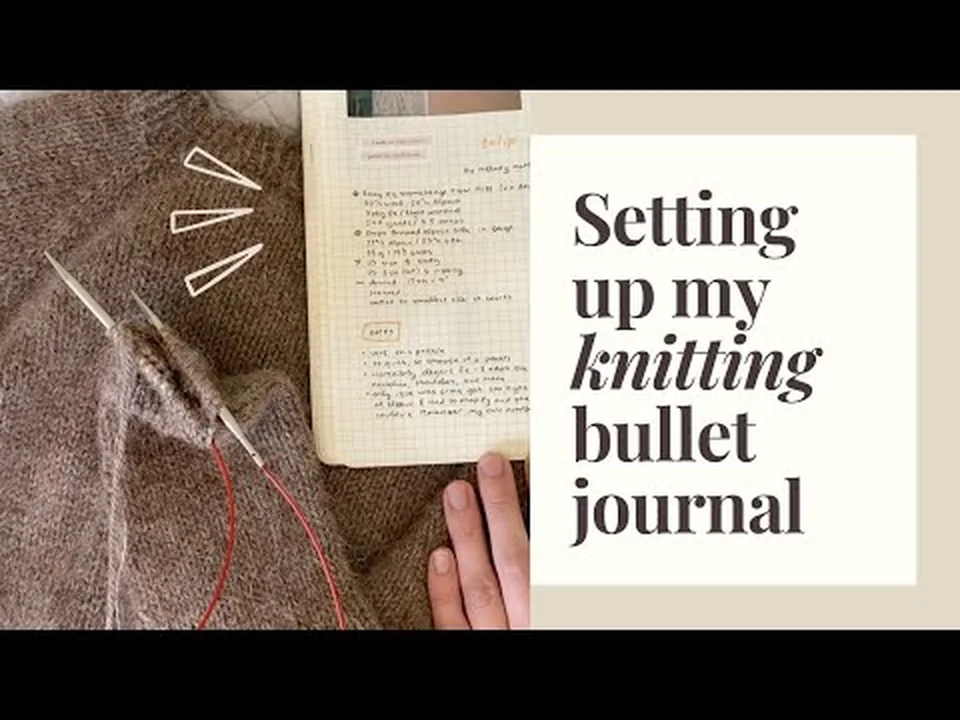
A knitter presents a personal journal setup. The materials and layout are examples, not purchases required for this guide.
For a complementary perspective, watch this video from hellorachelthefirst.
Self-assessment
My restart references
Pour chaque phrase, une réponse : la plus proche de ce qui est vécu ces dernières semaines.
I can find the pattern reference.
I separate my trials from the instructions.
I know which question to check next.
Your result appears once you’ve answered every sentence.
Comment lire le score (sur 9)
- 0–4 · Some references to add Choose one detail to find; this score does not measure knitting skill.
- 5–9 · References available Check the open question before continuing; this score does not validate a size.
Leave a note for returning after a break
Before putting things away, record the last checked location, current section, and open question. Note where the work, pattern, and supplies are stored without publishing private addresses. The method for preparing a project break does not require a certain return date today. If you have lost your place, mark that uncertainty instead of guessing a row number.
A project without an external deadline does not need an invented pace to deserve a record. Recognize a completed stage or resolved question without comparing your speed with a video. When closing a creative notebook, label projects as finished, paused, unraveled, or stopped. Closing the notebook does not automatically finish the knitting inside it.
Miraya can accompany a journaling intention or a personal small step. Paper is sufficient on its own: the app does not read patterns, count rows, or validate sizes. Check current features on the App Store or on Google Play before choosing a format.
Quiz
Which note is confirmed?
You are considering a change.
See the answer
Keep it as a planned trial. An intention is not a completed action.
You forgot the swatch condition.
See the answer
Mark the information unknown. A visible unknown is better than invented certainty.
The notebook is full but the project is unfinished.
See the answer
Leave a reference to its continuation. The object and its documentation have different statuses.
Checklist
A record you can find again
0 / 4
This list checks documentation, not knitting quality.
FAQ
Do I need a specialized notebook?
No. An existing notebook and an index are enough to try.
Should I copy the entire pattern?
No. Keep its reference and useful notes while respecting its terms.
What if I forgot a reference?
Mark it unknown and date later corrections.
Does the journal calculate a size?
No. It documents trials; use suitable technical guidance for adjustments.
Must I write after every session?
No. Write when a decision, observation, or restart calls for it.
Can I close an unfinished record?
Yes. Record its status and where to find its continuation without declaring the item finished.