Contents
- Finishing a creative journal: finishing the object or finishing the project?
- Define what you’re closing before you reread
- Reread with three types of pages in mind
- Create a selective index instead of an exhaustive inventory
- Finish a creative journal with a final note
- Carry one thread forward without carrying every obligation
- Keep, share, or archive the journal
- Accept an ending that isn’t dramatic
- Choose how you want to conclude
- Frequently asked questions
- Sources
Finishing a creative journal means choosing where a body of work ends and giving it a sense of conclusion, even if pages remain blank. You can select a few discoveries, write a final note, and prepare a useful index instead of filling every space just to honor the object.
A finished notebook doesn’t erase the ideas that are still open. It gives them a clear place: a lead you’ve carried forward, an experiment you’ve kept, or a question you’re letting rest. Here’s a way to close this cycle without turning the last page into an assessment of all your creativity.
Finishing a creative journal: finishing the object or finishing the project?
A notebook has a set number of pages, but your project can have a different lifespan. A series of observations might end with a trip; a color study might stop once you’ve chosen a palette; a writing workshop might leave several pages blank. You can decide that the body of work is complete for its purpose without requiring it to physically fill the entire binding.
The BnF’s resources on writers’ notebooks, manuscripts, and archives show a range of ways to preserve and work. They remind us that there’s no single model for an artistic notebook. This guide offers a personal way to bring things to a close, not a validated method that automatically makes you more creative or serene.
| Type of ending | What it means | Possible step |
|---|---|---|
| Notebook filled | No more space available | Create an index and a continuation |
| Purpose fulfilled | The research answered its question | Write the conclusion |
| Period ended | The context has changed | Date and locate the notebook |
| Project stopped | You no longer want to pursue it | Name the choice without justifying it everywhere |
If you only want to pick things back up after an interruption, the guide to returning to a notebook after a break will be a better fit. Here, you’re making a different decision: this volume or this research can stop being an open task. You’re still free to look through it later without undoing that ending.
Define what you’re closing before you reread
Write a sentence: “I’m finishing the notebook devoted to…” then specify the subject, period, or question. This boundary keeps rereading from becoming an investigation of all your projects. If the notebook combines several practices, you can close the body of work while keeping an index by theme. You don’t need to physically reorganize every page.
Also choose how much care you want to put into it. A private notebook may need only a title and a date. One you plan to show may need a selection, captions, and a privacy check. Your creative project journal can distinguish between the end of the research and the possible preparation of a public presentation.
Plan a limited review. Going through every page to correct every sentence would reopen the project. You’re looking for steps, discoveries, and questions that remain. One loose sheet is enough to note what you want to find again, without immediately adding new pages to the notebook you want to close.
Reread with three types of pages in mind
1. A page that shows the starting point
Choose a page that makes the original question visible, even if it’s rough. It might contain a list, a photograph, or an unfinished drawing. Its purpose isn’t to prove you were already capable, but to mark the path. A personal timeline in a journal can help you keep a few reference points without recounting every session.
2. A page that shows a shift
Look for a moment when you changed how you worked: a different point of view, a choice of material, an edit to a text, or letting go of a rule. The shift can be tiny and doesn’t have to be on your favorite page. In your learning journal, you can explain the decision that made it possible rather than note a general impression of progress.
3. A page you want to find again
Finally, choose a resource that’s still useful: a palette, phrase, process, or composition. It doesn’t need to launch a new project right away. Its purpose is to stay accessible. A selective index can point to this page, while your idea notebook keeps only the ideas that are truly active.
Create a selective index instead of an exhaustive inventory
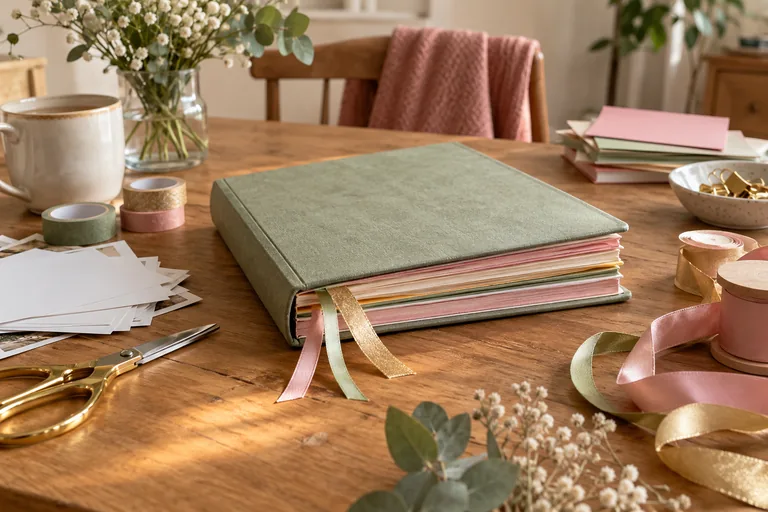
Number the useful pages if they aren’t already numbered, or use simple, consistent markers. The index can be just a few entries: contour experiments, market palettes, landing scene, alternate ending. Choose words you’ll search for later, not elaborate categories you’ll forget as soon as you put the journal away.
You can put the index at the beginning, at the end, or on an inserted sheet. Don’t redo the whole journal just to make it look uniform. Differences in paper, rhythm, and care are also part of the work’s story. If some pages need to stay private, mark that in your personal system before lending or showing the journal as a whole.
For related digital documents, note where they’re actually stored and check that you can open them. A vague file name like “final really final” doesn’t make it easier to pick up where you left off. Use a simple naming convention with the subject and date, then distinguish the source files from exports intended to be shared. Wrapping up works best when it makes links reliable, not just when it prettifies the last page.

 Read alsoScripting: Write your dream life to clarify what you want
Finish a creative journal with a final note
Write what you did, what you’re keeping, and what you’re not pursuing. A concrete version might be: “I explored the shapes of five objects. I’m keeping the method of using negative space. I’m leaving portraits for another time.” This note describes a decision; it doesn’t have to claim that the journal transformed you.
Add an unresolved difficulty if it matters, without turning it into a debt. “I still don’t know how to arrange these photos” can remain a question. You can also decide not to revisit it. The judgment-free goal review helps you distinguish a result, a limitation, and a decision about what comes next.
Workshop: write your last page
What this journal contains
Name the subject, time period, and forms you explored in a few concrete sentences.
What I’m keeping
Choose one discovery and say where to find it, without transferring the whole journal.
What I’m closing
Write what you won’t pursue for now. An ending decision doesn’t need a perfect justification.
Carry one thread forward without carrying every obligation
Choose only a few things to carry forward, based on the time and energy you actually have. A phrase might become part of a new story; a palette can wait in a collection. The guide to recycling drafts offers distinct destinations. Copying every page into a new journal would mostly just move the indecision elsewhere.
If you open another notebook, write down its purpose before returning to old habits. You can keep the same format or choose a more focused practice. Defining what success means for a goal can help you describe one possible endpoint from the start, without turning the activity into a rigid program.
Keep, share, or archive the journal
You can store the journal in a dry, accessible place, with its title and date visible. For fragile materials, collages, or specialty inks, find out how to preserve them rather than assuming all formats age the same way. A photo of a few pages may be useful, but it doesn’t automatically replace the object or a well-organized file backup.
If you’d like to prepare a creative exhibition, work from a separate selection. Check quotes, other people’s images, and personal information before showing the pages. A feedback on your creation can help you choose what will make sense to someone who hasn’t followed the whole process.
Accept an ending that isn’t dramatic
You may feel satisfied, indifferent, or a little regretful as you close the journal. No reaction determines the value of the work. You’ve simply set a clear boundary and kept what seems useful to you. You can recognize an accomplishment without waiting for perfection even if you still dislike some pages.
End with a practical step: note the date, put the journal away, and leave one idea visible for the next activity. The ritual for closing the day in a journal can accompany this moment. You don’t have to start a new series right away to justify the one that just ended.
Choose how you want to conclude
Generator
An entry for the final note
This journal helped me observe more closely…
See all the phrases
Record
- This journal helped me observe more closely…
- The page I want to find again later is…
Next
- I’m keeping just one idea active for what comes next…
- I’ve decided not to continue for now…
Quiz
Finishing without filling every page
Blank pages mean you can’t finish a journal.
See the answer
No. The ending can mark the project or period rather than a completely filled journal.
Archiving means the work has no value.
See the answer
No. An archive can preserve a phase without requiring you to return to it.
Flip cards
A fitting ending
I want to fix everythingFlip
Review to select, not to rewrite every page.
Too many ideas are still openFlip
Carry forward only the ones you really want to pursue.
I don’t see any progressFlip
Look for one specific choice or observation, not a total transformation.
I want to show the journalFlip
Prepare a selection and check for private or borrowed material.
Checklist
A closed journal
0 / 5
Your journal can remain available without staying open as an obligation.
For a complementary perspective, watch this video from by bun.
Frequently asked questions
Do you have to fill every page to finish a notebook?
No. You can close out a topic or a period while leaving blank pages. Simply note what you consider finished.
What should you put on the last page?
Describe what you explored, what you’re keeping, and what you’re not pursuing. A few specific sentences are enough.
How do you make an index?
Select the pages you want to find again and give them consistent markers. A short index can be more useful than an inventory of everything.
What should you do with unfinished ideas?
Choose between active follow-up, a reserve, and an archive. You don’t have to transfer them all to your next journal.
Can you revisit a finished notebook?
Yes. Looking through it or picking up a fragment again doesn’t undo the decision to close it. You can work on what comes next in a separate medium.
Do you have to show the notebook to consider it finished?
No. A private practice can be complete. Sharing is a separate decision that calls for its own checks.