Contents
- What are morning pages?
- Where did morning pages come from, and what does research show?
- How to do morning pages
- The test: does the practice still feel easy?
- A 21-day start
- The benefits of morning pages, and what they don’t do
- Mistakes that drain the ritual
- When to seek support
- Frequently asked questions
- Sources
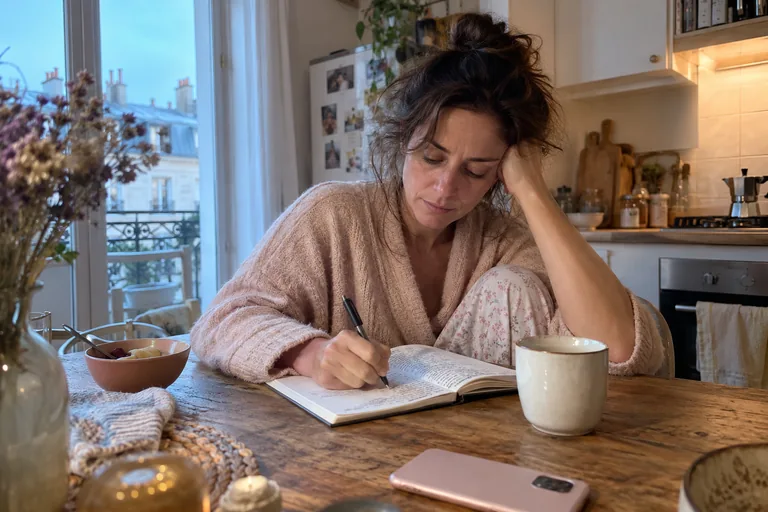
Morning pages are three handwritten pages, written as soon as you wake up, letting whatever comes to mind flow without editing yourself or rereading right away. Doing morning pages isn’t about producing beautiful writing: it’s about filling the paper before the day asks you to be clear, productive, or inspired.
You can use them as a simple practice alongside your morning routine. Here, you’ll learn where the ritual comes from, how it differs from the writing studied in a lab, how to keep up with it without turning it into a performance, and what research can really tell us. You can check off a 21-day plan on this page. Nothing promises a creative breakthrough, a new life, or a guaranteed empty mind.
What are morning pages?
Julia Cameron described morning pages, as she also calls them, in The Artist’s Way, published in 1992. In French, the book is published under the title Libérez votre créativité. The practice has few rules. You write three pages by hand when you wake up, before you get to the news, messages, and tasks. You write down whatever comes to mind: fatigue, a shopping list, irritation, an idea, a phrase that keeps going around in your head. You don’t look for a topic. You don’t correct your spelling. You don’t stop to make the writing interesting.
Cameron presents these pages as a stream of consciousness. The phrase means that your hand follows the thread, even when the thread is ordinary. She also asks you not to show these pages to anyone or reread them right away. In her method, rereading waits about eight weeks. After that, if you reread them, it’s to notice what keeps coming back, not to judge the writing style. This delay is an author’s instruction, not a threshold measured in a laboratory.
She sometimes describes these pages as a message about what you like, what you don’t like, and what you’d like more or less of. Some readers see them as an exchange with the universe. That’s a belief, a way of talking about the practice, not a fact. You can write without adopting that image.
Don’t confuse this notebook with the other kinds of morning writing. A journal tells a story and gets reread. A gratitude journal chooses things to acknowledge. journaling prompts set a theme. positive morning affirmations are prepared phrases. Morning pages have no content instructions. A gratitude list or phrases to believe in are a different exercise.
| Aspect | Morning pages | Personal journal | Expressive writing | Morning affirmations |
|---|---|---|---|---|
| When | On waking, before screens | Whenever you want | A few sessions, often in a laboratory | On waking, chosen phrases |
| What | Whatever comes to mind, without a topic | Stories, the day, memories | A specific emotion or event | Phrases you repeat |
| Correction | You don’t edit | You can reread and revise | Style isn’t the goal; the topic is assigned | You choose the words beforehand |
| Duration | Three pages, often 20 to 40 minutes at first | Open-ended | Usually 15 to 20 minutes | A few minutes |
| What we know | An author’s method, not a trial of the exact protocol | Personal practice | Meta-analyses, small average effect | Other literature, other risks |
Three pages aren’t a biological threshold. That’s the framework Cameron set so you know when to stop. It’s often said that the first page clears away the noise and the third is less rehearsed: that’s an account of the practice, not a study result. If three pages feel like too much, one written page is a scaled-down version, not the complete protocol.
Where did morning pages come from, and what does research show?
The Artist’s Way is a twelve-week creativity course. Morning pages are its daily practice. Cameron presents them as a support for creativity because they would leave less room for the inner critic. That’s a teacher’s hypothesis, not a measurement. Writing three pages every morning doesn’t guarantee a breakthrough. You might remain stuck on a project, or notice an idea returning more clearly. The notebook doesn’t sign a contract.
Alongside this method, there’s a real research tradition, and it deals with something else. In 1997, James Pennebaker summarized a series of studies in which people wrote about an emotional experience. In the classic expressive-writing paradigm, people write for about 15 to 20 minutes over three to five sessions about an event that matters, often a difficult one, linking facts and emotions. The instructions don’t call for three pages every morning, on no particular topic, for weeks. Nor do they ask you to wait eight weeks before rereading.
Joanne Frattaroli revisited this literature in 2006. Her meta-analysis brings together 146 randomized studies on experimental disclosure, mostly through writing and sometimes through speaking, about a personal subject. The average effect is positive and statistically significant, with an r of 0.075. That is a small effect. It varies considerably from one study to another. Frattaroli also notes that Joshua Smyth’s earlier 1998 review covered 13 studies and found an average effect of 0.230, using a statistical model that was less generalizable. When the body of research expands, the average effect shrinks. That doesn’t mean writing is useless. It means we can’t promise transformation based on such a modest average.
In 2001, Laura King tested a different prompt. Eighty-one students wrote for 20 minutes a day for 4 days, assigned at random to write about a trauma, their best possible self, both, or a neutral topic. Writing about life goals was less upsetting than writing about a trauma and was linked to an increase in subjective well-being. Five months later, the trauma, best-self, and combined groups had fewer illness-related visits than the control group. It was a short protocol with an assigned topic: it wasn’t three pages of freewriting upon waking. A present-tense scene belongs to the scripting or a letter to yourself, not from these pages.
When it comes to “writing three pages every morning,” research shows something different from the slogan. Writing a few times for 15 to 20 minutes about an emotion or a desired future may have small average effects on health or well-being under specific conditions, with considerable variation. It does not show that writing three handwritten pages every day, without a set topic, unlocks creativity, eases anxiety, or improves health. Applying Pennebaker’s, Frattaroli’s, or King’s figures to Cameron’s ritual conflates different tasks, durations, and measures.
For a complementary perspective, watch this video from ThePublishersOffice.
Quiz
True or false: the morning pages and research
The morning pages are James Pennebaker’s protocol.
See the answer
False. Pennebaker has people write for 15 to 20 minutes about an emotional experience over a few sessions. Cameron asks for three pages of freewriting every morning, with no assigned topic.
Julia Cameron describes this ritual in The Artist’s Way, in 1992.
See the answer
True. That is the practice’s editorial origin. The book is not a clinical trial report.
A meta-analysis of 146 randomized studies finds a large effect of expressive writing.
See the answer
False. Frattaroli (2006) finds a small average effect, r = 0.075. The effect exists in this body of research, but it is not spectacular, and it does not concern the morning pages.
You have to reread the pages every morning for them to “work.”
See the answer
False. Cameron’s instruction is the opposite: don’t reread them right away, for about eight weeks into her method.
Twenty-one days are enough for everyone to make this practice automatic.
See the answer
False. In Lally and colleagues’ study of a simple daily behavior, the median time to approach the automaticity plateau was 66 days, ranging from 18 to 254.
How to do morning pages
Get your notebook ready before you need it
Choose an ordinary notebook and a simple pen. Leave them where you’ll sit: at the table, beside the bed, or on a chair near the window. A beautiful notebook that “deserves” beautiful sentences often makes it harder to put pen to paper.
Decide on the setting, not the inspiration. Phillippa Lally and colleagues followed 96 volunteers who repeated a simple behavior every day—eating, drinking, or moving—at the same time for 12 weeks. When the automaticity curve fit well, the median time to reach 95% of the plateau was 66 days, ranging from 18 to 254 days. Missing an opportunity made little difference. These figures describe health behaviors, not three pages of writing. The useful guide: the same place, the same time, and a skipped day that doesn’t cancel the week.
Write without editing
Date the page if you like, then write. The first line can be “I slept badly” or “I don’t know what to say.” Keep going until you reach three pages, without crossing things out to make them look nice. Write down a harsh thought about yourself just as it is. Don’t turn it into an affirmation in the middle of the flow. The limiting beliefs are considered at another time.
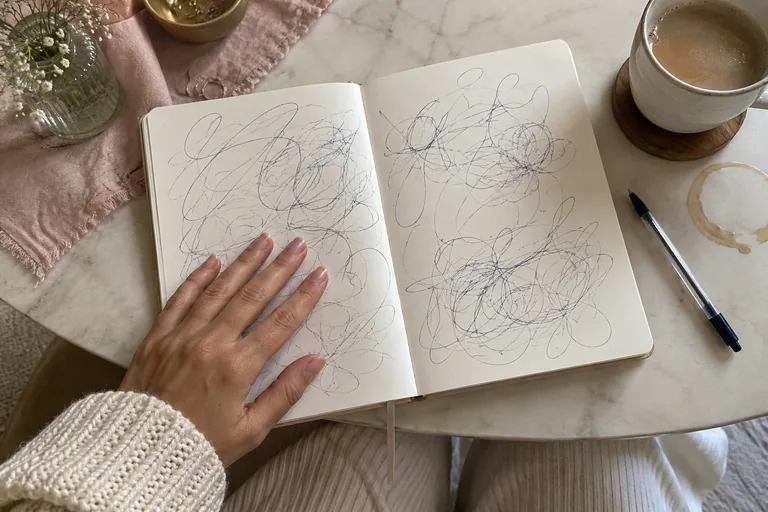
A supportive sentence can go on the very last line, after the three pages, if it feels believable to you. More more neutral affirmations often hold up better than a grand declaration. The plan below suggests a sentence based on a theme. It’s optional. The three pages remain free of a set topic.
Close the journal
Stop at the third page, even if an idea finally seemed interesting. Continuing often means starting another piece of writing. Close the notebook, don’t reread, and stretch if you like. The practice is done.

For a complementary perspective, watch this video from John's Studio Notebook.
When the page stays blank
A blank page is part of the beginning. Write that you have nothing to say, that the coffee is too hot, that you can hear the street. If nothing comes to mind, stick with that plain sentence. You don’t have to invent depth.
The phone is the vulnerable point. Peter Gollwitzer and Paschal Sheeran synthesized 94 studies on “if this situation, then this action” plans. The effect on goal attainment is positive, with a medium-to-large magnitude (d = 0.65). These studies aren’t about morning pages. They show that a specific cue helps more than a vague intention. “If I sit down, then I open the notebook before the screen” is an example of this kind. More examples are in the guide to if-then plan.
Flip cards
Four habits to keep in mind while writing
Keep your hand movingFlip
The right word can wait. Write the closest word and keep going.
Nothing to showFlip
For the first few weeks, these pages aren’t meant for anyone—not even you.
Three pages, then stopFlip
Don’t keep going just to “finally say something useful.”
You can pick up again after skipping a dayFlip
You don’t make up six pages the next day. You return to the day’s practice.
 Read alsoScripting: Write your dream life to clarify what you want
The test: does the practice still feel easy?
Answer based on your recent mornings, without trying to be a star student. The higher your score, the more the ritual has become a source of pressure.
Self-assessment
Your morning pages in six statements
For each sentence, choose one answer: the one closest to what you’ve experienced over the past few weeks.
I pick up my phone before opening my notebook.
I stop to correct my sentences or spelling.
I reread everything right away and think these pages are awful.
If I don’t have three “deep” pages, I’d rather not write anything.
I look for an intelligent topic instead of writing whatever comes to mind.
Skipping one morning makes me want to give up for the week.
Your result appears once you’ve answered every sentence.
How to read your score (out of 18)
- 0–5 · A practice that already feels light enough The setup works. Keep the same place and pen. Don’t add a second exercise to these pages.
- 6–11 · A few specific obstacles The phone, rereading, or the urge to get it right keeps coming up. An if-then plan and a rule against rereading are often enough to make things feel easier.
- 12–18 · The ritual feels heavy Three pages have become a debt. Go back to one page, or ten minutes, for a few days. If writing brings up deep distress, the section on getting support is there for that.
A 21-day start
Twenty-one days establish a time slot. They don’t mean a habit is formed: the median reported by Lally for a simple behavior is 66 days. Three weeks are a popular guideline, not a threshold for writing. You get started, then stick with the simplest version if you want to keep it up.
The plan is a starting point, not a performance. The buttons change a supporting phrase. Copy it only as your last line, and only if it feels doable. Your progress stays in this browser.
Program
21 days to get started with morning pages
An optional supporting phrase, based on the theme
Supporting phrase, only if it feels right
“I’m learning to trust myself a little more each day.”
Phrase for later, not a morning assignment
“I trust myself.”
0 / 21 days
You’ve checked off 21 mornings. That doesn’t mean the practice has become automatic. If you want to stick with it, keep the easiest time slot for a few more weeks.
With the journal closed, the day begins again. You can slip the notebook into your bag for tomorrow and let the ride be just a ride. A five-minute small step can come next, without opening the pages: water a plant, reply to a message, take out your shoes.

The benefits of morning pages, and what they don’t do
Looking for the benefits of morning pages often mixes up three different levels. Cameron’s aim: less self-criticism, more room to create. This isn’t an effect measured after three pages a day. Practitioners’ accounts: a less cluttered morning, a sentence you finally notice. These are experiences, not proof. Research on other forms of writing, cited earlier, can’t be directly applied here.
You can set more modest expectations: a stretch of time before screens, space for looping thoughts, and practice in not correcting yourself. Sometimes a later reread reveals a theme. Sometimes it doesn’t. The letting go, here, is a plain page that remains worthwhile.
| What it may offer | What it doesn’t do |
|---|---|
| A steady stretch of time before messages | A guaranteed creative breakthrough |
| Space for mental noise, without resolving it | Therapy or treatment for anxiety |
| The habit of not correcting yourself as you write | Proof that writing three pages improves your health |
| A starting point for an if-then plan | A structured journal, not a gratitude list |
| 21 days to get started | A habit that becomes automatic in three weeks for everyone |
Writing focused on the future happens at another time. These pages are for unloading your thoughts. They’re not meant to persuade anyone or describe an ideal day.
Mistakes that drain the ritual
- Trying to write something beautiful. Writing for an imaginary reader stops the flow. No one has to like these pages.
- Rereading your pages the same day. You turn a brain dump into a note. Cameron suggests waiting about eight weeks before looking for patterns.
- Writing only affirmations from then on. A chosen phrase is a different tool. If it replaces the three pages, it’s no longer the ritual.
- Making up for skipped days. Six pages “to catch up” punish the habit. You pick it back up the next day, once.
- Piling everything together. Gratitude, visualization, and pages all in the same half hour become a debt. Do the pages first and the rest later.
- Mistaking boredom for failure. A plain page often means you’re not making things up. If a mistake is weighing on you, the inner dialogue after a mistake helps you avoid adding more.
- Forcing a strong emotion. This ritual doesn’t ask you to reopen a wound. Doing it every morning is a different, more demanding exercise.
When to seek support
Writing whatever comes up can bring sadness, fear, or a memory to the surface. Often, an ordinary page is enough and you close the notebook. If the same distress has filled your pages for several weeks, if you’re sleeping poorly, or if you feel overwhelmed or unsafe, talk with a doctor or psychologist. These pages aren’t ongoing care.
Pennebaker’s writing focuses on a difficult emotion for a set period of time. Focusing on trauma can be upsetting in the moment, even though studies later find small average effects. Don’t turn your mornings into this protocol if you’re already feeling raw. If a very young voice returns with a lot of shame or fear, support from a professional is a better fit than one more page. The inner child can be read separately, not as a wake-up exercise.
Frequently asked questions
How do you do morning pages?
You set out a notebook and pen the night before. When you wake up, before looking at your phone, you write three pages by hand, without a topic and without editing yourself. You close the notebook without rereading. If three pages feel like too much at first, write one page and note that you’re doing a lighter version.
Do you have to write morning pages by hand?
In Julia Cameron’s method, yes: she insists on handwriting, which is slower and less likely to invite editing. This is the author’s instruction. The studies cited above don’t compare pen and keyboard for this specific ritual. If your hand hurts, writing another way is better than giving up, knowing that you’re stepping outside the framework she described.
How long do three pages take when you write them after waking up?
At first, it often takes between twenty and forty minutes, depending on the notebook size and how fast you write. It may take less time once you stop searching for the right sentence. There’s no official duration in the research because Cameron’s protocol isn’t the same as the 15- to 20-minute trials.
Can you reread your morning pages?
Not right away. Cameron suggests waiting about eight weeks, then rereading them in batches to see what keeps coming up, not to evaluate the style. Many people never reread them, and the ritual is still valid. Rereading right away is what most often turns the practice into an act of judgment.
What should I do if I don’t know what to write in the morning?
You write exactly that: that you don’t know, that you’re tired, that you can hear the refrigerator. You repeat the sentence if the blank page continues. You don’t have to come up with an idea. Morning pages don’t have a prompt of the day.
What’s the difference between morning pages and a journal?
A journal tells a story and can be reread. Morning pages let a stream of thoughts flow onto the page when you wake up, with no intended reader and no editing. You can keep both, at different times. Mixing them into the same three pages often pulls you back into making things look nice or talking only about the day before.
Are Julia Cameron’s morning pages proven?
No, not in the sense of a trial that tests exactly three handwritten pages every morning. Studies on expressive writing and on the best possible self show small average effects, with different prompts, durations, and measures. You can enjoy this ritual without attributing benefits to it that haven’t been measured.
Sources
- Cameron J. (1992). The Artist’s Way. Origins of the morning pages ritual. A book, not a clinical trial.
- Pennebaker J. W. (1997). Writing about emotional experiences as a therapeutic process. Psychological Science. doi:10.1111/j.1467-9280.1997.tb00403.x
- Smyth J. M. (1998). Written emotional expression: Effect sizes, outcome types, and moderating variables. Journal of Consulting and Clinical Psychology. doi:10.1037/0022-006X.66.1.174
- Frattaroli J. (2006). Experimental disclosure and its moderators: A meta-analysis. Psychological Bulletin. doi:10.1037/0033-2909.132.6.823
- King L. A. (2001). The health benefits of writing about life goals. Personality and Social Psychology Bulletin. doi:10.1177/0146167201277003
- Lally P., van Jaarsveld C. H. M., Potts H. W. W., Wardle J. (2010). How are habits formed: Modelling habit formation in the real world. European Journal of Social Psychology. doi:10.1002/ejsp.674
- Gollwitzer P. M., Sheeran P. (2006). Implementation intentions and goal achievement: A meta-analysis of effects and processes. Advances in Experimental Social Psychology. doi:10.1016/S0065-2601(06)38002-1