
Contents
- Sunday ritual: getting ready isn’t the same as planning everything
- What does research say about this kind of routine?
- Build your Sunday ritual with three supports
- Knowing where the ritual ends
- A realistic Sunday when you have little time
- If Monday still feels daunting
- Try it, then scale it back
- Frequently asked questions
- Sources
A Sunday ritual can be as simple as preparing two or three supports for the week, without planning all your meals, goals, and emotions. Choose what will make the next start easier, then give the rest of Sunday back to your personal life.
This suggestion is for moments when the big weekend “reset” feels more like another list of chores. It doesn’t require a spotless home or any particular motivation. If you work on Sundays, move it to the time that actually comes before you get back to work.
Sunday ritual: getting ready isn’t the same as planning everything
Getting ready means making an upcoming situation easier to manage. Planning the whole week means deciding many details in advance, some of which may still be uncertain. These two approaches can complement each other, but they aren’t the same in scope. Here, you’re looking only for the things that prevent a foreseeable difficulty: finding a document, knowing a schedule, having what you need to head out.
A weekly intention can offer direction if you want one. It isn’t required for this ritual. You can pack your bag without setting a personal growth goal, and enjoy a good Sunday without drawing a lesson from the previous week. This distinction protects your rest from the idea that you have to get everything organized before you deserve it.
| Choices | Goal | Limit |
|---|---|---|
| Check | Avoid an immediate difficulty | Don’t open every file |
| Practical support | Make it easier to head out | Don’t tidy the whole home |
| Free time | Enjoy the present day | Don’t require yourself to feel a certain way |
What does research say about this kind of routine?
Research by Lally and colleagues on habits shows that automaticity develops differently depending on the person and the behavior. It doesn’t validate any specific Sunday routine or prove that a well-prepared Sunday guarantees a good week. This protocol is a practical suggestion to adapt to your circumstances, not a scientifically tested program.
The if-then plan can help you set a single reminder: “When I get my things ready, I check tomorrow’s first scheduled item.” That doesn’t mean every unexpected event can be avoided. A useful ritual leaves room for uncertainty instead of promising that good organization will eliminate all fatigue.
Quiz
Check your understanding
Does a well-prepared Sunday guarantee a good week?
See the answer
No, unexpected events are still possible. The ritual covers a few supports, not every circumstance.
Can you move the ritual to another time?
See the answer
Yes, based on your actual schedule. Choose the time before you get back to work.
Build your Sunday ritual with three supports
Check what will have a real impact tomorrow
Check only the first departure or important commitment. Do you have the address, time, and things you need? A focused check may be enough. Avoid opening every work conversation afterward “while you’re at it.” If information is missing, note the question or use the appropriate channel, without automatically turning it into a work session.
The written mind dump can hold whatever comes up along the way. Make a holding list, not a list to finish before bed. You can add an administrative task without starting it right away. The fact that a task exists doesn’t mean it belongs on your Sunday.

Prepare a little practical support
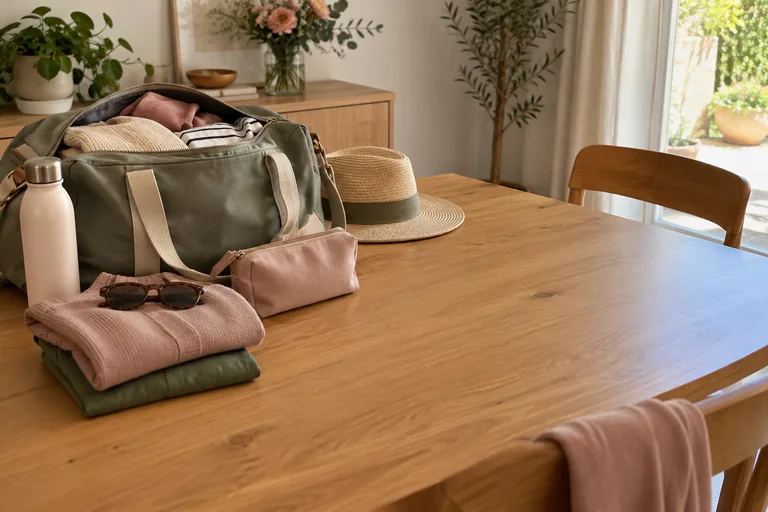
Choose something helpful whose purpose you know: an outfit that’s ready, a portion for lunch, or a document placed in your bag. Don’t start a major cleanup just to make this possible. If your chosen support takes an hour to prepare, look for a shorter version or decide it deserves another time slot.
In a shared home, consider who uses things and who prepares them. Your ritual shouldn’t become silently taking care of everyone else’s week. You can suggest a clear division of tasks or ask everyone to check their own things. The guide to setting a boundary without justifying yourself helps you distinguish a practical request from a lengthy defense of your right to take a breather.
Keep something that still belongs to Sunday
After these supports, choose an activity that isn’t only in service of tomorrow: reading, catching up with someone, cooking for pleasure, or making no plans. The little pleasures journal can offer ideas, but you don’t need to record the moment. Sunday isn’t just a prelude to Monday.
This final choice doesn’t have to be especially calming. You may prefer an outing, a game, or a lively conversation. The question is whether you want this moment, not whether it matches an image of a perfect routine. A chosen break can be simple, active, or quiet.
Flip cards
Choose a starting point
VerifyFlip
Check the first item on your schedule and what you’ll need tomorrow.
PrepareFlip
Choose just one practical support that will really help.
ProtectFlip
Keep a moment that still belongs to Sunday.
 Read alsoNew moon ritual: set your intentions for the month
Knowing where the ritual ends
Set the endpoint before you begin: once you’ve addressed the three points, close your planner. If a new task comes up, ask yourself whether putting it off has a concrete consequence or just leaves you feeling unfinished. You can accept that feeling without having to complete every category of your life.
The weekly check-in answers a different desire: to reflect and understand. You can do that another day or replace it with a sentence. Adding reflection, cleaning, meal planning, goals, and tidying can quickly turn a small ritual into a half-day of work. Choose the main need instead of collecting every good idea.

A realistic Sunday when you have little time
In a fictional scenario, Amina gets back from a trip in the late afternoon. She checks the train time for the next day, puts her badge in her bag, and plans to have an available meal. She doesn’t sort through all her photos or reorganize her desk. Her ritual focuses on what will prevent an immediate difficulty; then she moves on with her evening.
Another context: Camille works on Sunday and goes back on Tuesday. She uses Monday evening as a transition, without trying to follow everyone else’s schedule. Her time estimation journal It showed her that the big preparations took much longer than she thought. She now keeps one practical support and one check, nothing more.
Generator
A wording to adapt
Check the first item on your schedule and what you’ll need tomorrow.
See all the phrases
Starting point
- Check the first item on your schedule and what you’ll need tomorrow.
- Choose just one practical support that will really help.
Adapt
- Keep a moment that still belongs to Sunday.
- I can keep what works for me and remove the rest.
If Monday still feels daunting
Practical preparation doesn’t resolve a difficult work situation, an excessive workload, or a strained relationship. If the apprehension comes back strongly every week, write down exactly what it’s about instead of endlessly perfecting the ritual. The decision journal can help you separate the things you can act on, the information you’re missing, and the support you can seek.
You may also not want to analyze anything on Sunday. Keep a question to revisit at a time you choose, or talk it over with someone you trust. If this distress persists or interferes with your daily life, a qualified professional can support you. A personal growth routine doesn’t have to replace that help.
Try it, then scale it back
Try this format two or three times, without needing to make each one identical. After each time, notice which support actually helped. If the outfit you laid out didn’t help but finding your badge saved you a detour, keep only the second step. This reflection is more useful than a consistency score.
You can finish with a five-minute small step when there’s something left to prepare, but you can also decide that it’s enough. The right ritual is one you know how to step away from. It prepares you to enter the week while respecting the time that comes before it.
Checklist
Keep only what works for you
0 / 4
You’ve set your reference points. You can adapt or stop this practice.
Personal workshop
Create your version: Sunday ritual
Answer the three prompts below, or use them aloud. This workshop works without JavaScript. This workshop does not offer a save feature. Copy anything you want to keep into your journal, and avoid entering sensitive information on a shared device.
How do you finish this workshop?
Review your answers and keep only a next step that seems doable to you. You can also decide not to pursue anything today. This decision creates neither a score nor a commitment.
For a complementary perspective, watch this video from Kurzgesagt – In a Nutshell.
Frequently asked questions
What should you do on Sunday to prepare for the week?
Check your first commitment and prepare one practical support. Then you can close your calendar without planning out the whole week.
Do you need to review your week every Sunday?
No. Reviewing the week and preparing for the next day meet different needs. You can choose just the one that’s useful to you.
How much time should I set aside?
There’s no required duration. Set an end point based on the few actions you chose rather than a long list to complete.
What if I work on Sundays?
Move the ritual to the day before you actually return to your routine. The date is a reference point; it has no special power.
Do you need to prepare every meal?
Not for this exercise. One small form of support may be enough, and meal planning may deserve a separate time to do together.
What should you do if Mondays still make you anxious?
Look at the specific difficulty and the support available. If the distress continues or interferes with your daily life, seek appropriate support.
Sources
- Lally, P., van Jaarsveld, C. H. M., Potts, H. W. W., and Wardle, J. (2010). How are habits formed: Modelling habit formation in the real world. European Journal of Social Psychology. DOI verified.