Contents
- What is a vision board?
- Vision boards and creative visualization
- Set an intention for your board
- Choose images that evoke an experience
- Paper or digital: choose your format
- Make room for intermediate steps
- An example vision board you can adapt
- Arrange it without aiming for perfection
- Review it once a month
- How can you turn an image on your board into a decision this week?
- How can you prepare a plan in case the obstacle comes up again?
- Frequently asked questions
- Sources
A creative visualization board brings together a few images, words, or cues that describe an intention for the months ahead. To make one, choose a theme, keep it simple, and place it where you’ll see it during your rituals. It serves as a reminder; it doesn’t guarantee any results.
Pictures cut from magazines, a few words, a travel photo: the vision board is one of the most popular tools in manifestation practices. It’s tangible, creative, and enjoyable to make. But a board filled with dream images can also end up forgotten behind a door.
Thoughtfully put together, it becomes a daily reminder of what matters to you and a starting point for your next steps. Here’s how to create a vision board that feels like you, on paper or on a screen, and how to keep it meaningful over the months.
What is a vision board?
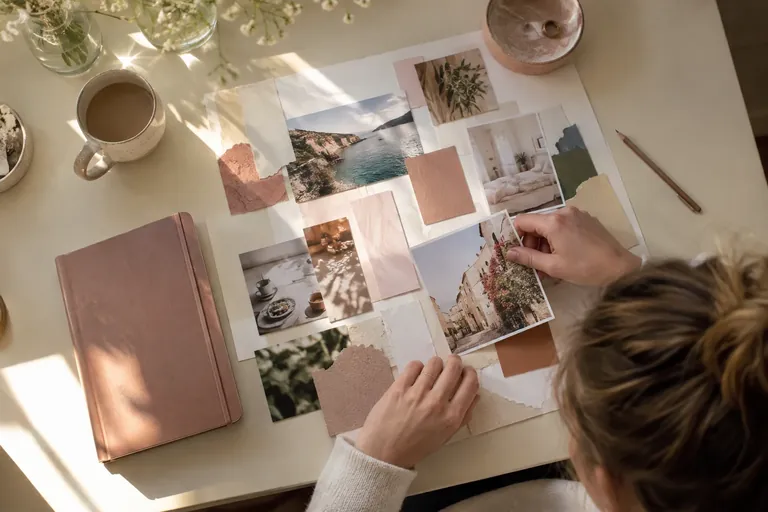
A vision board is a collage of images, words, and symbols that represent what you’d like to experience, feel, or build in the months ahead. It can take the form of a corkboard, a large sheet of paper, a two-page spread in a journal, or a screen background.
Its purpose isn’t to predict the future. It helps you clarify what you want, make it visible, and direct your attention to it in your daily life. When an image is in front of you every morning, it’s easier to remember the intention it represents and spot opportunities to move forward sooner.
Vision boards and creative visualization
It’s also called a visualization board, dream board, or vision board: it’s the visual aid for creative visualization. Its images serve as a starting point for imagining a scene in enough detail to feel it, rather than letting the board remain a simple decoration. You can choose a wish from your board and make it more specific with a WOOP exercise focused on a personal project. When you’re looking for a personal guidepost rather than an outcome, you can choose a word for the year without turning it into an obligation.
Imagining the path, not just the outcome, can make it easier to take action: researchers observed this among students preparing for an exam (see the sources at the end of the article).
Set an intention for your board
Before looking for images, write down a question: What would I like to grow over the next few months? A question gives your vision board a guiding thread and keeps you from piling up photos that don’t connect with one another.
Choose a flexible time frame, such as the coming season or year. You can also focus on just two or three areas: your work, health, relationships, creativity, or home. A board is neither a contract nor a prediction; it’s a visual aid to help you return to what matters today.
Choose images that evoke an experience
An image can represent a mood, an activity, or a feeling—not just something to own. A bright workspace might evoke time devoted to a project; a forest trail, the desire to move more; a table set for friends, the wish to host more often.
For each image, ask yourself how you feel when you look at it. If the answer is enthusiasm, joy, or calm, it belongs. If it’s comparison or pressure, leave it out.
Then add a few words in your own phrasing. Short phrases like “create every week” or “make room for rest” turn your attention toward lived experiences. To find them, take inspiration from our tips for writing positive affirmations that feel right.
 Read alsoCreative visualization: How to practice it, step by step
Paper or digital: choose your format
A paper vision board has a special charm: cutting, gluing, and touching the images makes the activity slower and more present. You’ll need a surface, such as a corkboard, a piece of cardboard, or a large sheet of paper; magazines or printed photos; scissors; glue or pushpins; and a few markers.
A digital vision board is easier to change and take with you everywhere: a collage app, a presentation tool, or a simple photo folder is all you need. You can use it as your phone’s wallpaper to see it several times a day. Many people combine both: a paper version on their desk and a digital version in their pocket.
Make room for intermediate steps
Next to a vision, write down a skill, habit, or person who could help you get closer to it. Intermediate steps make the goal less abstract and easier to fit into a real week.
You can set aside a corner of your board for actions you’ve already started: a train ticket you booked, a first sign-up, a journal you’ve started. Seeing small gains helps you recognize how far you’ve come without waiting for a big final result. To turn an image into a plan, our guided visualization links each vision to a likely obstacle and a first step.
An example vision board you can adapt
Imagine your seasonal intention is “making room for creativity.” The following lines are a fictional example to replace with your own images and constraints. The board serves as a reminder of something you want; it doesn’t guarantee it will happen.
| Chosen image | What it represents to you | A concrete first step |
|---|---|---|
| An open notebook | Write without waiting for a perfect piece of writing | Keep the notebook within reach and write one sentence |
| A table with supplies | Set aside a little space for creativity | Clear a corner of the table using what you already have |
| A walk near your home | Gather ideas by observing | Write down one detail you notice on your next usual outing |
You can write this first step on a removable piece of paper, then see what actually happened in a simple weekly check-in. If you like the image but the action doesn’t fit into your week, scale it back or remove it. To keep track without turning the board into a to-do list, one journal sentence a day may be enough.
Arrange it without aiming for perfection
Group the images by theme or make a looser collage. Leave space around the important elements and remove anything that no longer speaks to you. The board can stay simple: a few chosen images are better than a wall crammed with them.
Keep it somewhere you’ll see it without letting it become one more task: above your desk, inside a closet door, or near the mirror. Some people like to make one during a symbolic moment, such as the start of the year or a new moon ritual.
Review it once a month
Ask yourself which ideas still matter, what has changed, and which action is closest. Remove an image if it no longer matches what you want; add a new one if a priority emerges. A board that evolves is a living board.
This review can become a small ritual: a cup of tea, ten minutes, your notebook open. Write down what has moved closer, even a little, and what you want to try the following month. In Miraya, your vision board can also complement your morning audio sessionsto revisit your intentions in just a few minutes.
How can you turn an image on your board into a decision this week?
Choose an image, then write what it represents in a plain sentence. A sunlit studio might bring to mind taking up drawing again; it doesn’t mean you have to buy a studio or change careers. Then separate what you want, what you can do, and what depends on other people.
| Board reminder | Example of a next step | What still needs to be checked |
|---|---|---|
| A sketchbook | Take out the supplies you already have for a sketch | The time slot when you can actually settle in |
| A table with friends | Suggesting a date to someone | Their availability, without assuming it from what you want |
| A reading nook | Choosing a book you own | A pleasant spot and a time that works with your day |
These examples describe one way to prepare for an action; they don’t provide evidence that the board is effective. An image can remain inspiring without prompting an immediate decision. You can keep it, set it aside, or replace it.
At your next check-in, note what you did, what wasn’t possible, and the specific reason. “I didn’t have the materials” helps you adapt the action; “I’m not motivated” doesn’t yet describe the obstacle. If your goal doesn’t matter as much anymore, changing the image is also a valid decision. The paper or digital journal can be a place for this short reflection without turning the board into a constant tracking tool.
How can you prepare a plan in case the obstacle comes up again?
Add a possible response to a specific obstacle instead of another image of success. A vision board can remind you of a direction; it doesn’t guarantee that you’ll have time, energy, or resources every day. A flexible plan helps you avoid mistaking a setback for a personal failure.
| Board intention | Possible obstacle | Small, flexible plan | What you notice |
|---|---|---|---|
| Pick up drawing again | The supplies are still stored far away | If I feel like drawing, I’ll start with the pencil I have available | Is it easier to get started? |
| Reconnect with a friend | I don’t know what to suggest | If I hesitate, I’ll suggest a time and a simple activity | Does the suggestion work with our availability? |
| Spend time outdoors | The planned outing doesn’t work | If the conditions bother me, I’ll choose an option that’s easier to access or another time | Have I made room for this need? |
How can you use this example without turning it into an obligation?
These situations are fictional. Choose just one line that feels relevant to your need and change its details. An action should be within your reach; it doesn’t have to be impressive. If you can’t act right now, you can also note information to look for or help to ask for.
What should you do when even the small action doesn’t feel right?
Make it smaller, replace it, or set it aside. An image you like isn’t a debt you have to repay every day. Return to the need it represents: creating, sharing, learning, or finding calm. The format can change as your situation changes, without turning every change into a sign that you visualized incorrectly.
At your next review, keep one concrete observation: what was possible, what got in the way, and what you want to adjust. A pleasant feeling may accompany this exercise; it doesn’t prove that an outside event will happen. Your decisions remain separate from other people’s choices and constraints.
Frequently asked questions
What’s the difference between a vision board and a visualization board?
There isn’t one: they’re two names for the same tool, like vision board or dream board. People sometimes say creative visualization board when it’s used as a prompt for short visualization sessions.
How many images should you put on a vision board?
Eight to fifteen images are usually enough. Beyond that, the board becomes hard to read and each image loses some of its impact.
Should you show your vision board?
It’s a personal choice. Some people like to share it with someone close who supports them; others prefer to keep it to themselves. What matters is that it speaks to you.
When should you redo your vision board?
When most of the images no longer speak to you, or at a turning point: a new year, a birthday, a life change. In between, small monthly updates are enough.
Can a visualization board replace an action plan?
No. The board keeps an intention visible, while a plan lays out the steps, resources, and timeline. You can connect the two: add an intermediate step to the board, then break it down into actions in your notebook, as the guide suggests for breaking a project down into steps and milestones.
Sources
- Pham L. B., Taylor S. E. (1999). From thought to action: effects of process- versus outcome-based mental simulations on performance. Personality and Social Psychology Bulletin, 25(2), 250-260.