Contents
Elite athletes do it before a competition, musicians before a concert, and many people before an important interview: they imagine a situation in detail before experiencing it. Creative visualization uses this principle to focus on what you want, whether it’s a project, a life change, or a quality you want to develop.
Used thoughtfully, it can help you clarify what you want, nurture your motivation, and prepare to take action. Here’s what creative visualization is, what we know about its effects, and a seven-step guided session to practice it.
What is creative visualization?
The phrase was popularized in 1978 by American author Shakti Gawain, in a book that became a personal growth classic and was translated into French as Techniques de visualisation créatrice. In it, she describes visualization as the art of using your imagination to create what you want in your life.
In practice, you close your eyes, relax, and imagine a scene in which your wish has come true, making it as vivid as possible: images, sounds, sensations, emotions. Then you return to the present with a clearer intention. The law of assumption is based on a similar idea. To pair a desired scene with practical preparation, try a personal premortem focused on plausible obstacles.
What sports and psychology have to say about it
Mental imagery is widely used in sports: many athletes mentally rehearse a movement or race before taking action. Neuroscience studies show that imagining a movement partly activates the same brain regions as performing it. This is one reason mental rehearsal can complement training.
Psychology adds an important nuance. Imagining only the end result, such as winning or earning a degree, feels good but does little to help you take action. Visualizing the process—that is, the steps, effort, and obstacles you overcome—is more closely linked to taking action. Our guided visualization explains how to connect a vision to an obstacle and a first step.
Getting ready for your session
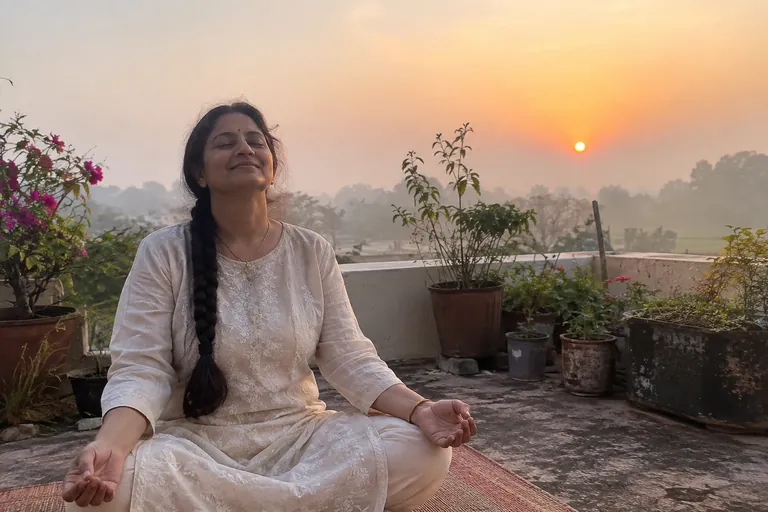
Choose a quiet moment when you won’t be disturbed: when you wake up in the morning, during a break, or in the evening. Get comfortable sitting or lying down, loosen anything that feels tight, and turn off notifications. Take a few slow breaths to help your body relax: a calm mind can imagine more easily. In the evening, the visualization before sleep offers a soothing version.
Before you begin, put your intention into one sentence: what you want to experience, feel, or become. The more specific it is, the easier the scene will be to build.
Visualizing with all your senses
Some people see very clear images; others see almost none. That’s not a problem: visualization isn’t limited to sight. You can hear a voice congratulating you, feel the warmth of the sun, sense lightness in your chest, or describe the scene in your mind using words.
If you find it hard to imagine, use some aids: a photo, music, a vision board. You can also write the scene before visualizing it, or listen to a guided visualization.
 Read alsoVisualize without mental images: start with words and sensations
Common mistakes
- Aiming for a scene that’s too grand : an ordinary, believable scene is easier to step into and more motivating.
- Expecting visualization to do everything : it prepares you to take action; it doesn’t replace it.
- Forcing the images : if nothing comes to mind, return to your breathing and start again more simply.
- Practicing once and then giving up : a few regular minutes are better than one long session on its own.
A guided meditation to get started
For a complementary perspective, watch this video from BetterListen & WisdomFeed.
You can also find personalized sessions in Miraya that create a visualization based on your own goals, narrated in the voice of your choice.
Frequently asked questions
How long should a session last?
Five to fifteen minutes is enough. You can start with five minutes and gradually extend the time if you enjoy it.
How is it different from meditation?
Mindfulness meditation invites you to observe the present moment without trying to change it. Creative visualization, on the other hand, actively directs your imagination toward a scene you’ve chosen. The two complement each other: a few minutes of meditation can be a good way to prepare for visualization.
Does creative visualization really work?
It doesn’t make a result appear on its own. It can, however, clarify what you want, strengthen your motivation, and help you prepare mentally to take action, especially if you also visualize the steps along the way.
Can you visualize several goals at once?
It’s better to focus on one or two intentions per session. You can alternate scenes from one day to the next, but a session centered on a single wish feels more vivid and is easier to recall.
Sources
- Jeannerod M. (2001). Neural simulation of action: a unifying mechanism for motor cognition. NeuroImage, 14(1), S103-S109.
- Pham L. B., Taylor S. E. (1999). From thought to action: effects of process- versus outcome-based mental simulations on performance. Personality and Social Psychology Bulletin, 25(2), 250-260.