Contents
- Intention object: a tangible, adjustable reminder
- What is symbolic and what is evidence-based
- Choosing your intention object without buying more
- Three everyday associations
- If the object loses its meaning or disappears
- Keep the reminder voluntary, not obligatory
- An intention can exist without an object
- Frequently asked questions
- Sources
An intention object is something you consciously associate with a reminder, such as taking a moment before replying or starting a small action. You don’t need to buy it or attribute to it any power over events.
A card, bookmark, or mug can serve this purpose. Its meaning comes from the association you choose and the place the object holds in your life, not from some magical property you need to activate or maintain.
Intention object: a tangible, adjustable reminder
A reminder makes an idea more visible at a moment when it might be useful. It doesn’t decide what you do or guarantee that you’ll always remember. You might pass by the object without noticing it or choose not to act that day. That doesn’t mean the object was a poor choice or that your intention lacks strength.
The distinction between intention and goal still matters. “Taking care of my relationships” is a direction; “sending a suggestion to meet” is an action. The object can remind you of the first, but it’s often more useful when connected to a specific question or action.
| Role | Example | Limit |
|---|---|---|
| Reminder | Card by the journal | Can become invisible |
| Symbol | Object tied to a memory | Doesn’t affect events |
| Time-based alert | Suitable reminder tool | A decorative object isn’t always enough |
What is symbolic and what is evidence-based
You can appreciate an object’s symbolism, history, or material without claiming that it attracts a particular outcome. Research on habits, including work by Lally and colleagues, examines the contexts in which repetition occurs. It doesn’t demonstrate any special power of a stone, piece of jewelry, or consecrated object.
The if-then plan gives you a more concrete framework: “When I see this card before a meeting, I reread my main question.” The object then serves as a cue in a sequence. If you’re interested in law of attraction, keep personal belief separate from actions whose effects you can observe.
Quiz
Check your understanding
Does the object need to have special energy?
See the answer
No, the meaning comes from the chosen association. No causal power is attributed to the object.
Does losing the object jeopardize the goal?
See the answer
No, the action is still possible without it. A reminder isn’t a magic requirement.
Choosing your intention object without buying more
Start with the moment when the reminder would be useful
Choose a specific situation: opening your notebook, leaving home, or settling in to create. The reminder should appear in the right place, rather than in a symbolic setting far removed from the action. An object placed in a room you never enter is unlikely to help when you need it.
The five-minute small step can help clarify what comes next. What would you like to make possible: opening the document, writing a line, asking for information? If the action is still vague, clarify it before looking for an object. A physical aid alone can’t resolve an intention that’s too broad.
Use an object you already have
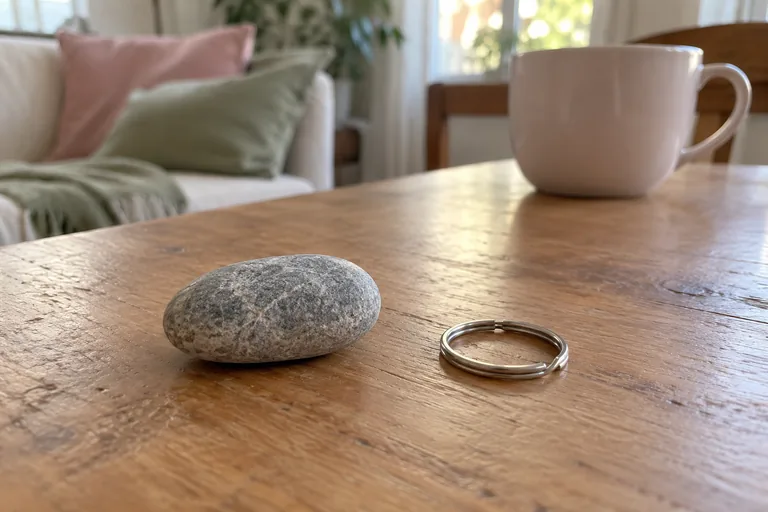
Choose something you own that has no financial or sentimental value that would make losing it too upsetting. A simple card may be enough. Avoid fragile or hazardous objects in a busy area. The reminder shouldn’t create a physical obstacle for you or anyone else who shares the space.
You can use something you made yourself from a creative journal, but looks are optional. A very simple reminder may be easier to notice than a complex design. It doesn’t have to reflect your whole personality perfectly to work as a reminder for a specific action.
Create a short association
Write or think of a concrete sentence: “Before I reply, I’ll check what I want to say.” The guide on affirmations before a difficult conversation can offer inspiration you can adapt. Avoid wording that promises the other person will react positively for sure.
If the text is private, you can use a word only you understand. Just make sure you’ll still know what it refers to in a few days. A symbol that’s too vague may become just a decorative object. That’s okay, but it will serve a different purpose than the one you intended.
Try the location
Leave the object at the chosen spot you pass by and observe what happens over a few opportunities. Did you see it at the right time? Did it remind you of an action you could take? You can move it or simplify the prompt. The judgment-free goal review helps you consider how it’s working without seeing it as a personal failure.
Don’t immediately add more objects to make up for a reminder that isn’t very useful. Several symbols may compete for your attention or become visual clutter. Start with just one. If you need an alert at a specific time, a tool designed for that purpose may be more suitable than an object on a shelf.
Flip cards
Choose a starting point
SituationFlip
Identify the specific moment when the reminder would be useful.
ObjectFlip
Choose an available, simple, and safe object.
AssociationFlip
Connect it to a question or an achievable action.
 Read alsoNew moon ritual: set your intentions for the month
Three everyday associations
A bookmark can remind you to write down a question after reading, as part of your reading journal. A card in a pouch can remind you of the first step in a project. A mug can mark a moment to simply check what you need before moving on.
These associations don’t turn objects into requirements. You can read without the bookmark, create without the card, and take a break with a different mug. The reminder supports a possibility; it doesn’t become permission to practice. This distinction keeps the ritual flexible.

If the object loses its meaning or disappears
Sometimes a reminder fades into the background with familiarity, or an intention is no longer current. You can move it, give it a different purpose, or put it away. The guide to adapt a goal to change encourages you to adjust the setup rather than preserve a system just for its own sake.
If the object is lost, you haven’t lost your ability to take action. You can find the phrase in a decision journal or choose a new one. A physical item going missing doesn’t predict any event or signal that your project is at risk.
Generator
A wording to adapt
Identify the specific moment when the reminder would be useful.
See all the phrases
Starting point
- Identify the specific moment when the reminder would be useful.
- Choose an available, simple, and safe object.
Adapt
- Connect it to a question or an achievable action.
- I can keep what works for me and remove the rest.
Keep the reminder voluntary, not obligatory
Notice how you react when the object isn’t available. Feeling disappointed because you like it is different from feeling intense fear that something bad will happen without it. If the ritual starts to take over, leads you to repeat actions, or severely limits your activities, a qualified professional can help. This article isn’t designed to address that difficulty.
Also, avoid lending the object to someone while promising them a result. You can share what it means to you, but the other person is free not to value it in the same way. Symbols don’t need to be shared to matter, and their importance doesn’t prove that they have power.
An intention can exist without an object
The little pleasures journal can preserve a record of a cherished object, even if it stops serving as a reminder. You can separate its practical function from your attachment to it. An object doesn’t have to be useful all the time to have a place in your home.
If you ultimately prefer a phrase, a place, or an action without an object, keep that version. The simplest setup may work best for your circumstances. What matters is finding a chosen direction and a possible action, while keeping the right to revise the whole approach as your life changes.

Checklist
Keep only what works for you
0 / 4
You’ve set your reference points. You can adapt or stop this practice.
Personal workshop
Create your version: intention object
Answer the three prompts below, or use them aloud. This workshop works without JavaScript. This workshop does not offer a save feature. Copy anything you want to keep into your journal, and avoid entering sensitive information on a shared device.
How do you finish this workshop?
Review your answers and keep only a next step that seems doable to you. You can also decide not to pursue anything today. This decision creates neither a score nor a commitment.
For a complementary perspective, watch this video from The ACT Therapist.
Frequently asked questions
What is an intention object?
It’s an item you use as a reminder you’ve chosen. It has no demonstrated power over events.
Do I need to buy a crystal or a piece of jewelry?
No. A card, a bookmark, or an object you already have may be enough.
Where should I put the reminder?
At the time and place where the decision is useful. Make sure it doesn’t get in the way of using the space.
What should I do if I stop noticing it?
Move it, simplify the prompt, or put it away. You can adjust the setup without judging yourself.
What if I lose the object?
You can reconnect with the intention another way. Losing the object predicts nothing and doesn’t take away your ability to act.
When does a ritual become too burdensome?
If it causes intense fear, intrusive repetition, or limits your daily life, seek qualified advice. The practice should remain voluntary.
Sources
- Lally, P., van Jaarsveld, C. H. M., Potts, H. W. W., and Wardle, J. (2010). How are habits formed: Modelling habit formation in the real world. European Journal of Social Psychology. DOI verified.