Contents
- Why write a character portrait without describing physical appearance?
- Writing a character portrait starting with a scene
- Writing a character portrait using precise gestures
- Organizing details to avoid a list
- Rereading labels and protecting real people
- Ending a portrait with room for interpretation
- A workshop to bring a character to life
- Writing a character portrait through three successive choices
- Working with speech without turning the portrait into an interview
- Preserve complexity without blurring the portrait
- Move from real observation to responsible fiction
- How can you distinguish two characters making the same gesture?
- Frequently asked questions
- Sources
Writing a portrait without describing physical appearance means introducing a character through their gestures, habits, words, and decisions. You don’t hide their appearance to create mystery; you simply choose other clues to give them a presence in a scene.
This approach works for a fiction exercise, a short story, or a journal page. It calls for distinguishing what you observe from what you assume. We’ll build a portrait in context, avoid labels, and review the details that truly shape the reader’s interpretation.
Why write a character portrait without describing physical appearance?
A list of traits doesn’t show how someone occupies a scene. Three characters of the same age and appearance might act very differently when a train is canceled. One looks for another route, another calls a friend, and a third sits down to think. The portrait takes shape through the relationship between a situation, an action, and its consequences.
Temporarily leaving out physical appearance lets you observe how this works. This doesn’t mean descriptions have no place in your writing. A coat color can help identify someone; a physical detail can matter to the story. Here, you’re learning not to use appearance as an automatic shortcut to a person’s character or worth.
| Clue chosen | Original example | What it doesn’t prove |
|---|---|---|
| Habit | She puts the chairs away before leaving | That she’s always helpful |
| Words | She asks the substitute’s name | That she already knows this person |
| Choices | She lets a train pass so she can wait | The exact reason she’s waiting |
| Contradiction | She plans everything but forgets her ticket | An inconsistent personality |
In your reading journal, identify a character you recognize without being able to describe their face. Note the technique that creates this effect: the rhythm of their dialogue, the way they enter a room, or an object they move. You can study this technique without copying lines from the work.
Writing a character portrait starting with a scene
Choose an everyday task: set up a room, return a book, mend a seam, or welcome a new colleague. The task offers opportunities for observable actions. “Describe a brave woman” remains abstract; “show a woman who asks a question again after being interrupted” gives you a specific event to write.
Write down what the character wants to achieve during this scene. Their desire can be modest: finish on time, find an object, or avoid bothering anyone. It doesn’t need to reveal their whole story. Tension often comes from a small obstacle, such as a table that’s too heavy to move alone or an instruction no one understood.
For the setting to contribute to the portrait, draw on observation through the five senses. A noisy room changes how someone speaks; a door that won’t shut properly forces them to come back; dim light slows a gesture. The character acts within an environment, not in a vacuum.

Writing a character portrait using precise gestures
Start with three verbs. Set aside overly general actions like “move” and explanations like “show kindness.” Try “pull closer,” “wait,” “check” instead. Then give each verb an object and a context: she pulls a chair closer to the radiator after hearing someone say they’re cold.
This detail may suggest thoughtfulness, but the text doesn’t need to conclude right away that “she was empathetic.” Let the reader interpret the action. Another passage can add nuance to that impression. Perhaps the same character later forgets to ask the person concerned what they think before changing the layout of the whole room.
Avoid turning every gesture into a definite psychological sign. There can be many reasons to cross your arms; looking away doesn’t prove someone is lying. In fiction, you can give a gesture a specific meaning by building the context. That doesn’t mean you’re creating a reliable dictionary of human behavior.
Making a character’s way of speaking come through
A character’s voice can stand out through what they ask, what they avoid, or how they rephrase things. One person offers a solution right away; another first tells a memory; a third responds with a question. These choices are more precise than a caricatured accent or piling on mistakes meant to assign someone a social class.
Write three lines of dialogue about the same difficulty, then remove the names. Can you still tell the voices apart? If they all seem interchangeable, change their intentions rather than their spelling. The guide to writing dialogue helps you develop this work without turning the portrait into an endless conversation.
Introducing a contradiction with a reason behind it
A character can love organizing and want to be left alone. They can be generous with their time and hesitate to lend an object they care about. This tension isn’t a flaw to fix. It becomes interesting when the scene forces them to choose between two preferences that truly matter to them.
Let’s imagine Salomé, who runs a small workshop. She prepares handouts for all the participants but keeps the last blank sheet for herself. When someone new arrives, she hesitates, then turns over an old poster to offer them a surface to write on. The portrait shows a limited resource, a desire, and a decision; it doesn’t label Salomé as good or bad.
Organizing details to avoid a list
A portrait can become a collection of anecdotes with no movement. To avoid that, keep a clear sequence: the person starts something, encounters a difficulty, reacts, and then leaves a trace. Three connected details are often better than ten scattered traits. You can keep the rest in your creative project journal.
Also notice who is watching the character. A new colleague may notice how welcoming they are; their sister may notice an old habit; a customer may see only a brief exchange. A portrait always tells a story from a particular point of view. Showing that point of view keeps a passing impression from becoming a sweeping truth about someone.
If you’re starting from a memory, our method for writing a specific scene from the past helps you separate remembered facts from narrative additions. You can change the person, the context, and what’s at stake to create a story that stands on its own, rather than a barely disguised portrait of someone close to you.

 Read alsoScripting: Write your dream life to clarify what you want
Rereading labels and protecting real people
Highlight the character adjectives: shy, bossy, generous, messy. For each one, ask yourself whether a fact in the text supports it and whether it’s necessary. You can keep an adjective in a narrator’s voice, but then it also expresses their judgment. The portrait becomes more precise when the reader can see what supports or contradicts that judgment.
Being careful matters when you’re writing about someone who exists. Changing their first name isn’t always enough to prevent people from identifying them. Remove private details that don’t serve your point, and get permission before sharing a sensitive personal portrait. For a public workshop, using a completely fictional person greatly reduces these difficulties.
Then ask for a feedback on your creation focused on the clues: “What did you understand about the character, and which sentence helped you understand it?” A vague answer like “she’s nice” can be made more specific. This conversation helps you check the effect of the text without asking the reader to rate your worth as a writer.
Ending a portrait with room for interpretation
The last sentence can show a consequence instead of drawing a moral conclusion. Salomé puts the poster, turned around, in her folder for the next session. This gesture extends her way of doing things without explaining her entire personality. An open ending leaves room for the character beyond the scene you’ve just told.
You can schedule a solo writing session in two parts: a first draft, then a read-through focused only on labels. Keep in your idea notebook the gestures you set aside, along with their context. That way, you won’t reuse them as universal signs detached from any situation.

Finally, notice a concrete sign of progress, even a small one: a recognizable line of dialogue or an adjective replaced with an action. Recognizing an attempt without expecting perfection helps you get back to the work. A portrait doesn’t need to capture everything about a person to make them feel present.
A workshop to bring a character to life
Generator
A portrait scene
An organizer has to welcome someone who arrived without signing up.
See all the phrases
Choices
- An organizer has to welcome someone who arrived without signing up.
- A neighbor finds a forgotten bag just before leaving.
Habit
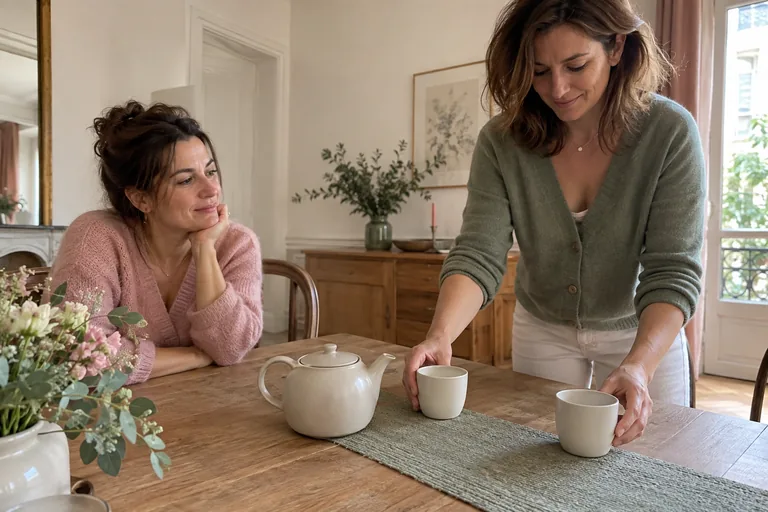
- Someone always prepares two cups, even when alone.
- Someone corrects the posters but leaves their own note unfinished.
Flip cards
From judgment to evidence
She’s generousFlip
Show what she gives, to whom, and within what limits.
She’s shyFlip
Write what she wants to say and what she actually does.
She’s organizedFlip
Show a useful preparation taking place in the scene.
She’s contradictoryFlip
Look for the two things she cares about.
Quiz
Observe or draw a conclusion?
A single gesture always reveals someone’s character.
See the answer
No. Context and other actions matter; a gesture isn’t a diagnosis.
A contradiction can enrich a character.
See the answer
Yes, if it appears in an understandable situation. Two preferences can be in tension without making the character inconsistent.
Checklist
Review my portrait
0 / 5
Your portrait is based on clues the reader can discover.
Writing a character portrait through three successive choices
To develop your character further, place them in front of three decisions with different levels of impact. The first can be practical: where to sit in a nearly empty room. The second involves a relationship: interrupting a conversation to ask a question. The third changes the situation: staying past the scheduled time to finish a task. The portrait emerges from the sequence, especially when the decisions don’t all confirm the same label.
Imagine Jeanne preparing a small community exhibition. She arrives with a precise list, checks the fasteners and lines up the chairs. You might conclude that she likes to control everything, but wait to see what happens next. When a participant suggests moving her work, Jeanne gives her all the space she needs and starts the setup again without complaint. So her attention to the framework doesn’t automatically mean she rejects other people’s ideas.
In the third moment, though, she keeps a mismatched chair that the team wanted to put away. The chair belonged to the old studio, but you can save that information for later. The gesture introduces a point of resistance and a question. Jeanne isn’t a sum of contradictory qualities; her decisions concern different stakes. She’s willing to change the setup while holding on to a physical reminder that the others don’t yet recognize.
Write these three moments without using the words “organized,” “generous” or “nostalgic.” Then read the scenes and ask what’s really missing. Maybe one sentence of context will make the chair understandable. Maybe you’d rather keep that story in reserve. The goal isn’t to ban character adjectives forever, but to learn to make the narrative evidence come alive before summing it up.
Working with speech without turning the portrait into an interview
A line of dialogue can reveal a way of seeing the world. Faced with a broken shelf, one character asks how many books they’ll be able to put back on it; another looks for whoever has a drill; a third wants to know how long it’s been about to fall. These differences are about attention and action. You don’t need to give every character an extravagant expression or a recurring speech error.
Also choose what the person doesn’t answer right away. If someone asks Jeanne why she’s keeping this chair, she might start by checking that it isn’t blocking the way. This detour has no universal meaning. In your story, it simply lets you delay a piece of information and show a practical priority. Silence becomes interesting when it meets a specific question, not when it’s presented as an automatic sign of depth.
Avoid dialogue in which characters recite their biographies. A longtime colleague probably won’t say, “In the fifteen years we’ve been organizing this exhibition together…” if the other person already knows that. Look for a detail that comes up naturally: a joke about the old fasteners, a first name mentioned without explanation, a familiar habit corrected. The reader can piece together a shared history from these clues.
Preserve complexity without blurring the portrait
Nuance doesn’t require showing both sides of everything. If Jeanne refuses all help in one paragraph, then delegates without hesitation in the next, there needs to be a difference in context or an event that makes the shift clear. Maybe she refuses help with a delicate task but is happy to delegate the welcome. You don’t have to justify every action, only avoid having the character change to suit the author’s immediate needs.
Choose a main thread and two deviations. The thread might be the way she prepares things for others. One deviation reveals her attachment to an object; the second, her inability to anticipate a personal detail like her lunch. These deviations open up the portrait without scattering it. You can return to each one in another scene, but the first text doesn’t need to develop everything.
Other people’s reactions are another tool, to be used with care. “Everyone admired her” is still a sweeping claim. “They asked her where to put the tables before asking how she was doing” instead shows the role assigned to her. The portrait can then capture a gap between the person and the expectations of those around her, without deciding that those people are necessarily right about her.
Move from real observation to responsible fiction
If a detail comes from someone you know, first note why it interests you: the rhythm of a gesture, the way they phrase a request, their relationship with an object. Then you can recreate that approach in a completely invented situation. Changing only the first name isn’t always enough to make someone unrecognizable; a profession, a place, and a distinctive incident can together make them very easy to identify.
For a private exercise, you can keep a factual note separate from the fiction. Before sharing, remove information you don’t need and ask yourself whether the text attributes sensitive actions or intentions to a recognizable person. This guide doesn’t assess the legal conditions for any particular publication. If the portrait concerns a delicate situation, choose a more distant fictional scenario or seek qualified advice before sharing it.
Finally, let your reader discover the character without asking her to make a diagnosis. She can say which actions stood out to her, what she understands about Jeanne’s desire, and what she’d like to see next. This feedback is about the text. It avoids turning the workshop into a judgment about a real person or assuming that someone’s whole character can be inferred from a few selected behaviors.
Workshop: Bring the Portrait to Life
What choice becomes visible?
Replace a character label with an action in context.
Does the detail allow for another interpretation?
Check the context without treating one gesture as universal psychological proof.
For a complementary perspective, watch this video from Bookfox.
How can you distinguish two characters making the same gesture?
Specify the object, timing, and consequence before adding a personality label. In a group scene, two people may put chairs away for different reasons. The reader first needs to understand who does what. You may hold back their motivations, but avoid making the actions unintentionally ambiguous.
| Sentence to examine | Difficulty | Original revision |
|---|---|---|
| Nora joins Lina. She sets down the chair. | She could refer to either person. | Nora joins Lina and sets the chair by the wall. |
| They tidy up carefully. | The same summary covers two different actions. | Nora folds the backrest; Lina checks the walkway. |
| Generous Lina helps Nora. | The label explains a character before showing the action. | Lina holds the door while Nora carries the chair. |
These versions prove neither altruism nor a need for control. They make an action attributable. If you then want Nora's judgment of Lina, establish a point of view: Nora admires her patience or finds her intrusive. The portrait changes because one voice judges someone else, not because the story has established a permanent personality.
Reread a paragraph while temporarily replacing each pronoun with the appropriate name. This paper exercise exposes some ambiguities; it does not require keeping all the names in the final version. Restore pronouns when their reference is clear. To test a quality without losing identifying information, try the writing without adjectives workshop. Then keep the wording that makes your scene easiest to follow.
Frequently asked questions
How do you write a portrait without physical description?
Choose a scene and bring the character to life through their actions, words, and decisions. A few connected clues are enough to get started.
How is it different from a moral portrait?
A character sketch often describes personality traits. Here, you focus on situations that let the reader form an impression without piling on labels.
Can you use adjectives?
Yes. The exercise is about checking whether they are useful and where they come from, not banning them from all writing.
How do you make a character recognizable?
Work on their intentions, habits, and speech patterns. A recurring gesture can help if it continues to serve a concrete purpose in the scene.
Do you need to invent a contradiction?
It isn’t required. A tension between two preferences can add depth, though, as long as it doesn’t become an artificially added quirk.
Can you describe someone you know?
For a private journal, you can record your observations carefully. Before sharing them, consider private information, the possibility of identifying the person, and whether you need their consent.