Contents
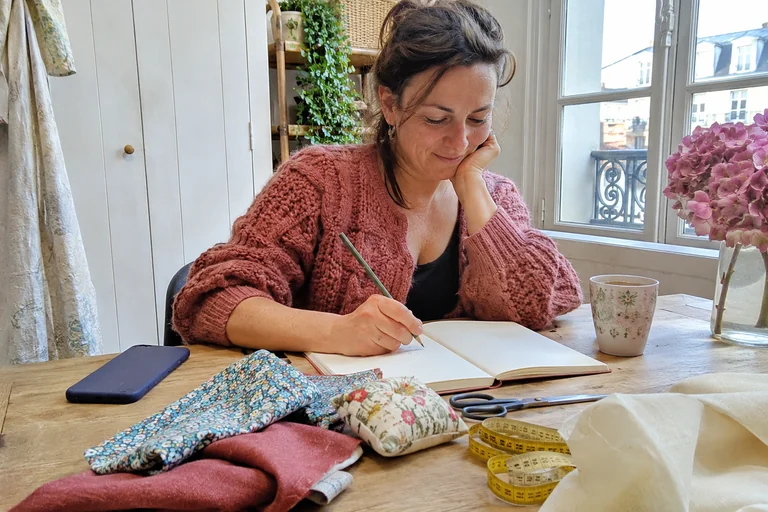
A sewing journal collects project references, materials, trials, and a place to restart. Begin with a notebook you already own and one record per project. Separate pattern instructions, your observations, and changes actually made. The journal documents your work; it does not replace a sewing pattern or technical guidance.
Identify the project and pattern
Give the item a short name and keep the pattern reference, version, and chosen variation. A photograph can help identify the document, but it does not replace its name. If you use a book or class, record the relevant section without copying protected material into a public space.
Add page numbers to your paper index. You can open a record for an idea you are still exploring: label it “considering” rather than counting it as a started project. A forgotten detail can remain unknown. Date a correction if you find it later instead of presenting a reconstruction as a note made at the time.
Find materials without turning an idea into a purchase
Record the available label details for fabric and notions. Separate what you own from what you are considering using. Atelier de la Création’s project sheet provides spaces for the pattern, fabric, and supplies already available or still missing. It illustrates one possible structure without requiring a specialized journal purchase.
A personal color palette can accompany color combinations. A screen does not necessarily reproduce the real material or color: keep a reference to a sample you own instead of assuming a photograph proves an exact match. Avoid loose needles or pins in notebook pages; a reference to suitable storage may be enough.
Separate instructions, trials, and retained decisions
Allow three spaces: what the technical resource asks for, what you tried, and what you decided to retain. Record a trial’s context instead of an isolated setting. A result observed on a scrap does not automatically validate its use elsewhere. To choose a needle, stitch, or cutting method, consult guidance suited to your equipment and project.
| Note | What it describes | Do not confuse it with |
|---|---|---|
| Instruction | Document reference | Your personal trial |
| Observation | What you noticed | A universal rule |
| Decision | A change actually retained | An idea to test |
A discarded decision can remain readable with a date. You can then understand the process without repeating exactly the same trial.
Leave a short restart note
Before a break, record the last checked point, the open question, and where the pieces are stored. “Check which document version is in use” is more reliable than invented certainty. The guide to returning after an unexpected interruption helps you begin with what is actually possible today.
Fictional example: a pouch is underway, its supplies are stored together, and the closure has not been chosen. Your note can identify that open choice without declaring the item nearly finished. You may stop the project and retain useful information; the notebook does not create an obligation to finish.
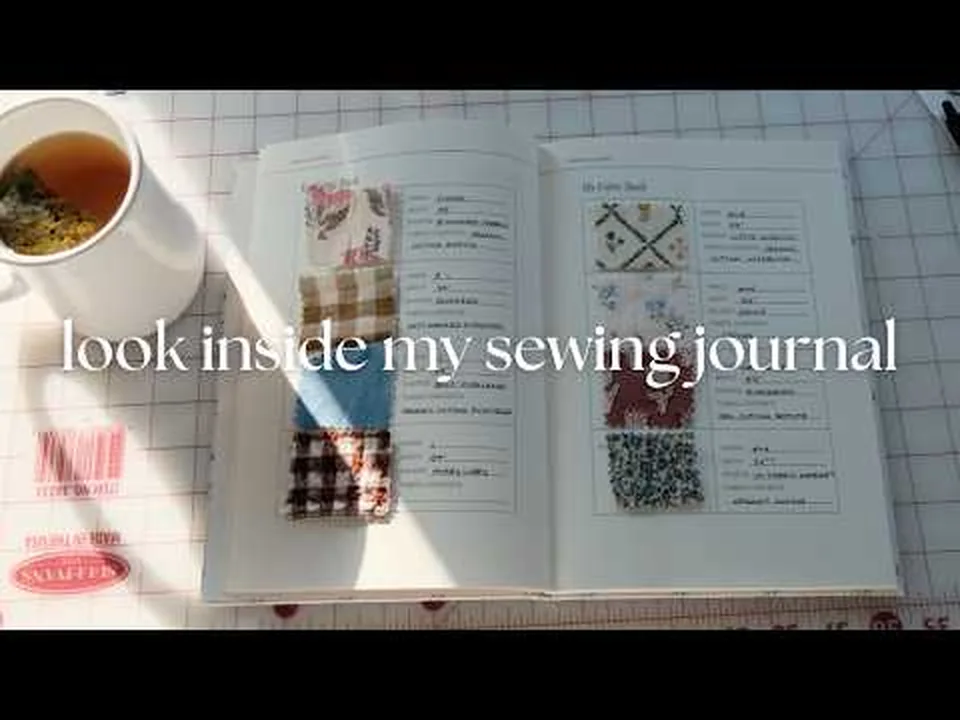
For a complementary perspective, watch this video from Rooney Sewing Patterns. Courtney presents her commercial sewing journal as an example of layout and project records. No purchase or giveaway entry is needed.
 Read alsoScripting: Write your dream life to clarify what you want
Keep a useful notebook rather than a perfect inventory
You can organize records by project or leave pages in order with an index. When an idea returns, refer to its record instead of copying every detail: organizing ideas helps you find them, not measure productivity. Creators’ notebooks are personal examples; their supplies are not required to try this method.
A final photograph and a note about what you want to remember can close the record. Miraya can accompany a personal writing break; the app does not check sewing adjustments. Keep technical references in a suitable place and do not share personal measurements unnecessarily.
For several crafts, a creative project notebook provides a general framework; a knitting journal records a different craft without making its measurements interchangeable with sewing. When you stop working, prepare a pause by naming the last checked point. You can also finish a notebook while leaving some projects open, with a reference to their continuation.
Flip cards
One detail, three places
The pattern asksFlip
Keep a reference to the original instruction.
I observedFlip
Record conditions and date.
I want to tryFlip
Do not mark the trial as already completed.
Self-assessment
My restart references
Pour chaque phrase, une réponse : la plus proche de ce qui est vécu ces dernières semaines.
I can find the pattern reference.
I separate my trials from the instructions.
I know which question to check next.
Your result appears once you’ve answered every sentence.
Comment lire le score (sur 9)
- 0–4 · Some references to add Choose one detail to find; this score does not measure sewing skill.
- 5–9 · References available Check the open question before continuing; this score does not validate a size.
Quiz
Which note is confirmed?
You are considering a change.
See the answer
Keep it as a planned trial. An intention is not a completed action.
You forgot the trial condition.
See the answer
Mark the information unknown. A visible unknown is better than invented certainty.
The notebook is full but the project is unfinished.
See the answer
Leave a reference to its continuation. The object and its documentation have different statuses.
Checklist
A record you can find again
0 / 4
This list checks documentation, not sewing quality.
FAQ
Do I need to buy a special journal?
No. Try a notebook you already own first.
Should I copy the entire pattern?
No. Keep its reference and your notes while respecting its terms.
What if I forgot a detail?
Mark it unknown and date corrections.
Does a note validate a setting?
No. Consult suitable technical instructions.
Must I finish every project?
No. Record their actual status without creating an obligation.
Can I continue in another notebook?
Yes. Add reciprocal references to find the continuation.