Contents
- Creative ritual or preparation that holds you back?
- What you can borrow from habits, without a magic formula
- Build your creative ritual with four decisions
- Three starting points for three different practices
- Know when your ritual becomes too complicated
- Finish by preparing for an easy return
- Creating when desire and availability don’t align
- A worked example: stepping into a fictional scene
- Keep the ritual separate from your organizing system
- Test the ritual across three different sessions
- Frequently asked questions
- Sources
A creative ritual is a small cue that helps you start an activity, not a ceremony you have to complete before you’re allowed to create. It can be as simple as opening your file, setting down a pencil, and writing an imperfect first sentence.
The challenge arises when preparation takes up all the space: choosing music, tidying the room, looking for the right notebook, then waiting for the ideal mood. This guide suggests building a simple starting point, with a version that requires no supplies and a clear rule for moving from preparation to the first action.
Creative ritual or preparation that holds you back?
Preparing your space can be useful. Having an accessible tool and a specific instruction can prevent some hesitation. But a preparation isn’t automatically useful just because it resembles what an admired artist does. Look at what it actually makes possible: after this action, do you know better what to do? If you’re still changing your playlist or font, you may still be at the edge of the activity.
The solo creative session Set aside time for exploration. The entry ritual has a shorter purpose: getting through the first few seconds of that time. It doesn’t replace practice time or learning. You can enjoy a particular atmosphere while knowing how to begin without it. This flexibility protects your creative practice when your location, schedule, or energy changes.
| Aspect | Helpful ritual | Preparation that delays you |
|---|---|---|
| Duration | Brief and adaptable | Gets longer with each session |
| Materials | Needed for the first action | Multiple decorative touches |
| Next | One identifiable creative action | Another search for the right atmosphere |
What you can borrow from habits, without a magic formula
Lally and colleagues’ study on habit formation examines the repetition of behaviors in everyday contexts. It does not prove that a particular ritual increases creativity, or that artists should follow the same schedule. Above all, it suggests not to confuse repetition with a guaranteed timeline: how long it takes for a behavior to take hold varies depending on the people and actions studied.
You can draw a modest practical hypothesis from this: pair a recognizable cue with an action small enough to repeat. The if-then plan lets you write it down: “When I open my notebook, I draw the outline of the first object in front of me.” This sentence describes a start, not a promise of inspiration. If it doesn’t work for you, change the action instead of concluding that you lack discipline.
Quiz
Check your understanding
Do you need a perfect atmosphere to get started?
See the answer
No, it can be pleasant without being essential. Plan a way to begin in an ordinary setting.
Is rereading an entire chapter always a good way to begin?
See the answer
No, it can take the place of the first planned action. Choose preparation that fits your goal.
Build your creative ritual with four decisions
Defining what counts as getting started
“Writing” can sometimes be too broad a goal to get a session started. Choose a visible action: copy the last sentence and continue with a new one, describe a color, play a single chord transition, or place three shapes on a sheet of paper. You should be able to recognize when you’ve started without waiting for a result you consider interesting. Spending a minute looking for a topic can still be part of the preparation.
The writing freely upon waking offers an example of a starting point without a final project. You can return to this freedom at another time of day. If your goal is different, adapt the first action: a dialogue begins with a line, a visual composition with a choice of shape. The right starting point is one that truly belongs to your activity.
Reducing the number of essential items
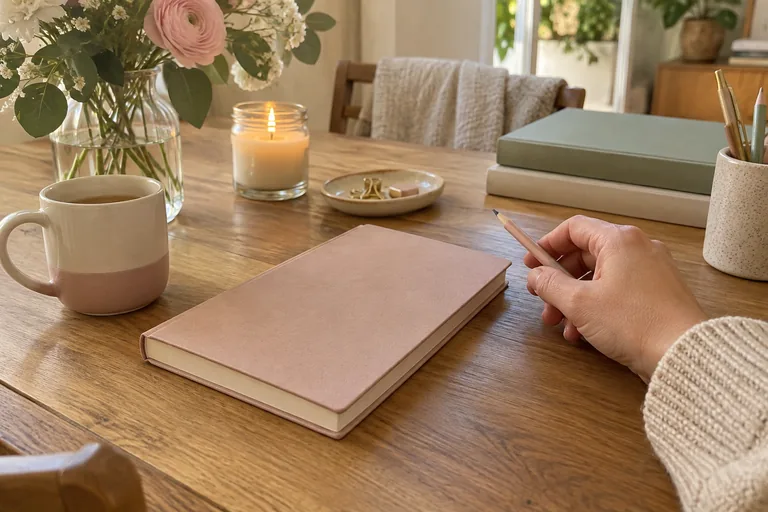
List what you really need for the first action, not the whole session. A pencil and a sheet of paper may be enough to explore an idea that you’ll later develop on a computer. If you use a specific instrument or software, make sure it’s accessible without adding ten accessories. The creative project journal can save more complex decisions for another step.
Next, distinguish what’s necessary from what’s pleasant. Soft lighting, a favorite mug, or music can be enjoyable, but they don’t have to become prerequisites for permission to create. You can keep them when they’re available. Still, plan a session that works without them, so a mug in the dishwasher or an occupied room doesn’t decide whether you’re allowed to create.
Choose a brief cue
Your cue can be a tidying gesture, a phrase, or opening a tool. One action is enough. “I’ll start with a try” is a useful reminder that the session isn’t an exam. Avoid a grand declaration about what you’re going to produce: it could widen the gap between the blank page and the work you imagine. The five-minute small step helps bring the project back to a workable scale.
Set a limit on preparation, too. For example, once your materials are laid out, the next action belongs to creating. If you notice another need to tidy up, make a note for later unless it truly prevents you from working. This limit is a working rule to try, not a punishment. You can loosen it when preparation is itself an essential part of the activity.
Plan a portable version
Imagine you have only a seat, a few minutes, and your attention. What version would still be possible? Coming up with two lines of dialogue in your head, noticing three colors, or humming a transition can help you stay connected to your project. You don’t need to consider this version equivalent to a long session. It simply serves another purpose: making it possible to get started in a less favorable setting.
The guide to describing a place through the five senses offers ways in without any equipment. Choose only what’s accessible and comfortable for you. You don’t need to engage every sense, close your eyes, or shut yourself off from what’s happening around you. Creative observation should always be compatible with the safety of the place where you are.
Flip cards
Choose a starting point
WritingFlip
A new sentence after the last lines.
DrawingFlip
The simple outline of an available object.
MusicFlip
A short, familiar sequence followed by a variation.
 Read alsoNew moon ritual: set your intentions for the month
Three starting points for three different practices
For a work of fiction, you can reread just the last few lines, then write an action that happens next. Don’t immediately start revising the whole chapter again. For a drawing, choose an object and begin with its simplest outline. For a sound creation, play a short, familiar passage before exploring a variation. In all three cases, the ritual leads to something produced, even if it’s provisional.
If you work with references, choose one before the session, then stop searching at the planned time. The collection of visual references can support the project, but it can also become an endless activity. Another image isn’t always what’s missing. Instead, ask yourself what decision you can make now with the references you already have.
Finally, when you return to a creation you left on pause, the best starting point may be to find where you stopped. The guide to resuming an abandoned project distinguishes picking up where you left off from making a fresh start. You can begin by looking over what’s there without judging everything. The first session doesn’t have to make up for all the weeks you didn’t work on it.

Know when your ritual becomes too complicated
A simple warning sign is how many conditions you add. You stop creating because the room isn’t tidy, then because you don’t have enough time for the right music, then because the session would be too short. Return to the first defined action. If it’s still possible and you want to do it, you can try it directly. If it isn’t, reschedule without turning the delay into an accusation against yourself.
Another sign is being afraid to change the order of the steps. A routine can be enjoyable without becoming essential to your sense of security. If a ritual causes significant distress when you can’t carry it out, or takes over too much of your life, professional advice may be helpful. The aim of this article is to offer a flexible way into a creative activity, not to address a mental health difficulty.
Generator
A wording to adapt
I can make a first attempt without knowing what comes next.
See all the phrases
Begin
- I can make a first attempt without knowing what comes next.
- The next step is part of creating, not tidying up.
Lighten
- I’ll keep one tool and one prompt for this session.
- The setting can be imperfect, and the first step can still be possible.
Finish by preparing for an easy return
At the end, leave a concrete cue: the next scene, a color to try, or the musical passage to pick up again. A note of a few words can save you from having to reconstruct the whole next session. Put away only what protects the materials and respects the shared use of the space. You don’t need to make your desk look photogenic before considering your work finished.
Then look back on the experience in terms of its usefulness: did the cue lead you to take action? What added friction? The judgment-free goal review can help you work out an adjustment. Keep the option of no longer needing a ritual. When getting started becomes easy, no extra ceremony is needed to make the session feel more legitimate.
Checklist
Keep only what works for you
0 / 4
You’ve set your reference points. You can adapt or stop this practice.
Creating when desire and availability don’t align
You may have an hour with no ideas, then find a direction just as you have to leave. A ritual can’t perfectly synchronize these two realities. Its purpose is more modest: to make it possible to connect with a project when you have a block of time. A session can begin by exploring a question, testing a material, or making an attempt without any expectations. It’s still a creative activity, even if no dramatic burst of inspiration comes along.
When an idea comes outside your scheduled time, leave a minimal note if circumstances allow. A sentence, a keyword, or a sketch is enough to prepare for picking it up again. You don’t have to develop the whole idea right away or interrupt an important responsibility. The next ritual can begin with that note. It should open up a possibility, not become another obligation you blame yourself for failing to make use of.
If fatigue is taking over, distinguish the desire to stay connected to the project from your ability to work right now. A very short version may work, but rest is also a valid choice. The ritual shouldn’t be used to routinely bypass signs that you need to stop. A postponed session keeps the project available for later; it says nothing final about your creativity.
A worked example: stepping into a fictional scene
In a fictional scenario, Nora wants to return to a short story. Her old ritual was to open several playlists, reread the beginning, and revise the first few pages. By the time she ran out of time, she had rarely made any progress. She chooses a more specific starting point: open the document where she left off, reread the last paragraph, and write down the character’s next action. Music is still an option, but it’s no longer a prerequisite.
On her first try, the new action feels awkward to her. She leaves it in brackets and continues with a line of dialogue. This choice doesn’t mean that quality doesn’t matter; it simply separates producing a first draft from revising it. Her ritual now leads to an observable narrative decision. She can rework the sentence in another phase, with a fresh perspective.
At the next session, she doesn’t have access to her computer. She uses the portable version: describe on a sheet of paper what the character is looking for in this scene. The result isn’t interchangeable with a drafted page, but it helps her prepare a choice. Nora keeps two possible starting points, one for writing directly and the other for clarifying her ideas. She isn’t trying to make every session identical.
Keep the ritual separate from your organizing system
A cluttered space may call for a proper organizing session. But if you start one every time you feel like creating, it may take up the time you set aside for your activity. Choose a level of tidiness that lets you work safely and find the tool you need. The rest can wait for a dedicated time. You don’t need to sort out your entire home before putting a sentence on paper.
The same distinction applies to digital work. Finding the right file and making sure it’s saved are useful steps. Reorganizing all your folders, renaming the project, and looking for a new app can become detours. Set up a direct way to access it or a note to help you pick up where you left off if that makes things easier. Still, avoid accumulating preparation systems that require constant upkeep themselves.
If you share the space, plan how to wrap up the session, too. A box or pouch can sometimes make it possible to return the table to its shared use without losing track of everything. The goal is to preserve enough continuity to pick up where you left off while respecting other people. A setup you can pack away may support consistency better than a perfect creative space that’s impossible to maintain day to day.
Test the ritual across three different sessions
For your first try, choose a typical time and simply check that the cue leads to the action. For the second, deliberately scale back the conditions: less equipment, less quiet, or a different time, as long as you’re comfortable. For the third, use the short version. This comparison isn’t a scientific test; it helps you find out whether your ritual is still practical when the day varies.
After each session, answer a factual question: What did I actually begin? If the answer is always “I prepared,” make the starting point more specific. If you’ve started but want a longer session, the issue may be the time slot available rather than the ritual. Don’t ask an entry gesture to solve every time constraint. A good starting point opens the door; it doesn’t build the whole room by itself.
You can also decide that you’d rather start right away, without a phrase or a particular sequence. A ritual isn’t a sign of artistic authenticity, and going without one doesn’t make your practice any less serious. Keep it only as long as it helps you get into a creative flow. Its form can change with the project, your experience, and the stage of life you’re in.
Personal workshop
Create your version: creative ritual
Answer the three prompts below, or use them aloud. This workshop works without JavaScript. This workshop does not offer a save feature. Copy anything you want to keep into your journal, and avoid entering sensitive information on a shared device.
How do you finish this workshop?
Review your answers and keep only a next step that seems doable to you. You can also decide not to pursue anything today. This decision creates neither a score nor a commitment.
For a complementary perspective, watch this video from Christina Kent Art.
Frequently asked questions
What is a creative ritual?
It’s a brief cue that leads into a creative activity. It guarantees neither inspiration nor the quality of the result.
How do you get started writing?
Choose a specific action, such as continuing a sentence or describing an object. Avoid making that action depend on lengthy preparation.
Do you have to create at a set time?
That’s not required. A consistent cue can be useful, but it should still fit your life.
Is music essential?
No. You can enjoy it while still knowing how to work without it.
What if I spend all my time preparing?
Reduce the supplies and decide on the next action. Check that this action actually produces something, even if it’s imperfect.
Can you give up your ritual?
Yes. Keep what makes it easier to get started and remove the rest when it’s no longer useful.
Sources
- Lally, P., van Jaarsveld, C. H. M., Potts, H. W. W., and Wardle, J. (2010). How are habits formed: Modelling habit formation in the real world. European Journal of Social Psychology. DOI verified.