
Contents
- How do you know if you want to stop journaling?
- What has changed since you started?
- Stopping journaling: how can you try taking a break?
- How can you change the format without starting over?
- What should you do with old notebooks and files?
- Should you write one last page?
- When is writing a reason to seek support?
- Frequently asked questions
- Sources
You can stop journaling when it no longer works for you; you don’t have to finish or replace it right away. Before deciding, consider what’s bothering you: the format, the pace, privacy, or the activity itself. Taking a break, switching to a lighter version, or stopping for good are all options.
A journal you started isn’t a debt. The pages you’ve already written may have been useful at one point and may no longer serve a purpose. You don’t have to keep up a practice just because it’s often presented as a good habit.
How do you know if you want to stop journaling?
Start with your actual experience. Do you still feel like writing sometimes, but not within the structure you chose? Is the timing wrong? Has the practice started to feel pointless or burdensome? These questions can help you distinguish an organizational challenge from a legitimate desire to do something else.
| What’s bothering you | An option to try | An equally valid option |
|---|---|---|
| The daily pace | Write occasionally | Stop |
| Long entries | A sentence or a fragment | Take a break |
| The medium | Switch between paper and digital | Don’t replace it |
| How you feel after writing | Write less or change the subject | Stop and seek support if needed |
The one-sentence-a-day journal may work if the length is the only thing that feels burdensome. But don’t turn every desire to stop into a problem to solve: you may simply no longer want to keep a journal.
What has changed since you started?
Remember why you started. Maybe you wanted to get through a period of waiting, keep memories, or prepare for a project. If that need has changed, the journal may have served its purpose. Our guide to journaling while waiting offers an example of a practice tied to a particular period, which doesn’t have to last indefinitely.
Next, consider your current circumstances: time, a private place, fatigue, and other activities. A practice that’s easy in one context can become difficult in another. That change doesn’t prove that you lack discipline or are unable to take care of yourself.
Finally, distinguish what you enjoy about the journal from what you do to follow a rule. You may like writing down a memory but dislike daily check-ins. The personal reading journal or the idea notebook can remain useful even without a general personal journal.
Stopping journaling: how can you try taking a break?
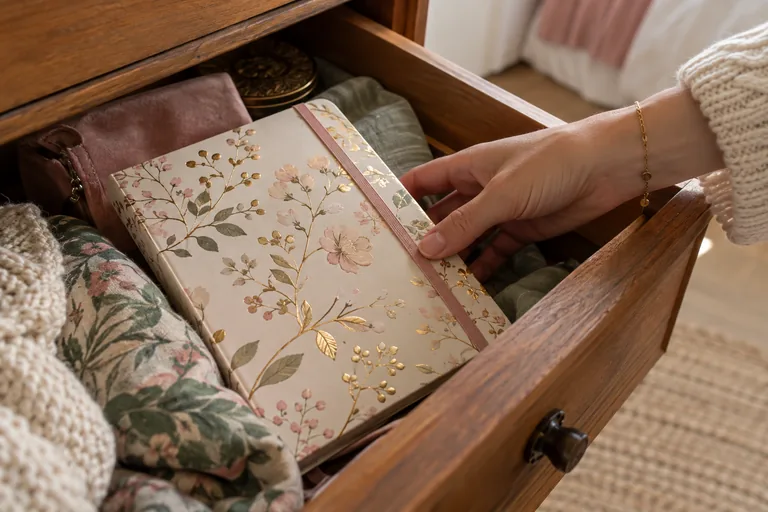
Choose not to write for a period that works for you, without planning to resume by a set date. You can simply note the date you last used the journal and put it away. The point isn’t to test your willpower or check every day whether you miss writing.
If the urge to write comes back on its own, you can do so without treating the pause as a failure. A personal practice isn’t an abstinence contract. On the other hand, if you don’t miss it, you don’t need to make yourself write just to confirm that stopping is a reasonable choice.
If needed, return just once to the question: “Is there something specific I’d like to pick back up?” The guide to picking up a journal after a break may help if the answer is yes. If it’s no or you’re unsure, leave the decision open.
How can you change the format without starting over?
Identify the main source of friction before choosing a tool. If you rarely write because your journal stays at home, an accessible format may help. If you feel watched, the first question is privacy. If introspection feels heavy, changing the journal’s color may not solve anything.
You can keep just one purpose: memories, ideas, recipes, or reading. The recipe and memory journal shows that a practice can be very practical. You don’t have to interpret your emotions every time for writing to have personal value.
Avoid copying all your old pages into the new system. A transition date and a few reference points are often enough. The change should make the journal easier to use, not create an archiving project that keeps you even more tied to an activity you wanted to make less central.
Flip cards
A few things to keep in mind
AdaptFlip
What’s one source of friction you’d like to reduce?
PauseFlip
What can you leave on hold without keeping tabs on yourself?
StopFlip
How can you put the pages away without creating another project?
 Read alsoScripting: Write your dream life to clarify what you want
Checklist
Prepare your page
0 / 4
You can now try something, adapt your approach, or close your journal.
Your workshop
Choose your starting point
Open a suggestion and try it in your journal. You don’t have to share anything personal on this page.
The routine feels burdensome
Remove the required frequency before changing the whole system. You can also stop completely.
The content upsets me
Stop the exercise and seek appropriate support if the difficulty persists. You don’t have to force yourself to write one last page.
I don’t need it anymore
Put the journal away and distinguish between keeping the pages and continuing the practice.
Generator
A writing prompt
Notice what no longer works for you. What I’m noticing specifically is…
See all the phrases
Observe
- Notice what no longer works for you. What I’m noticing specifically is…
- Distinguish the format, the pace, and the activity itself. My example today would be…
Choose
- Leave open the possibility of returning without making it an obligation. The version that works for me is…
- I can leave this page as it is, because what I wanted to put down here was…
What should you do with old notebooks and files?
You can keep the pages without rereading them. Store them somewhere appropriate for their level of privacy, and distinguish originals from copies. For digital files, check storage, syncing, and exports; the CNIL reminds us that backups also need to be protected and checked.
If you’re considering deleting them, take time to distinguish the need to declutter from a decision made in a moment of anger. You can put it off or choose a reversible option when one is available. You don’t have to destroy the pages to prove you’re turning a page in your life.
On the other hand, you’re not required to create a complete archive. You can keep a selection, as long as you understand how your tool handles copies and trash folders. The choice concerns your writing; it shouldn’t lead to deleting documents shared with or owned by other people.

Should you write one last page?
It’s optional. A sentence like “This journal accompanied me during this time; I’m putting it away now” may be enough if you’d like to leave a record. You can also stop in the middle of a page. The last piece of writing doesn’t have to perfectly sum up the practice or your life.
If you choose to reflect, write down what was useful to you, what no longer is, and what you want to keep in another way. The judgment-free goal review offers guidance so you don’t turn stopping into a verdict. A practice that has run its course can still have been a success.
You can then return to an everyday activity. The ritual for closing your day in a journal can inspire a simple way to wrap up, but there’s no need to add another ritual. Putting away your pen may be all it takes.
When is writing a reason to seek support?
If writing regularly leaves you feeling more upset, leads you to relive difficult memories, or starts taking over, stop this exercise and seek appropriate support. You don’t have to keep going to get a benefit promised by general advice. If this practice was suggested as part of support you’re receiving, it’s worth discussing it with the person supporting you.
Also, don’t mistake a private journal for your only way to talk. You may need a real conversation, practical help, or a professional. The journal of memorable conversations is one way to write about relationships; it doesn’t replace the relationships themselves.
The BnF presents a wide range of writing practices across authors and periods. This cultural reference is enough to remind us that there are many ways to write. It sets no personal standard: continuing, changing, or stopping remains a choice tied to how you use it and your situation.

For a complementary perspective, watch this video from Jared Henderson.
Frequently asked questions
Is it bad to stop keeping a personal journal?
No, a personal practice can come to an end. If it’s part of a support program, talk with the professional involved about what no longer works for you.
Do I have to finish the notebook before I stop?
No. Blank pages don’t obligate you to keep going.
Does a break need an end date?
Not necessarily. You can choose a time to think about it again without promising to start back up.
Should I throw away the old pages?
No. You can keep them, choose which ones to keep, or put off that decision; stopping writing and deleting pages are two separate choices.
Can I start again several months later?
Yes. A new date and a few words are enough; you don’t have to tell the whole story of the time you missed.
What should I do if journaling increases my distress?
Stop or cut back on the practice, and seek appropriate support if the distress persists. Writing on its own is neither an obligation nor a universal treatment.
Sources
- CNIL. “Security: backing up.” Data protection and backup verification principles from a guide for organizations. View the resource.
- Bibliothèque nationale de France. “Writers’ rituals.” Cultural insight into the diversity of writing practices, with no evidence of a therapeutic benefit. View the resource.