Contents
A hiking journal keeps a personal record of your walks: place, date, observed details, and memories to revisit. Start with a notebook you own and one entry per outing. Separate notes made at the time from later reconstruction. The journal does not replace a map, safety information, or preparation for the route.
Identify an outing without ranking it
Give the entry a date and recognizable title: the place name if you know it, or a personal marker that helps you find the outing again. A short walk deserves a page as much as a trip does. You need not set a record to preserve a scene. Leave distance or duration unknown if you did not measure it rather than adding a plausible number.
FFRandonnée describes its notebook as a place for stages, discoveries, and emotions. That illustrates possible uses without making a specialized purchase necessary. A paper index may be enough to find entries. Keep verified technical information in a suitable separate resource; an enjoyable personal account is not automatically a reliable route for someone else.
Choose a scene instead of recording every step
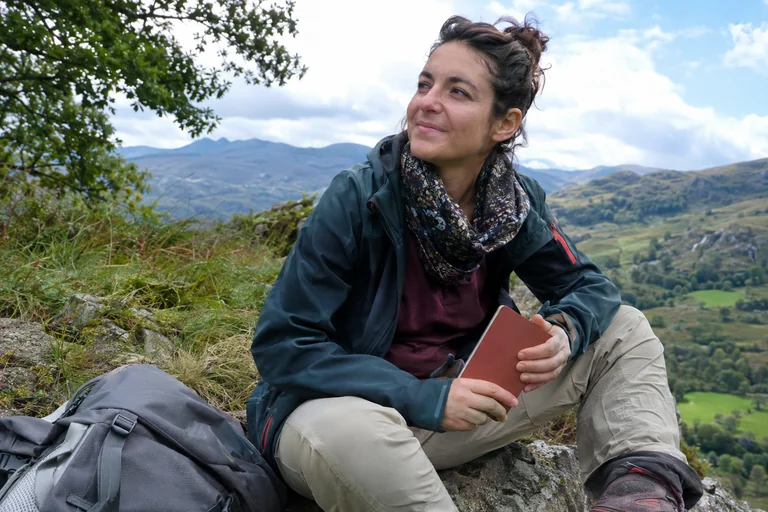
Pick a moment: light between branches, a pause on the way home, or a conversation whose meaning you want to keep. Record the viewpoint and details that matter to you. The guide to describing a place helps you choose without mechanically filling a sensory checklist. You can write from a window or after an accessible outing; the journal does not prescribe a correct way to walk.
In a fictional example, the entry describes a damp bench and clear light after rain. It need not invent tree names or an exact time. Note when a photograph helped recover the memory. When writing a specific memory, a small documented scene can be clearer than a timeline filled with guesses.
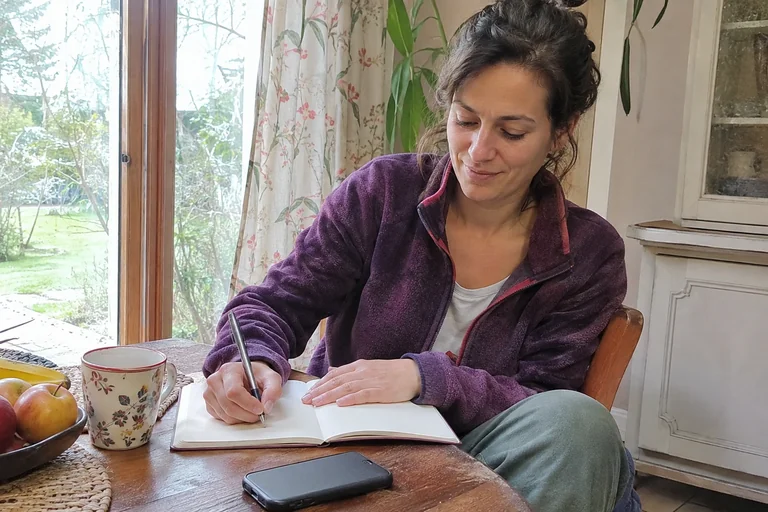
An art journal as a creative notebook example, not hiking preparation.
For a complementary perspective, watch this video from by bun.

Separate observation, reference, and memory
An observation records what you noticed; a reference identifies an information source; a memory may be reconstructed later. Keep those statuses visible. A flower sketch can preserve a shape without identifying a species. Add a name found later with its source and date, leaving uncertainty visible if it remains. A nature notebook extends this practice.
| Record | What it may preserve | What it does not prove |
|---|---|---|
| Dated note | An observed detail | Current trail conditions |
| Sketch | A noticed shape | Certain identification |
| Personal photograph | One view at one time | Continuing access permission |
| Later account | Your memory today | An exact transcript |
Do not publish sensitive locations or identifiable images of other people by default. A private notebook and a shared page have different audiences. Decide what needs to be shared before making a copy. An empty detail can remain empty without making the account less personal.
Return to the entry without having to finish everything
You can add a drawing, sentence, or reference to another page after returning. Mark later additions instead of presenting them as notes made on location. If the outing left no memory you wish to describe, a single line is enough. An unfinished page does not require another trip to obtain a missing detail.
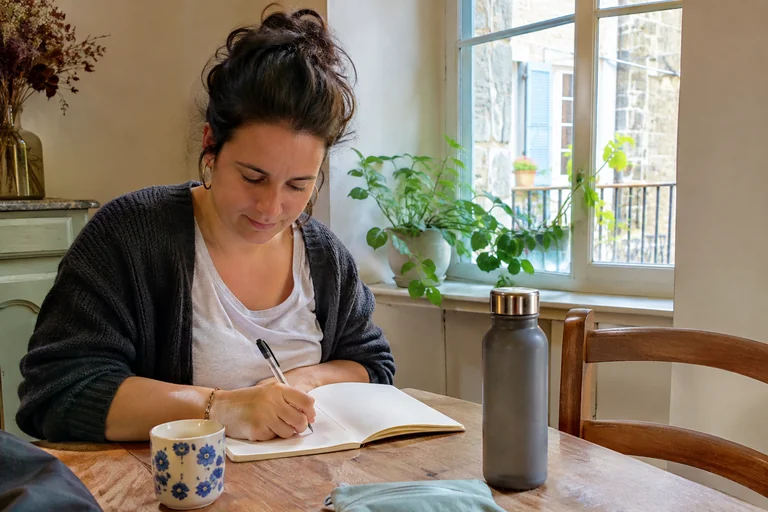
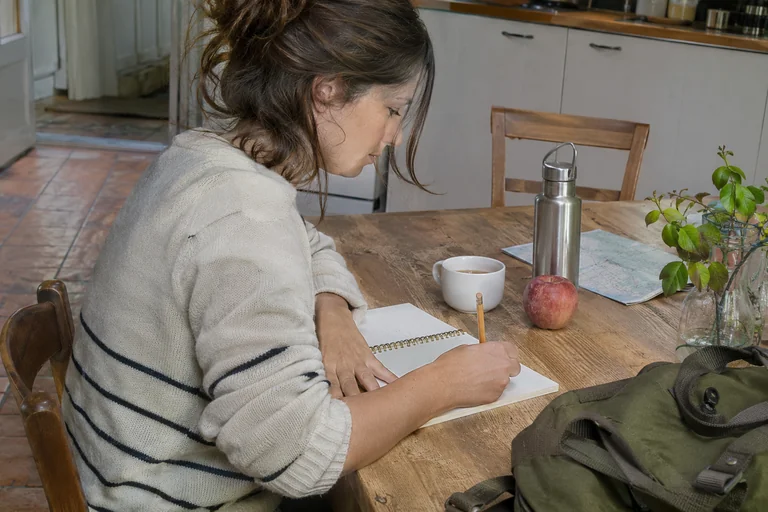
Try a creative observation walk, an observation haiku , or a photo journalfor another form. The images and videos here illustrate creative notebooks, not a hike tested by the editorial team. Miraya can accompany a personal writing break; the app does not plan a route or check conditions on the ground. Keep those practical decisions separate from the pleasure of preserving your account.
Self-assessment
Check the entry markers
Pour chaque phrase, une réponse : la plus proche de ce qui est vécu ces dernières semaines.
A title or date helps find the outing.
Unknown details remain identifiable.
Later additions are separate from notes made there.
Your result appears once you’ve answered every sentence.
Comment lire le score (sur 9)
- 0–4 · One point to clarify Choose a useful marker without grading the memory.
- 5–9 · An entry to revisit Check a missing detail if useful, without an obligation to finish.
 Read alsoScripting: Write your dream life to clarify what you want
Flip cards
Three kinds of record
ObservationFlip
What you noticed in a specific context.
ReferenceFlip
An identified source and its date.
MemoryFlip
What comes back today, including uncertainty.
Quiz
What does the entry establish?
You did not measure distance.
See the answer
Leave it unknown. An account needs no invented measurement.
A photograph is from last year.
See the answer
Date it as a memory. Its context limits what it shows.
The entry is short.
See the answer
Keep it that way if it is enough. A notebook creates no obligation to take another trip.
Checklist
Before closing the entry
0 / 4
This list reviews an account; it does not check route safety.
For several outings, a travel journal can connect scenes without copying the whole notebook. Choose what you want to revisit; a sequence of dates need not create an obligation to fill every day.
FAQ
Do I need a special notebook?
No. A notebook you own may be enough.
Must I record every stage?
No. Choose scenes that matter to your account.
What if I forgot a name?
Leave it unknown or add a dated reference later.
Can I write after returning?
Yes. Separate reconstruction from notes made there.
Does a sketch identify a species?
No. Keep uncertainty visible and consult a suitable reference.
Is the account a route guide?
No. Check current technical information separately.